答案先行
MST 将 P&ID 到原生 SOLIDWORKS 装配定位为可复核的工程流程。首轮应准备 P&ID 背景、BOM 字段、客户零件库、规则边界和目标输出,最终批准仍由合格工程复核完成。
- 在向 MST 请求伙伴确认后的下一步之前,先用本文准备一版非保密首轮 brief。
- 在 NDA 和评审路径确认前,不要把设计 IP、客户 rulepack 或受控文件放入公开表单。
- 如需确认准确范围,请通过对应 MST 页面发送简短 RFQ 或工程评审请求。
原文标题: NeuroBox D vs Smap3D vs SOLIDWORKS 2026 LEO: Which Tool Actually Automates P&ID to Assembly?
- →Three Tools, One Goal: Faster Assemblies from P&ID
- →Smap3D Plant Design: The Established Semi-Automatic Workflow
- →SOLIDWORKS 2026 LEO: AI Assembly Scaffolding (Beta)
- →NeuroBox D: Full Automation from P&ID to Assembly
- →Head-to-Head Comparison
Key Takeaway
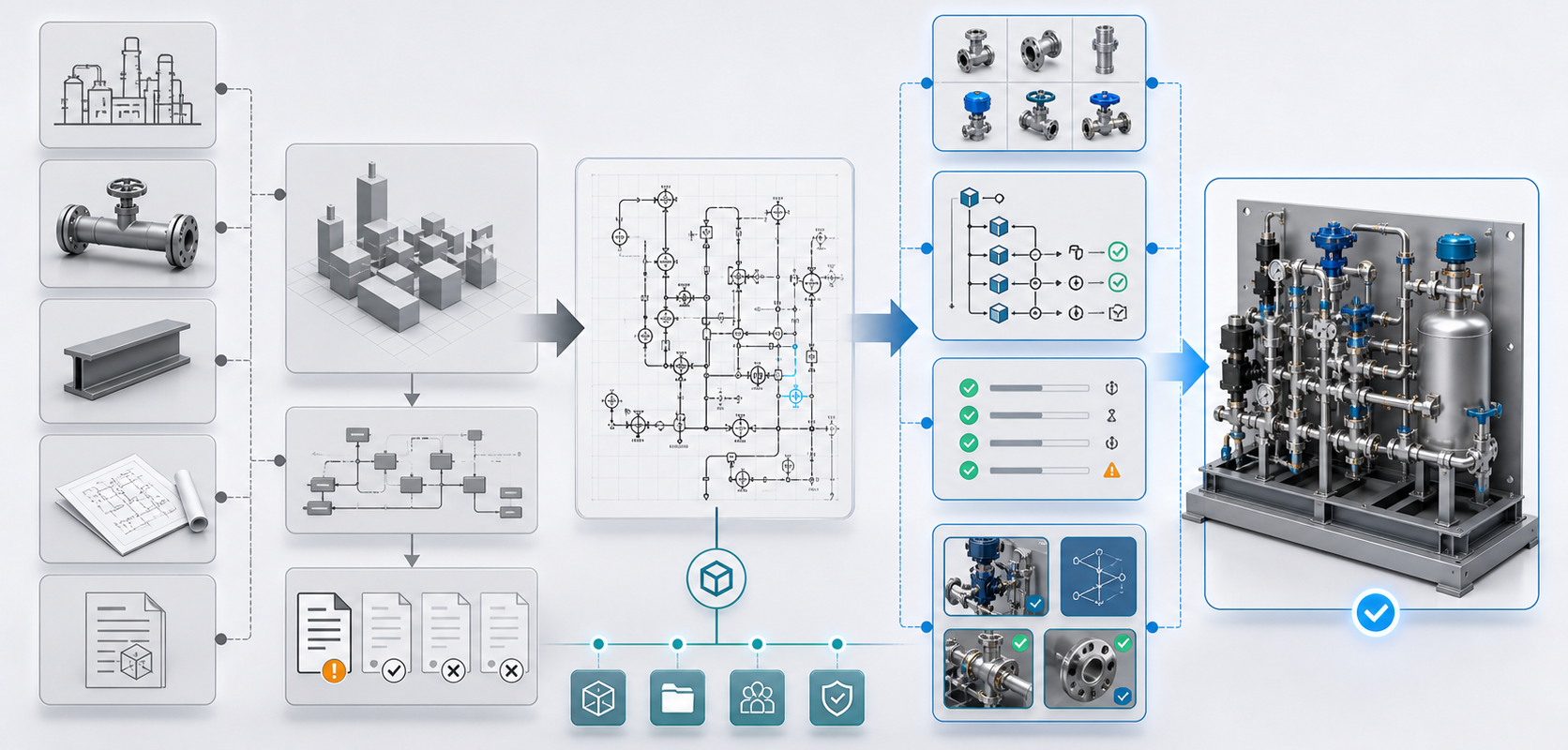
Smap3D Plant Design, SOLIDWORKS 2026 LEO, and NeuroBox D can all participate in native SolidWorks workflows, but they solve different parts of the P&ID-to-assembly problem. Smap3D is strong for integrated P&ID and piping workflows, SOLIDWORKS LEO assists general assembly scaffolding, and NeuroBox D is designed around P&ID recognition, customer part-library matching, spatial layout, routing, and engineer review for semiconductor gas-panel assemblies.
Three Tools, One Goal: Faster Assemblies from P&ID
If you design gas delivery systems, chemical panels, or process equipment in SolidWorks, you have probably searched for ways to automate the journey from a 2D P&ID to a 3D assembly. Three tools currently address this space — each with a very different approach.
Review whether your P&ID and part library can support native SOLIDWORKS assembly automation.
Choose how you'd like to connect:
This comparison is based on publicly available documentation and official product pages. Treat competitor capabilities as point-in-time public information and verify details with each vendor before procurement. We will cover what each tool actually does, where it stops, and which gaps your engineers still need to fill manually.
Smap3D Plant Design: The Established Semi-Automatic Workflow
Company: Smap3D Plant Design GmbH (Germany, ~90 employees, founded 2019 from CAD Partner GmbH)
What it does
- P&ID creation: Smap3D includes its own P&ID editor with symbol libraries compliant to ISA and DIN standards
- To-do list generation: From the P&ID, the system generates a structured list of every component and pipeline that must exist in the 3D assembly
- Pipe routing automation: Once an engineer manually places components in 3D space, Smap3D can automatically route pipelines between them — including bends, tees, reducers, and flanges
- Isometric drawing output: Automatically generates fabrication-ready isometric drawings from the 3D pipe routes
- Native SolidWorks output: Yes — works directly inside the SolidWorks environment
Where it stops
- No automatic component placement: Engineers must manually drag each valve, MFC, filter, and regulator into the 3D workspace and position it. The to-do list tells you what to place, not where to place it
- No spatial layout optimization: There is no AI or algorithm that calculates optimal 3D positions considering volume constraints, maintenance access, or panel dimensions
- No P&ID image recognition: Smap3D reads its own P&ID data format. It cannot take a PDF or DWG drawing from a customer and parse it automatically
Best for
Process plant engineering firms that need integrated P&ID-to-piping workflows and already have engineers who handle 3D layout manually. Strong in food & beverage, chemical, and environmental industries.
SOLIDWORKS 2026 LEO: AI Assembly Scaffolding (Beta)
Company: Dassault Systèmes (France, part of the 3DEXPERIENCE platform)
What it does
- Assembly Structure Designer (Beta): Ask LEO to create an assembly product structure, and it generates a hierarchy of assemblies and subassemblies with empty files — a skeleton to start from
- SmartMate AI: Automatically identifies nuts, bolts, and washers from non-Toolbox parts and applies appropriate mates when inserted
- PDF-to-3D (Beta): Can convert a 2D PDF drawing of an individual part into a parametric 3D part model
- Native SolidWorks output: Yes — this is SolidWorks itself
Where it stops
- No P&ID input: LEO cannot read, parse, or understand P&ID diagrams. There is no connection between process flow and assembly generation
- No component matching: LEO does not map P&ID symbols to specific 3D parts from a component library
- No spatial layout: The Assembly Structure Designer creates a file hierarchy, not a 3D arrangement. Engineers must still place every component manually
- No pipe routing: LEO does not generate tube or pipe connections between components
- Beta status: Key features are still in beta as of early 2026 and may change
Best for
General mechanical design teams who want AI assistance with part creation and assembly organization. Not designed for process equipment or gas panel workflows.
NeuroBox D: Full Automation from P&ID to Assembly
Company: MST Singapore / 迈烁集芯 (AI for semiconductor equipment manufacturing)
What it does
- P&ID recognition: Reads P&ID input (PDF, DWG, or image), identifies every symbol per ISA 5.1 standards — valves, MFCs, filters, regulators, sensors — and extracts connectivity, flow direction, and annotations
- Component matching: Maps each identified symbol to the correct 3D part from your company’s own standard parts library (user-provided SolidWorks .sldprt files)
- Automatic spatial layout: Calculates optimal 3D positions for all components within your panel dimensions — considering volume constraints, maintenance clearance, layer conventions (MFCs on top, valves in middle, routing below), and interference avoidance
- Automatic tube routing: Plans every tube connection with optimal paths, correct bend radii, and zero interference
- Native SolidWorks output: Outputs .sldasm assembly files with correct mate relationships, referencing your original .sldprt files — ready to edit, run interference checks, and generate engineering drawings
What it requires from you
- Your standard parts library: NeuroBox D does not ship with pre-built 3D models. Your engineers provide the .sldprt files for every valve, fitting, and component your company uses. This is the foundation of the system
- P&ID input: A process diagram — the document your customers already provide at the start of every project
What it does NOT do
- Does not generate individual part models: If you need a 3D model of a new valve type, your engineer must create or obtain the .sldprt file first. NeuroBox D assembles existing parts — it does not model new ones
Best for
Semiconductor equipment companies, gas panel manufacturers, and process equipment OEMs who design custom assemblies from standard components and need to dramatically reduce design-to-delivery time.
Head-to-Head Comparison
| Capability | Smap3D | SW 2026 LEO | NeuroBox D |
|---|---|---|---|
| Reads P&ID input | Own format only | No | Yes (PDF/DWG/image) |
| Auto component matching | To-do list only | No | Yes (from your library) |
| Auto 3D spatial layout | No (manual) | No | Yes (AI-optimized) |
| Auto pipe/tube routing | Yes | No | Yes |
| Native .sldasm output | Yes | Yes | Yes |
| Uses your parts library | Yes | Toolbox only | Yes (required) |
| Generates part models | No | Beta (PDF→part) | No |
| Semiconductor focus | No | No | Yes |
| Engineer time per 200-part panel | 5-7 days | 8-10 days | Hours + review |
The Real Question: Where Does Your Engineer’s Time Go?
When a semiconductor equipment company receives a new P&ID from a customer, the engineering clock starts ticking. Here is where time is actually spent in a typical 200-component gas panel project:
- Reading the P&ID and building a BOM: 0.5–1 day
- Selecting and placing components in 3D space: 2–3 days
- Routing tubes between components: 2–3 days
- Interference checking and adjustments: 1–2 days
- Engineering drawings and documentation: 1 day
Smap3D automates step 3 (routing) and partially step 1 (BOM from its own P&ID). Steps 2 and 4 — which consume the most time — remain fully manual.
SOLIDWORKS LEO helps organize the assembly structure but does not address any of these five steps directly.
NeuroBox D is designed to automate steps 1 through 4 as a native assembly proposal. Your engineer reviews symbol extraction, component matching, layout, routing, clearances, and BOM context before proceeding to release drawings. Cycle-time savings should be measured against the buyer’s current baseline.
Choosing the Right Tool
Choose Smap3D if you design process plants across multiple industries, need integrated P&ID editing and isometric output, and your engineers are comfortable handling 3D layout manually.
Choose SOLIDWORKS 2026 LEO if you want general-purpose AI assistance in SolidWorks for assembly organization, part creation from drawings, and SmartMate automation — but your workflow does not start from P&ID.
Choose NeuroBox D if you are a semiconductor equipment company or gas panel manufacturer that needs to go from customer P&ID to finished SolidWorks assembly as fast as possible, using your own standard parts library, with AI handling the layout and routing that currently consumes your engineers’ time.
Related Reading
See NeuroBox D in Action
From P&ID to a native SolidWorks assembly proposal using your own parts library, with layout and routing prepared for engineering review. Request a demo with your own drawings.
Review a semiconductor AI workflow with MST
From Smart DOE to VM/R2R review, project impact depends on equipment data, validation scope and customer acceptance criteria.
Book a Demo →