
SECS/GEM for Legacy Equipment: Retrofit, Replay Debugging & Acceptance Checklist
A practical guide for legacy-tool retrofits and industrial OEMs entering semiconductor automation—covering equipment models, gateway mappings, replay evidence, responsibility boundaries and fab acceptance scenarios.
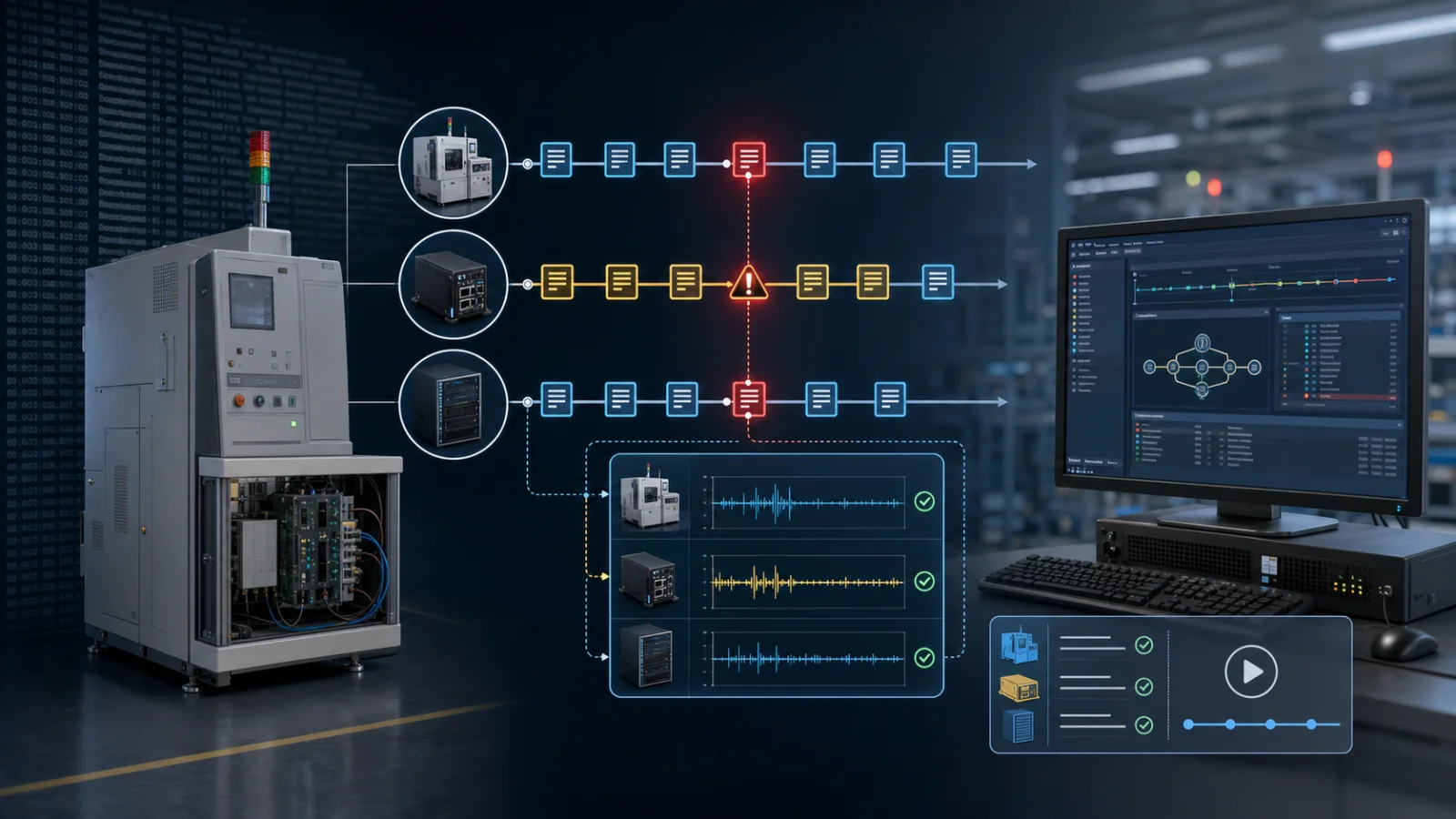
Short answer: adding SECS/GEM to legacy equipment is not a TCP or message-conversion exercise. A production-ready retrofit must translate the machine’s real states, events, alarms, variables, recipes and commands into an equipment model that a fab Host can understand, then prove the behavior through normal, timeout, disconnect and recovery scenarios. The difficult part is usually not sending one S1F1 message. It is making the complete interface reviewable, repeatable and supportable.
This guide is for two groups: fabs and integrators modernizing older tools, and industrial equipment makers that already know PLC, Modbus, OPC UA, serial or proprietary TCP but need a credible path into semiconductor automation.
Why SECS/GEM becomes an industry-entry barrier
Teams coming from general industrial automation often already know how to expose tags, read registers and send commands. Semiconductor automation asks for an additional behavioral contract. SECS-II defines structured messages; GEM adds communication and control states, events, alarms, variables, equipment constants, process-program behavior and remote-operation expectations. GEM300 adds further coordinated models for advanced automation.
The interface is also equipment-specific. The machine builder and fab still need to agree what each status variable means, when a data value is valid, which event announces a transition, what an alarm blocks, which remote commands are accepted in each state, and how recovery behaves after a timeout or disconnect. A gateway can move bytes without resolving those semantic questions.
| Existing capability | What the team already knows | What SECS/GEM adds |
|---|---|---|
| PLC / Modbus | Registers, coils, deterministic control and local HMI behavior. | Host-facing equipment states, events, alarms, variables, transactions and remote-operation rules. |
| OPC UA | Typed data, browsing, subscriptions and industrial interoperability. | Semiconductor-specific message sequences, GEM services, fab operational scenarios and acceptance evidence. |
| Serial / proprietary TCP | Device commands, replies and vendor-specific frames. | HSMS session behavior, SECS-II message structures, transaction correlation and a documented equipment model. |
| Machine software | Actual process, alarms, recipes, interlocks and operator actions. | A stable Host contract that remains correct across commissioning, software updates and factory acceptance. |
The real pain points in traditional SECS/GEM work
Traditional tools are not all primitive. Mature commercial products already provide drivers, simulators, scenario design, consolidated logs, sequence diagrams and acceptance reports. The remaining pain is the engineering work around those tools.
| Tool category | What it solves well | What still consumes expert time |
|---|---|---|
| SDK / driver | HSMS and SECS-II connectivity, message encoding, timers and standard service building blocks. | Equipment-specific modeling, state ownership, message validity and integration into the controller. |
| Gateway | Bridges PLC, Modbus, OPC UA, serial or proprietary data into a Host-facing interface. | Versioned bidirectional mapping, command safety, recovery policy and proof that translated behavior matches the real machine. |
| Log viewer | Captures and filters messages by time, direction, transaction or message type. | Correlating Host, equipment and gateway clocks; reconstructing state; deciding which missing or late event actually matters. |
| Host / equipment simulator | Sends messages, runs scripts and tests expected communication behavior. | Authoring representative scenarios, covering timing and failure permutations, and maintaining the test library as the interface evolves. |
| Compliance / acceptance tester | Runs repeatable standards or fab-defined test plans and produces pass/fail evidence. | Connecting a failed test back to the exact implementation, configuration, mapping or requirement owner. |
PEER Group describes the same gap from a test-product perspective: ordinary scripts can depend heavily on the engineer who authors and interprets them, while production-equivalent scenario coverage must account for timing, parallel software interactions and failure recovery. Its current DiDaCT 2 product already offers reusable scenarios, merged logs and sequence diagrams. Therefore, a credible new product must improve the incident-to-evidence workflow, not merely claim to have a log viewer or scenarios.
Five recurring retrofit failure modes
1. The connection works, but the equipment model is incomplete
S1F13/S1F14 can establish communication while the Host still lacks reliable events, status values, alarms or command behavior. “Connected” is a transport milestone, not an integration acceptance result.
2. A tag-to-SVID mapping loses machine meaning
A raw PLC tag may be readable without being valid in every machine state. The mapping needs units, quality, update rule, valid-state boundary, source version and an owner. Otherwise the Host receives a number without enough context to use it safely.
3. Host and equipment logs tell different stories
Clock skew, retries, duplicate transactions, missing payload capture and independent retention policies can make two correct-looking logs disagree. Engineers then spend hours aligning timestamps before they can discuss the fault.
4. Happy-path testing hides recovery defects
Normal online processing covers only a fraction of the state space. Timeout, reconnect, operator intervention, invalid parameter, repeated command, partial mapping and controller restart cases often expose the expensive defects during fab acceptance.
5. Responsibility is discussed without an evidence boundary
A failed lot-start scenario can involve the machine state, adapter mapping, protocol runtime, Host command, timing assumption or an ambiguous acceptance requirement. A useful workflow does not guess who is at fault. It identifies which layer produced each fact and what evidence is still missing.
How an evidence-led replay workflow is different
The intended differentiation of MST Agentic SECS/GEM Engineering Suite is not “AI reads a log and declares a culprit.” V1 is local-first and deterministic. The engineering workflow is designed around trace provenance, replay and bounded diagnostic findings.
- Record immutable communication evidence. Preserve ordering, direction, transaction references, connection lifecycle and approved redacted fields without making payload capture mandatory.
- Reconstruct an incident timeline. Display message events, state changes, clock regressions and evidence gaps in one deterministic replay view.
- Link every finding to supporting steps. A diagnosis candidate should point back to the exact replay events that support it and explicitly state when evidence is insufficient.
- Separate responsibility boundaries. Keep device facts, adapter mapping, protocol behavior, Host behavior and acceptance requirements distinct so a review can assign follow-up to the right owner.
- Convert learning into a scenario candidate. A confirmed incident should become a repeatable validation case. Scenario execution and automated incident-to-test conversion remain release-gated; they are not claimed here as generally available autonomous features.
Why “Agentic”? It describes a guided engineering loop—collect evidence, reconstruct state, propose a bounded finding, request review and preserve the decision—not an LLM controlling production equipment. Wire truth, transaction correlation, GEM state and live commands remain deterministic and authority-controlled.
A responsibility matrix for faster joint debugging
| Boundary | Evidence to preserve | Question it can answer |
|---|---|---|
| Machine / controller | Raw state, command response, alarm and local timestamp. | Did the physical or control system reach the claimed state? |
| Gateway / adapter | Raw-frame reference, parser version, mapping version and normalized fact. | Was the source fact translated correctly and with the intended version? |
| SECS/GEM runtime | Session lifecycle, message direction, transaction correlation, timer and state transition. | Did the protocol layer send, receive and correlate the exchange as designed? |
| Factory Host | Command, parameters, expected reply, Host timestamp and workflow state. | What did the Host request, and what response did it accept or reject? |
| Requirement / acceptance | Interface revision, scenario version, precondition, expected result and approver. | Were both sides implementing the same agreed behavior? |
Important: evidence boundaries support a technical responsibility review. They do not automatically assign contractual liability.
Legacy-equipment retrofit readiness checklist
Step 1: inventory the current control surface
List every physical and software interface: PLC, Modbus, OPC UA, serial, digital or analog IO, proprietary TCP, controller API, database and operator-only action. Record which commands can change equipment state.
Step 2: choose the integration mode
Use SDK or DLL integration when the equipment software can call a supported connector directly. Use a gateway or adapter when the legacy controller must remain largely unchanged. Do not choose only by transport; choose by ownership, lifecycle, command safety and upgrade constraints.
Step 3: define the Host-facing equipment model
Create controlled lists for SVIDs, DVIDs, CEIDs, ALIDs, ECIDs and RCMDs, then define communication, control and process-state behavior. Record units, valid states, trigger conditions and expected acknowledgements.
Step 4: create a versioned mapping ledger
For every Host-facing item, link the raw source, parser or adapter version, transformation, target item and reverse-command policy. A mapping change must be reviewable like a software release.
Step 5: write scenarios before commissioning
Start from the fab workflow, not from a list of available messages. Each scenario needs a precondition, actor, action, expected messages and state, timeout, recovery path and evidence required for pass/fail.
Step 6: make time and correlation explicit
Define clock sources, synchronization limits, transaction identifiers, retention and redaction policy. Without those controls, replay can create a convincing but false sequence.
Step 7: test negative and recovery paths
Include lost connection, delayed reply, duplicate command, invalid parameter, offline state, controller restart, rejected online transition, stale mapping and missing data. Fail closed when a command cannot be mapped safely.
Step 8: prepare the acceptance dossier
Deliver the interface document, mapping ledger, software and adapter versions, scenario set, run results, unresolved deviations, recovery evidence and named sign-off owners. This becomes the baseline for later support.
Ten scenarios to include in the first pilot
- Transport connection, HSMS selection and communication establishment.
- Offline to online transition with operator-controlled rejection.
- Status-variable request in valid and invalid equipment states.
- Collection-event report with the expected associated data.
- Alarm set, alarm clear and Host recovery visibility.
- Remote command accepted, rejected and repeated.
- Recipe or process-program selection under the approved scope.
- Reply timeout followed by a deterministic recovery path.
- Connection loss during an active transaction and clean re-establishment.
- Controller or gateway restart with version and state reconciliation.
What procurement should ask before buying a retrofit
- Which equipment family and controller versions are explicitly supported?
- Who owns the equipment model and mapping after handover?
- Are raw-source references and mapping versions retained for diagnosis?
- Can the supplier demonstrate timeout, reconnect and rejected-command scenarios?
- What data is captured, where is it stored and how is sensitive payload redacted?
- Is the deliverable a driver, gateway, configured interface, scenario library, acceptance report or all five?
- Which features are generally available, preview-only or project-specific?
- What evidence is required before the fab or end customer signs acceptance?
Request a private SECS/GEM engineering evaluation. Start with the equipment type, current controller and protocol, target fab or Host expectation, present blocker and one representative scenario. Do not upload customer logs, interface manuals or other confidential files through the public form.
Frequently asked questions
Can a gateway automatically convert any legacy machine to SECS/GEM?
No. A gateway can provide a reusable transport and mapping framework, but each device family still needs a versioned parser or source adapter, an equipment model, bidirectional command policy, state correspondence and acceptance scenarios.
Do engineers still need SECS/GEM knowledge?
Yes, but the knowledge can be concentrated into controlled models, templates, diagnostic rules and review gates instead of requiring every machine developer to interpret raw protocol behavior from scratch. Qualified engineers still approve the interface and acceptance result.
Is scenario testing unique to MST?
No. Established commercial test platforms already support scenario design and automated acceptance. MST’s intended distinction is the connected incident workflow: local trace provenance, deterministic replay, evidence-linked findings, mapping-version context and a path from a confirmed incident to a regression-scenario candidate.
Does replay prove which company is responsible for a failure?
No. Replay can show which system produced each observable fact and where evidence is missing. Contractual responsibility depends on the agreed interface, acceptance criteria and commercial terms.
Can non-semiconductor equipment makers use this approach?
Yes. It is particularly relevant to OEMs moving from PLC, Modbus, OPC UA, serial or proprietary TCP into semiconductor automation. The first pilot should focus on one equipment family, one target Host profile and a small set of representative scenarios.
Is MST Agentic SECS/GEM Engineering Suite generally available?
Not as an unrestricted public release. The current path is a private engineering evaluation. Preview capabilities and supported scenarios must be confirmed against the specific equipment, operating environment and release evidence.
Primary sources and review boundary
- SEMI: Evolution of semiconductor equipment automation standards — explains the roles of SECS-II, GEM, GEM300 and EDA, including why other industrial protocols do not supply the same equipment-behavior model.
- PEER Group CCS Product Suite — describes the expert-dependence of ordinary scripts and log interpretation and the role of repeatable test plans.
- PEER Group PFAT — documents scenario testing, timing and error permutations, reusable test libraries and log packages for troubleshooting.
- PEER Group DiDaCT 2 — documents current scenario, consolidated-log, comparison, sequence-diagram and acceptance-report capabilities.
- PEER Group: Well-Known Names — explains why factories otherwise need equipment-specific lookup mappings for variables, events and alarms.
- Siemens WinCC OA SECS/GEM Gateway documentation — documents gateway configuration, data mapping and the secure-network boundary of unencrypted standard TCP/IP communication.
- MKS SenseStream SECS/GEM Gateway application note — describes legacy-equipment cost, unsupported vendors and conversion from analog, serial, Modbus and industrial Ethernet sources.
Last technically reviewed: July 29, 2026. SEMI standards are copyrighted and evolve. Use authorized current standards, the target fab’s interface requirements and qualified engineering review for an actual implementation.
Related Articles
Turn one failed scenario into reviewable evidence.
Start with the equipment type, current interface, target Host expectation and one representative failure or acceptance scenario. MST will review whether a private legacy-retrofit, trace/replay or validation pilot is appropriate. Preview scope and availability are confirmed case by case.