
MPW Tapeout Cost: What Drives the Quote?
MPW cost is not only about node name. Die area, process options, reticle use, packaging, probe, test and schedule all shape the quote.

- →1. Node and process family
- →2. Die area
- →3. Shared-reticle utilization
- →4. Packaging, wafer probe and final test
- →5. Readiness and schedule pressure
Answer-first summary: MPW quote drivers include node, process family, die area, shared-reticle utilization, package, wafer probe, final test, logistics, readiness and schedule pressure. A quote-ready RFQ needs these assumptions before partner review.
MPW cost is not determined by node name alone. A useful quote discussion needs the full prototype context: process family, die area, mask or reticle sharing, sample target, package, wafer probe, test scope, logistics, readiness and schedule pressure.
This is why the first RFQ should be a structured engineering brief, not a one-line price request.
1. Node and process family
The node matters, but the process family often matters more. A plain CMOS prototype, an RF design, a high-voltage device, a BCD or power design, and an eNVM option may have very different availability and cost behavior even when the node number looks similar.
For RFQ screening, describe both the node range and the process family. If you are not sure which node fits, state the electrical or device requirements that drive the choice.
2. Die area
Die area is one of the strongest cost drivers. Larger die occupy more shared reticle or wafer area, reduce the number of gross dies available and may increase the risk of lower good-die count depending on yield assumptions.
If final layout is not ready, provide a range. A rough die estimate is better than no die-area information because it lets the review team model cost sensitivity.
3. Shared-reticle utilization
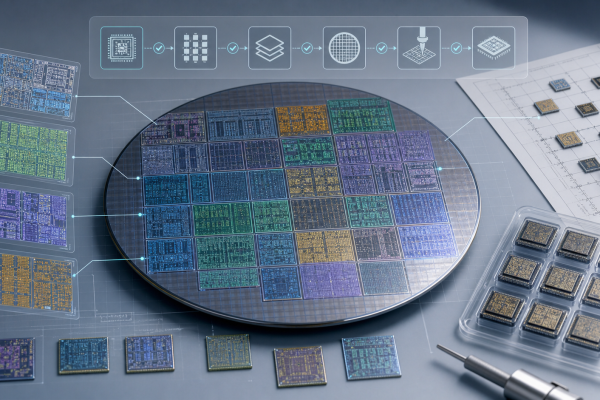
In MPW, multiple designs may share reticle or wafer resources. The way projects fit into the shared area affects cost allocation and planning. A small die with flexible placement behaves differently from a large die with special process or test needs.
This is why reticle planners and dies-per-wafer estimators are useful before RFQ submission. They do not replace partner quotation, but they make the discussion more concrete.
4. Packaging, wafer probe and final test
The wafer run is only part of the project. Packaging, wafer probe, electrical test, characterization, logistics and sample delivery can change the practical cost and schedule.
A buyer asking only for wafer price may later discover that package, probe or test assumptions are the real bottleneck. Put them into the first brief, even if the package is not final.
5. Readiness and schedule pressure
Urgent timing can affect the route. Shuttle availability, NDA/PDK timing, DRC/LVS readiness, package/test planning and compliance review all influence what can be confirmed. A project that is not ready may miss the intended window even if a public shuttle date exists.
What MST needs for cost screening
For first screening, send node range, process family, die-area estimate, sample quantity, package/probe/test assumptions, timeline, country and end-use context. Do not send GDS, netlist, RTL or proprietary design files at public intake.
FAQ
Can MPW cost be estimated before final GDS?
An indicative discussion can often start from node, process family, die area, sample needs and package assumptions. Final pricing depends on partner confirmation.
What is usually the biggest driver?
There is no universal answer, but die area, process family, node, package and test scope are usually important.
Does a smaller die always mean a cheaper MPW run?
Often it helps, but final quotation also depends on process options, schedule, package, test and route availability.
Next step: Use MST MPW tools to estimate die-area and reticle effects, then submit a high-level RFQ for partner-review preparation.
Related Articles


Ready to plan your MPW and first-silicon path?
Start with a non-confidential brief covering node/process fit, schedule, first-silicon validation, packaging/test, sample handling or re-spin needs. MST routes the request for review; feasibility, availability, timing and quotation are confirmed case by case.