- →Why Evaluating AI Design Tools Requires a Different Framework
- →Criterion 1: Native Output Format — The Non-Negotiable
- →Criterion 2: Component Library Depth and Accuracy
- →Criterion 3: Design Rule Customization
- →Criterion 4: PDM/PLM Integration
Key Takeaway
Not all AI design tools are equal — the critical differentiator is whether the output is reviewable in the buyer’s real SolidWorks workflow. For P&ID-driven gas panels, evaluate native .sldasm output, symbol and connection extraction, customer part-library reuse, validation reports, and PDM readiness. NeuroBox D is designed for this P&ID-to-native-SolidWorks workflow; any time-savings claim should be validated against the buyer’s own drawings, parts library, and review rules.
Why Evaluating AI Design Tools Requires a Different Framework
The market for AI-assisted mechanical design tools has grown rapidly since 2024. According to a 2025 report by MarketsandMarkets, the AI in CAD market is projected to reach $6.8 billion by 2028, growing at a 19.2% CAGR. With dozens of vendors claiming AI-powered automation, engineering managers face a genuine challenge: how do you separate tools that deliver production-ready output from those that generate impressive demos but fail in real workflows?
This checklist distills the five criteria that matter most when evaluating AI design tools for SolidWorks environments — particularly for semiconductor equipment, gas delivery systems, and other complex mechanical assemblies.
Criterion 1: Native Output Format — The Non-Negotiable
This is the single most important factor in your evaluation, and the one most frequently glossed over in vendor presentations.
What to look for:
- Does the tool output native .sldprt and .sldasm files? Or does it generate STEP, IGES, or other neutral formats that require manual conversion?
- Are feature trees preserved? Native files with intact feature trees can be edited parametrically. Imported geometry cannot.
- Are mates and constraints intact? A SolidWorks assembly without proper mates is just a pile of parts in 3D space.
Why this matters:
Converting from neutral formats introduces errors. A 2024 study by CIMdata found that engineers spend an average of 3.2 hours per assembly cleaning up imported geometry — re-establishing mates, fixing broken references, and re-applying materials. For a 200-component gas panel, that cleanup can consume an entire workday.
NeuroBox D is designed to generate native SolidWorks assembly proposals directly from P&ID context and the customer’s approved part library. The goal is to preserve feature-tree, mate, BOM, and rule-check context so engineers review a native assembly proposal instead of cleaning up dead STEP geometry.
Criterion 2: Component Library Depth and Accuracy
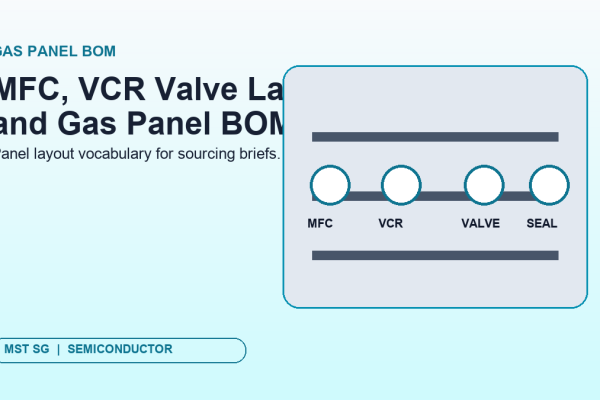
An AI tool is only as good as the components it can instantiate. Semiconductor gas delivery systems use thousands of specialized components — mass flow controllers, pneumatic valves, regulators, check valves, filters, and fittings — from specific manufacturers like Swagelok, Fujikin, Parker, and CKD.
Evaluation questions:
- How many manufacturer-verified component models are in the library?
- Can the library be extended with your proprietary or preferred components?
- Are component specifications (Cv values, pressure ratings, wetted materials) embedded as metadata?
- Does the library distinguish between similar parts (e.g., VCR vs. compression fittings) at the specification level?
Tools with shallow libraries will generate assemblies that look right on screen but contain incorrect or placeholder components — a problem you will not discover until procurement or fabrication.
Criterion 3: Design Rule Customization
Every semiconductor equipment manufacturer has internal design standards. Tubing bend radii, minimum clearances between components, preferred routing paths, seismic bracing requirements — these rules are often undocumented tribal knowledge.
What to verify:
- Can you encode your company’s design rules into the system?
- Does the AI enforce those rules during generation, or merely flag violations afterward?
- Can rules be version-controlled and updated as standards evolve?
The difference between enforcement and flagging is the difference between getting a correct assembly on the first pass and spending hours on design review iterations. NeuroBox D is designed to apply company-specific design rules during generation and to flag exceptions for engineering review. Final release still belongs to the customer’s design authority.
Criterion 4: PDM/PLM Integration
An AI tool that exists outside your data management ecosystem creates more problems than it solves. Files generated by the tool need to flow into your PDM system (SolidWorks PDM, Teamcenter, Windchill) with proper part numbers, revision controls, and BOM structures.
Critical integration points:
- Part numbering: Does the tool assign part numbers following your naming convention?
- BOM generation: Can it produce a BOM that maps directly to your ERP system?
- Revision management: Are generated designs checked into PDM with proper revision history?
- Multi-user access: Can multiple engineers work with the tool against the same PDM vault?
Without PDM integration, AI-generated designs become orphaned files that engineers must manually import, rename, and check in — adding 1-2 hours of administrative overhead per design and introducing version control risks.
Criterion 5: Validation and Verification
Trust but verify. Any AI design tool should include built-in validation that confirms the generated assembly matches the input specification.
Validation checks to require:
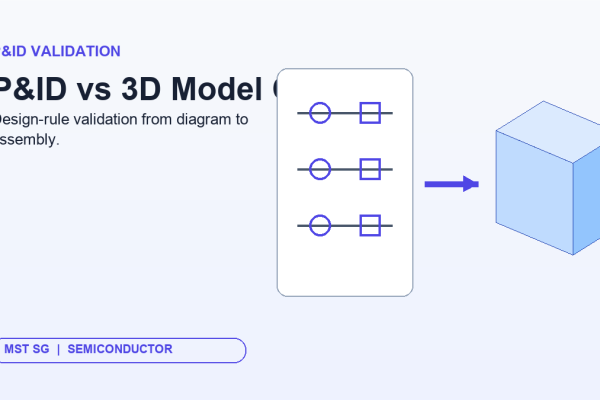
- P&ID compliance: Every symbol in the P&ID is represented by the correct physical component
- Connectivity verification: All flow paths are connected and free of dead-legs
- Interference detection: No physical collisions between components in the 3D layout
- BOM accuracy: Generated BOM matches the as-designed assembly with correct quantities
- Specification cross-check: Component specifications meet process requirements (pressure, temperature, material compatibility)
Validation should be automated and produce a clear pass/fail report. If a tool requires your engineers to manually verify every aspect of the generated design, you have not eliminated work — you have merely shifted it.
Putting It All Together: The Evaluation Scorecard
When evaluating AI design tools, score each criterion on a 1-5 scale:
- 5 — Fully meets: Production-ready capability, no workarounds needed
- 3 — Partially meets: Functional but requires manual intervention
- 1 — Does not meet: Missing or demo-only capability
Any tool scoring below 3 on Criterion 1 (native output) should be eliminated regardless of other scores. Native output is foundational — without it, every downstream step incurs a conversion tax.
For a serious evaluation, ask each vendor to run a representative P&ID through the workflow and compare engineering hours, correction loops, BOM accuracy, mate integrity, and review findings against the current baseline. NeuroBox D was designed around semiconductor gas-panel and equipment-design workflows, but ROI should be measured on the buyer’s own project data.
Next Steps
Before scheduling any vendor demo, send them a real P&ID from your recent project history. Not a simplified example — an actual 150+ component gas panel. Ask for a native SolidWorks assembly output. Then open it, check the feature tree, verify the mates, and export the BOM. The results will tell you everything the marketing slides cannot.
Related Reading
Still designing assemblies manually?
NeuroBox D converts your P&ID into a complete SolidWorks assembly — in hours, not days. See how it works with your own designs.
Review P&ID-to-native-SOLIDWORKS assembly scope
Check whether your P&ID, BOM, part library, interface rules and spatial constraints are ready for a reviewable native assembly workflow.
Open NeuroBox D page →