MPW Node Selection: 0.35um, 180nm, 65nm, 40nm and 28nm Tradeoffs
A practical node-selection guide for mature-node MPW scoping across analog, mixed-signal, RF, BCD, high-voltage and digital prototype needs.
- →What engineers should clarify first
- →Start from function, not node marketing
- →The missing fields that slow quotation
- →Node pages should be educational
- →How this connects to MST
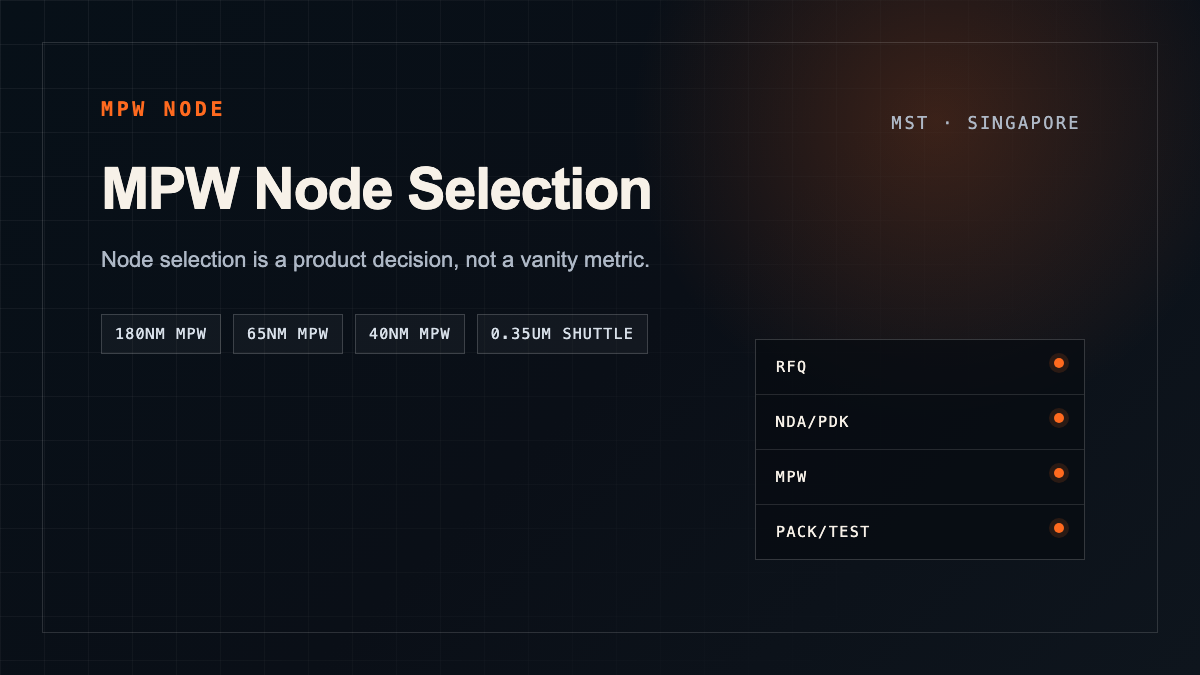
Answer-first summary: Node selection is a product decision, not a vanity metric. Mature-node MPW scoping should start with voltage, analog/RF needs, IO, die area, IP availability, package/test plan and first-silicon learning goals before choosing 0.35um, 180nm, 65nm, 40nm or 28nm.
A team often asks for the smallest affordable node. For MPW, that can be the wrong starting point. The better question is: which process family gives enough learning for the prototype while keeping PDK, IP, package, test and cost risk under control?
What engineers should clarify first
| Node family | Common MPW fit | Early scoping questions |
|---|---|---|
| 0.35um / 0.18um | Analog, high-voltage, mixed-signal, sensor interface, BCD-like needs | Voltage, passive devices, IO, package, analog test coverage |
| 65nm / 40nm | Digital or mixed digital prototypes that need denser logic | EDA flow maturity, SRAM/IP availability, timing closure and package/test budget |
| 28nm and below | Higher density prototypes, stronger tool/IP dependence | PDK access, signoff maturity, IP licensing and whether MPW is enough for the learning goal |
| Specialty processes | RF, high-voltage, eNVM, MEMS-like needs | Do not assume a generic CMOS shuttle fits a specialty requirement. |
Start from function, not node marketing
Power ICs, analog front ends, RF blocks and high-voltage interfaces often prefer mature or specialty nodes because device options matter more than transistor density. Digital prototypes may need tighter nodes, but they also need stronger signoff and IP discipline.
The missing fields that slow quotation
Node requests often arrive without die size, voltage, package, test, expected samples or design-readiness information. Those missing fields make partner review slower than the actual keyword suggests.
Node pages should be educational
It is acceptable to write node pages that explain tradeoffs and scoping questions. It is risky to imply a named foundry route or reserved shuttle slot. Keep node pages informational and route serious cases to RFQ screening.
How this connects to MST
For node scoping, send node range, process family, die area, package/test expectations and design readiness. MST uses this article as an intake guide, not as a promise of partner access, compliance certification, fixed sample count, fixed pricing, or automatic production approval.
FAQ
Is 180nm still useful for MPW?
Yes for many analog, mixed-signal, high-voltage and lower-cost prototype cases. Usefulness depends on device options and product goals.
Should a startup start at 28nm?
Only if the design need, tool maturity, IP and budget justify it. Many first-silicon learning goals are better served by a mature-node route.
Can one page cover all nodes?
A pillar can cover the overview, but SEO and buyer intent usually justify node-specific explainers once the service scope is clear.
Public references for engineering context
准备定义您的项目?
发送节点、工艺类型、芯片面积、数量和时间线 - 不包含设计 IP。我们筛选后对接合格伙伴,并返回伙伴确认后的下一步。