Engineering Value of P&ID to Native SOLIDWORKS Assembly Generation
Where P&ID-to-native-SOLIDWORKS automation can help engineering teams: repeated assemblies, BOM consistency, senior-review bottlenecks, customer variants and earlier exception visibility.
- →Where the time goes today
- →Where automation creates value
- →Benefits by role
- →How to define a pilot
- →What not to promise internally
Answer block: The engineering value of P&ID-to-native-SOLIDWORKS automation comes from giving engineers a structured assembly proposal with BOM context, customer standards and reviewable exceptions. The best pilot is a bounded equipment module with a known P&ID, part library, BOM schema and rulepack.
Engineering automation should be judged by practical outcomes, not by demo novelty. A generated model is useful only when engineers, procurement and project managers can review it, edit it and connect it to the next stage of work. For P&ID-to-SOLIDWORKS assembly generation, the clearest value usually appears in variant-heavy equipment: gas panels, gas boxes, skids, process modules and custom industrial systems.
Where the time goes today
Manual design time is often consumed by translation work:
- Reading the P&ID and reconstructing the component list.
- Finding approved SOLIDWORKS parts or supplier models.
- Rebuilding repeated subassemblies with small customer variations.
- Aligning ports, fittings, brackets and access clearances.
- Keeping the CAD assembly, BOM and drawing notes consistent.
- Waiting for senior engineers to catch standard violations.
This is not low-skill work. It requires engineering judgment. But much of the effort is repetitive and can be structured.
Where automation creates value
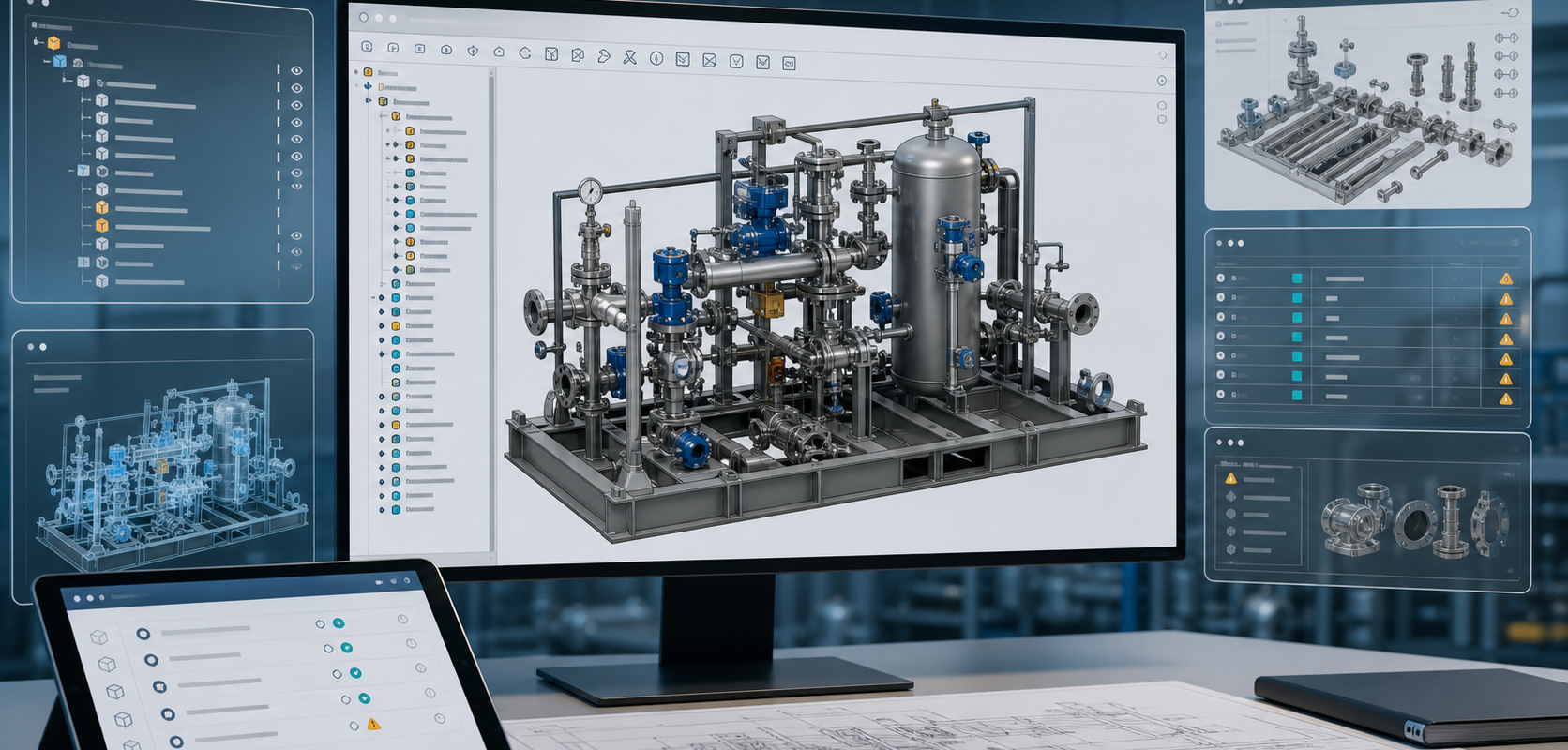
A P&ID-to-native-assembly workflow creates value by giving the engineer a better starting point. Instead of starting from a blank SOLIDWORKS assembly, the team receives a proposed hierarchy, mapped components, BOM context and exception list.
The value is strongest when:
- The company has repeated product patterns with customer-specific variants.
- Approved parts and supplier models already exist.
- Design rules can be documented as a rulepack.
- Procurement needs cleaner BOM context earlier in the project.
- Senior engineers are the bottleneck for review, not for every manual placement task.
Benefits by role
| Role | Pain point | Potential benefit |
|---|---|---|
| Mechanical engineer | Rebuilding repeated assemblies | Starts from a structured native assembly proposal |
| Senior engineer | Reviewing every detail manually | Focuses on exceptions, rules and design quality |
| Procurement | BOM drift and unclear part identity | Receives earlier part context and cleaner fields |
| Project manager | Late rework and schedule uncertainty | Sees missing inputs and rule conflicts earlier |
| Customer engineering | Standards not followed consistently | Can encode standard expectations into reviewable rules |
How to define a pilot
The first pilot should not be the largest or messiest project. Pick a bounded module that is representative enough to test the workflow but small enough to review quickly.
A good pilot includes:
- One P&ID or one logical slice of a P&ID.
- A known equipment category such as a gas stick, panel or skid.
- A usable SOLIDWORKS part library or a clear placeholder policy.
- A BOM field schema.
- Documented rules for naming, mounting, port direction, clearance and review output.
- A success criterion: first-review readiness, exceptions found, BOM completeness or revision quality.
What not to promise internally
Do not sell this internally as a substitute for engineering review and release controls. That sets the wrong expectation. The right promise is controlled acceleration: a stronger first assembly proposal, clearer missing data, better reuse of standards and less manual reconstruction of repeated patterns.
Every output still needs engineering review. The automation should make review easier by organizing structure and exceptions, not by hiding decisions.
FAQ
What is the strongest value case?
Repeated equipment modules with many customer variants and a stable part library. The more repeated structure there is, the more automation can help.
What blocks value?
Unclear drawings, missing part libraries, undocumented standards, inconsistent BOM fields and no agreed review process.
Can procurement benefit?
Yes. Procurement benefits when part identity and BOM fields are carried into the assembly earlier instead of being reconstructed later.
How should management evaluate the pilot?
Measure time to first reviewable assembly, number of exceptions caught, BOM completeness, revision time and senior-engineer review load.
Start with the P&ID to Native SOLIDWORKS Assembly capability page to frame the pilot and required inputs.
Need a native SOLIDWORKS assembly?
Send the P&ID scope, part-library expectations, rulepack boundary and target assembly output. MST reviews whether the case is suitable for native assembly generation with feature tree, mates and BOM context.