AI P&ID to SOLIDWORKS for Gas Panel Design Automation
Gas panels and gas boxes are strong candidates for P&ID-to-native-assembly automation because they combine repeated patterns, strict rules, BOM pressure and frequent variants.
- →Why gas panels create repetitive engineering load
- →What AI can help with
- →Why native SOLIDWORKS output is valuable
- →Common pain points this addresses
- →What should be validated before release?
Answer block: Gas panels and gas boxes are strong candidates for P&ID-to-SOLIDWORKS automation because they combine repeated component patterns, strict part-library usage, port alignment, routing constraints, BOM pressure and frequent customer-specific variants. AI can reduce repetitive modeling work, but the output still needs rulepack validation and engineering review.
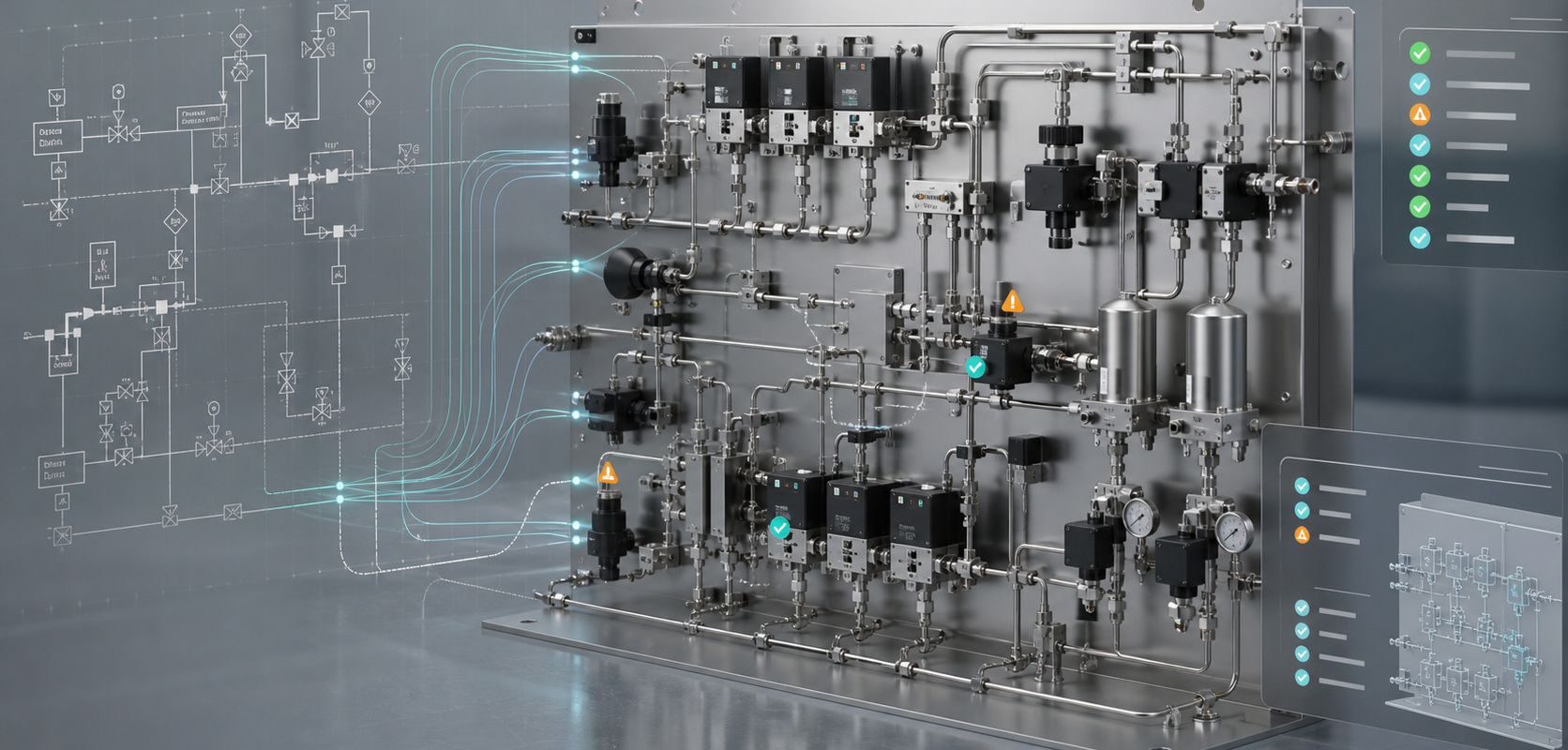
Gas panels are a good example of why P&ID-to-native-assembly automation matters. The design is structured, but not simple. A panel may contain regulators, valves, filters, transducers, pressure gauges, mass-flow components, fittings, purge lines and supports. The P&ID shows the functional logic, but the mechanical assembly must solve packaging, access, part availability, port orientation, routing and serviceability.
Manual CAD work is slow because engineers repeatedly translate the same intent across drawings, BOMs, libraries and SOLIDWORKS assemblies. Every customer option can trigger another round of placement, mating, checking and documentation.
Why gas panels create repetitive engineering load
Gas-panel engineering often has repeatable patterns: inlet conditioning, pressure regulation, isolation, measurement, purge and outlet logic. Yet each customer variation changes the real design. Different component vendors, panel boundaries, mounting rules, flow directions, pressure classes and service clearances can all affect the assembly.
The work is tedious because it is both rule-heavy and exception-heavy. A junior engineer may model quickly but miss standards. A senior engineer knows the standards but cannot spend the whole week rebuilding variants.
What AI can help with
AI-assisted P&ID-to-assembly workflow can help by connecting the functional diagram to engineering context:
- Recognize component classes and tag relationships from the P&ID.
- Map symbols and tags to customer-approved parts or placeholders.
- Build a proposed subassembly structure for gas sticks, panels and modules.
- Apply spatial and rulepack constraints where they are available.
- Create a reviewable exception list when the input is ambiguous.
- Preserve BOM context so procurement and engineering are not disconnected.
This does not mean the system should make unchecked manufacturing decisions. It means the system should reduce the blank-modeling burden and push unclear items into explicit review.
Why native SOLIDWORKS output is valuable
For a gas panel, the value is not just the first visual model. The value is the ability to revise. Engineers need to replace a regulator, move a transducer, adjust a bracket, split a gas stick into a subassembly, or update a BOM field without restarting the design.
A native SOLIDWORKS assembly makes that possible when it preserves component identity, assembly hierarchy and editable relationships. This is why MST’s target is native SOLIDWORKS assembly generation with feature tree, not a static model preview.
Common pain points this addresses
- Slow concept-to-assembly time: engineers spend hours rebuilding standard patterns.
- Inconsistent part use: different designers choose different vendor models for the same function.
- BOM drift: the P&ID, Excel BOM and CAD assembly diverge over revisions.
- Late clash discovery: routing, access and clearance issues appear after layout assumptions have hardened.
- Senior engineer bottleneck: standards are known by experts but not encoded in the workflow.
What should be validated before release?
A generated assembly should go through normal engineering review. Important checks include component identity, pressure rating, port orientation, mounting, service access, tube routing assumptions, part availability, BOM fields and customer-specific rules. If the rulepack is incomplete, the output should clearly identify what still needs a human decision.
FAQ
Can AI understand every gas-panel standard?
No. The practical approach is to start with the customer’s drawing conventions, part library and rulepack. AI helps apply and structure that context, but the standards must be reviewed.
Can this replace a mechanical engineer?
No. It is intended to compress repetitive translation work and give engineers a better starting assembly, not to remove engineering responsibility.
What is a good pilot scope?
One representative gas stick or one bounded panel, with a known P&ID, part library, BOM fields and clear validation rules.
Teams evaluating this workflow can start with the P&ID to Native SOLIDWORKS Assembly capability page and send a non-sensitive representative sample for review.
Need a native SOLIDWORKS assembly?
Send the P&ID scope, part-library expectations, rulepack boundary and target assembly output. MST reviews whether the case is suitable for native assembly generation with feature tree, mates and BOM context.