
MPW RFQ Pack Builder: How to Prepare a No-GDS First Brief
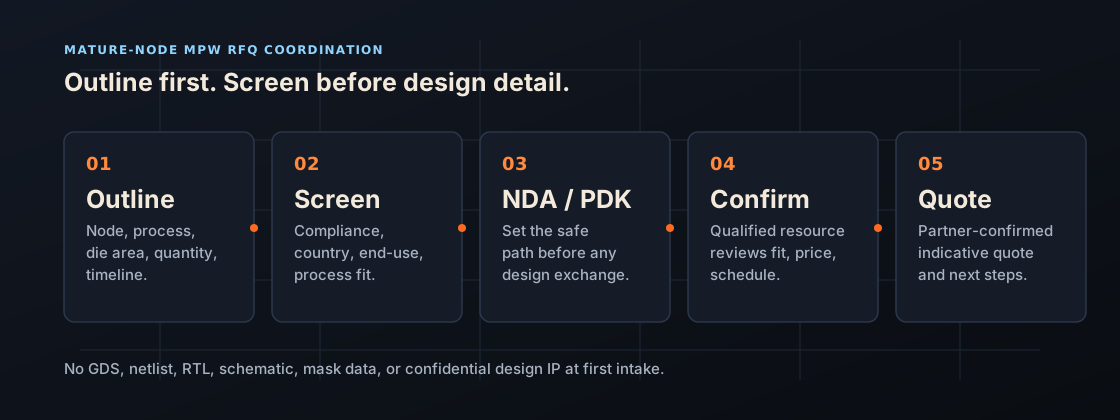
The MPW RFQ Pack Builder helps overseas teams prepare a non-confidential first brief covering process, die area, package, test, timeline and end-use context.
- →Answer-first summary
- →Why a no-GDS RFQ pack matters
- →Fields a first MPW brief should include
- →Example no-GDS RFQ pack output
- →What not to put in the public brief
Answer-first summary
An MPW RFQ pack builder helps a team start partner review without sending GDS or design IP. The first brief should describe the application, node range, process family, rough die area, sample target, package and test assumptions, design-readiness status, timeline, country and end-use context. This gives MST enough structure to screen the case and prepare the right questions before any NDA-gated file exchange.
The MPW RFQ Pack Builder is built for early mature-node prototype requests, especially overseas teams that need a controlled first step before discussing route-specific PDK access, shuttle windows or package/test scope.
Why a no-GDS RFQ pack matters
Many early MPW conversations fail because they start in one of two ways: the customer asks for a price with only a node name, or the customer is pushed to share sensitive files too early. A no-GDS RFQ pack avoids both problems. It gives enough information for screening while keeping proprietary design data out of the public intake path.
For MST, the RFQ pack is a routing document. For the customer, it is a safety document. For a qualified partner, it is a cleaner first read than a long email thread with missing assumptions.
Fields a first MPW brief should include
Customer and route context
- Company, university or design-service context
- Country or region of the customer entity
- Commercial, research or industrial use case
- End-use statement at a non-confidential level
- Whether export-sensitive or restricted applications are involved
Technical scope
- Target node range, such as 0.35um, 180nm, 130nm, 90nm, 65/55nm or 40nm
- Process family, such as CMOS, analog/mixed-signal, BCD, high voltage, RF or eNVM
- Rough die-area estimate and whether it is preliminary
- Sample count target and whether packaged samples are required
- Known IP, memory, high-voltage, RF, analog or sensor-interface assumptions at category level
Prototype service chain
- Expected package family or package constraints
- Wafer-probe need or wafer-only assumption
- Final-test and characterization expectations
- Logistics constraints for samples
- Timeline target and schedule flexibility
Example no-GDS RFQ pack output
Project summary
Commercial industrial team is evaluating a mature-node mixed-signal prototype for sensor-interface validation. Target process range is 180nm to 130nm mixed-signal CMOS. Estimated die area is 3 mm x 3 mm to 5 mm x 5 mm. Initial sample target is 25 to 100 packaged units for bench validation. Package family is likely QFN, but pad count and thermal constraints are not final.
Partner-review questions
- Which mature-node process families could support the voltage, analog and sensor-interface assumptions?
- What NDA and PDK path would be required before detailed design review?
- Which package and wafer-probe assumptions should be clarified before quote review?
- What additional customer or end-use information is needed before route confirmation?
Missing fields
- Final die size and top-level pad-ring estimate
- Operating voltage and special device requirements
- Package body and pin-count target
- Wafer-probe coverage and final-test scope
- Design-readiness status for schematic, layout and DRC/LVS
What not to put in the public brief
The first RFQ pack should not include GDS, OASIS, netlists, RTL, source code, PDK files, foundry documents, proprietary schematics, confidential customer drawings or mask data. A strong first brief is useful precisely because it avoids those files while still letting MST judge whether the request can be prepared for partner review.
How to use the tool with MST
Open the MPW RFQ Pack Builder, fill in the non-confidential fields, review the generated brief and use it as the starting point for the MPW RFQ intake. MST can then ask targeted follow-up questions, identify route constraints and prepare a partner-review packet when the case is mature enough.
Related Articles


Ready to scope your run?
Send node, process family, die area, volume and timeline - no design IP. We screen it, route to a qualified partner, and return an indicative quote.