- →The Hidden Cost of Slow Equipment Commissioning
- →Traditional DOE vs. AI-Powered Smart DOE
- →How AI Smart DOE Actually Works
- →Results That Matter
- →Who Benefits Most?
Key Takeaway
Equipment commissioning can be compressed from 2-4 weeks to 3 days, with 80% fewer trial wafers. MST’s NeuroBox E5200 uses AI-powered Smart DOE to find optimal recipes with just 10-15 wafers instead of 50-100, achieving CPK≥1.33 on first pass across CVD, PVD, and etch chamber types.
The Hidden Cost of Slow Equipment Commissioning
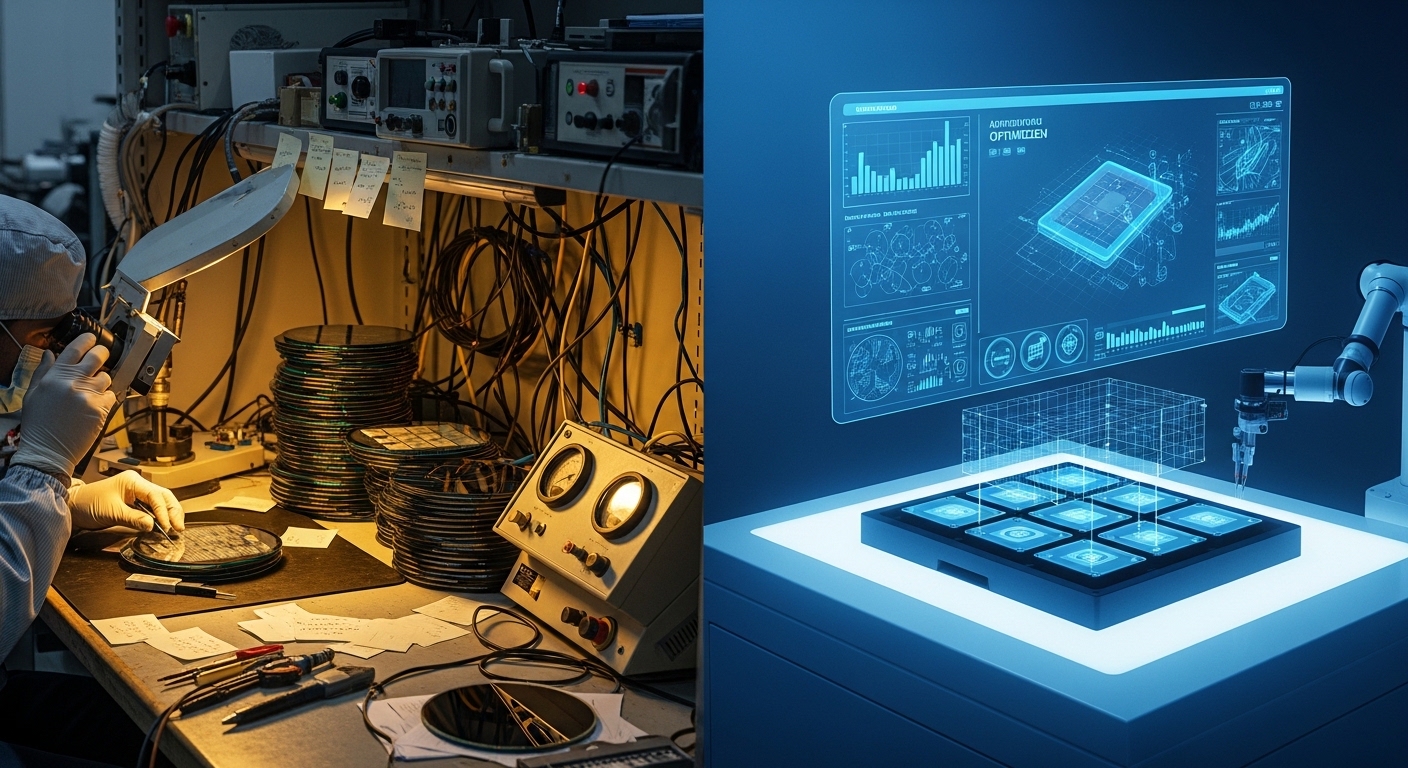
If you’re running an equipment delivery team or managing fab tool qualification, you already know the math doesn’t work:
Smart DOE reduces trial wafers by 80%. See how it works for your equipment.
Choose how you'd like to connect:
- 50-100 trial wafers per chamber at $50-200 each — that’s $2,500-$20,000 in consumables alone, per tool
- 2-4 weeks of engineer time for a single chamber, with your most experienced (and most expensive) process engineers tied up on-site
- Delivery deadlines slipping because traditional DOE requires multiple iteration cycles — run batch, wait for metrology, analyze, adjust, repeat
- Knowledge trapped in people — when your senior engineer is unavailable, commissioning quality drops or timelines double
For equipment OEMs, this directly erodes margin. For fabs, every day of commissioning is a day of lost production capacity. The question isn’t whether you need a better approach — it’s whether one actually exists that works.
Traditional DOE vs. AI-Powered Smart DOE
| Metric | Traditional Full-Factorial DOE | AI Smart DOE (NeuroBox E5200) |
|---|---|---|
| Trial Wafers | 50-100 per chamber | 10-15 per chamber |
| Commissioning Time | 2-4 weeks | 2-3 days |
| Cost per Chamber | $5,000-$20,000 | $1,000-$3,000 |
| Engineer Dependency | Requires senior process engineer | Junior engineer can operate |
| First-Pass CPK | Often requires multiple iterations | ≥1.33 on first pass |
| Cross-Chamber Transfer | Start from scratch each time | Model transfer enables rapid replication |
How AI Smart DOE Actually Works
Smart DOE isn’t a black box — it’s a three-phase process that replaces brute-force experimentation with intelligent, model-guided optimization.
Phase 1: Exploratory Runs (5-8 wafers)
Instead of running a full factorial matrix, the AI uses Bayesian optimization to select the most informative parameter combinations. Each wafer maximizes knowledge gain — the system isn’t “covering the space,” it’s zeroing in on the optimal region.
The AI considers your process parameters (temperature, pressure, gas flow, RF power, etc.) and automatically determines which combinations yield the most information per wafer.
Phase 2: Model Building + Recipe Optimization (Automated)
After the exploratory phase, NeuroBox E5200 automatically constructs a process response model using Gaussian process regression combined with deep ensemble methods. This model simultaneously outputs:
- The recommended optimal recipe with confidence intervals
- Parameter sensitivity ranking — which knobs matter most
- Process window boundaries — how much margin you have
Phase 3: Verification (3-5 wafers)
Run the recommended recipe to confirm CPK targets are met. If the model’s confidence is below threshold, it automatically suggests targeted supplementary experiments — but typically no more than 5 additional wafers.
The entire process connects to your equipment via SECS/GEM protocol. Data flows in real-time — no manual data entry, no CSV uploads, no PLC modifications.
Results That Matter
Who Benefits Most?
Equipment OEMs — Your on-site commissioning efficiency directly determines gross margin and customer satisfaction. Instead of dispatching a senior engineer for 2-4 weeks, a junior engineer can complete the job in 3 days with AI guidance. Scale this across dozens of tool deliveries per quarter, and the impact on your bottom line is substantial.
Foundries & IDMs — Every post-PM re-qualification cycle costs production capacity. Smart DOE turns re-qual from “engineer spends weeks tweaking” into “AI completes in 3 days.” For high-mix fabs running frequent PM cycles, this compounds fast.
OSAT & Advanced Packaging — Diverse equipment fleets with limited engineering bandwidth. Smart DOE’s model transfer capability means once you’ve optimized one chamber, the same model accelerates commissioning of identical chamber types across your fleet.
Getting Started: The 3-Phase Path
- POC on One Chamber (1 week) — No hardware modifications required. NeuroBox E5200 connects via SECS/GEM or OPC-UA. Pick your most painful tool — the one that always takes the longest to commission.
- Head-to-Head Validation (2 weeks) — Run a controlled comparison: traditional DOE vs. Smart DOE on the same equipment. Let the data speak.
- Fleet Rollout — Once validated, extend across chamber types and equipment models. The AI model improves with each commissioning cycle.
No PLC changes. No production interruption. No process flow modifications.
See how Smart DOE can cut your commissioning time from weeks to days. Book a 30-minute demo with our engineering team.
See how NeuroBox reduces trial wafers by 80%
From Smart DOE to real-time VM/R2R — our AI runs on your equipment, not in the cloud.
Book a Demo →