
- →Why Is SECS/GEM Implementation So Difficult?
- →What Is secsgem-driver and How Did It Originate?
- →How Does the Technical Architecture Work?
- →Project Status
- →How Does Open-Source SECS/GEM Accelerate the AI Ecosystem?
Key Takeaway
MST’s secsgem-driver is an Apache-2.0 licensed, early open-source Python project for SECS/GEM prototyping, simulator work, and equipment-integration evaluation. It is a starting point for engineering teams, not a drop-in production compliance guarantee; production deployment still requires equipment-specific mapping, validation, and customer acceptance testing.
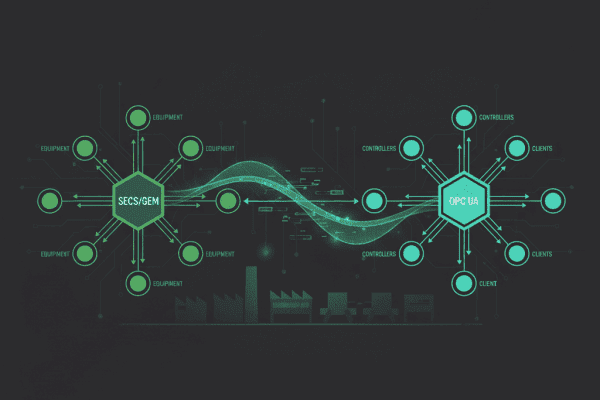
Many semiconductor production tools communicate with factory host systems using SECS/GEM — the SEMI Equipment Communications Standard and Generic Equipment Model. Developed in the 1980s and refined through dozens of SEMI standard revisions, SECS/GEM is the lingua franca that allows host systems to send recipes, receive alarms, collect process data, and control equipment state across tools from different manufacturers.
Open-source SECS/GEM driver + AI-native equipment connectivity platform.
Choose how you'd like to connect:
And yet, implementing SECS/GEM has traditionally been one of the most painful, expensive, and opaque tasks in semiconductor equipment engineering. Until now.
Why Is SECS/GEM Implementation So Difficult?
The SECS/GEM specification spans hundreds of pages across multiple SEMI standards: E4 (SECS-I transport), E5 (SECS-II message content), E30 (GEM behavior), E37 (HSMS transport), E40 (process management), E87 (carrier management), E90 (substrate tracking), E94 (control job management), E116 (equipment performance tracking), and more. Each standard defines message formats, state machines, and behavioral requirements that must be implemented precisely for interoperability.
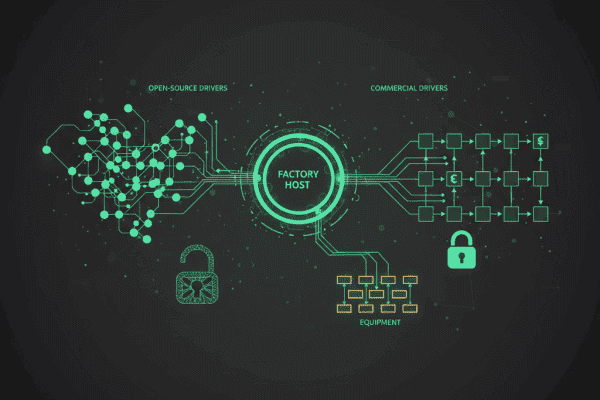
Historically, equipment companies had three options. First, buy a commercial SECS/GEM SDK from vendors like Cimetrix, Brooks Automation, or PEER Group — licenses that typically cost $50,000-200,000 per product line plus annual maintenance fees. Second, implement the protocol from scratch — a project that consumes 6-18 months of senior engineering time and produces code that only the original developers can maintain. Third, cobble together incomplete implementations from forum posts and undocumented examples, resulting in equipment that passes basic connectivity tests but fails during complex production scenarios.
For large equipment makers like Applied Materials, Lam Research, or Tokyo Electron, the commercial SDK cost is negligible relative to revenue. But for the thousands of smaller equipment companies worldwide — specialty tool makers, retrofit integrators, academic labs, and startups — the cost and complexity of SECS/GEM implementation is a genuine barrier to market entry.
What Is secsgem-driver and How Did It Originate?
secsgem-driver is an Apache-2.0 licensed, early open-source Python project for SECS/GEM prototyping and integration evaluation. It is intended for learning, simulator work, and controlled engineering experiments; production equipment deployment requires project-specific validation and customer acceptance testing.
The project originated from MST’s internal need for a flexible SECS/GEM layer that could support the NeuroBox product line. MST’s AI systems need to communicate with semiconductor equipment to collect real-time sensor data and send control commands. Rather than licensing a commercial SDK — which would have created a dependency on third-party software at the core of MST’s product — the engineering team built a clean-room implementation in Python.
The decision to open-source it was strategic, not charitable. MST recognized that the semiconductor industry’s AI transformation depends on equipment connectivity. Every tool that cannot communicate effectively with AI systems is a tool that cannot benefit from AI. By lowering the SECS/GEM implementation barrier, MST accelerates the overall market for semiconductor AI — a market in which MST’s products compete on AI capability, not on protocol implementation.
How Does the Technical Architecture Work?
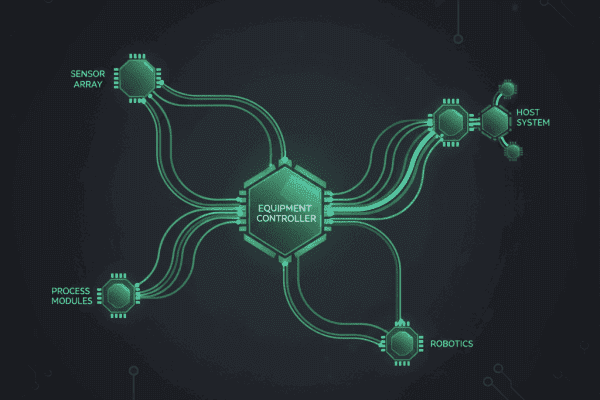
The library is structured in clean, modular layers that mirror the SECS/GEM standard hierarchy:
Transport Layer. Implements both SECS-I (RS-232 serial, for legacy equipment) and HSMS (TCP/IP, for modern equipment) with full connection state management, timeout handling, and multi-session support. The HSMS implementation handles T3, T5, T6, and T7 timer management, separate session establishment, and the control message handshake sequence that trips up many custom implementations.
Message Layer. Provides a complete SECS-II message encoder/decoder supporting all standard data types: binary, boolean, ASCII, JIS-8, signed and unsigned integers (1/2/4/8 byte), and floating point (4/8 byte). Messages are constructed using a Pythonic API that maps directly to SEMI standard nomenclature. Defining a new message type requires 5-10 lines of code rather than the hundreds of lines typical in C/C++ implementations.
GEM Layer. Provides a starting point for GEM state modeling — communication state, control state, processing state, alarms, and events. Production GEM behavior must still be mapped to the specific equipment model and validated against the customer’s acceptance and compliance test plan.
Application Layer. Provides example abstractions for common integration tasks such as recipe handling, event configuration, report creation, and status-variable access. The exact implementation size depends on the equipment model, host requirements, GEM option set, and validation scope.
Project Status
secsgem-driver is an early-stage open-source project, first public release in March 2026 under the Apache-2.0 license. Technical highlights at the current stage:
– Async-native implementation on Python asyncio for non-blocking I/O
– Full HSMS (E37) and SECS-II (E5) codec covering all data types
– Configuration-driven: equipment profiles in YAML, no hardcoded message definitions
– Hardened against real-world failure modes: HSMS message-length DoS protection, SECS-II boundary decoding, race-condition-free reply handling, monotonic system_bytes
– Apache-2.0 licensed — free for commercial use, contribution-friendly
– Repository: github.com/shensi8312/secsgem-driver
Contributions welcome — bug reports, E87 carrier management, E40 process job extensions, or real-world equipment profiles.
The project is open for engineering review and contribution. Planned areas include clearer examples, simulator workflows, carrier-management experiments, and documentation that helps equipment teams understand what must be validated before production use.
How Does Open-Source SECS/GEM Accelerate the AI Ecosystem?
The connection between an open-source protocol driver and the semiconductor AI ecosystem is direct and measurable.
Early data-pipeline scoping. AI models for semiconductor manufacturing require reliable equipment data. Open-source SECS/GEM examples can help engineering teams prototype data collection, understand message behavior, and identify the validation work required before a production host connection is accepted.
Lower barrier for AI startups. A semiconductor AI startup can now prototype a complete data collection and model training pipeline without licensing a $100,000+ SECS/GEM SDK. This lowers the minimum viable capital required to enter the semiconductor AI market, increasing competition and innovation.
Standardized data formats. When the community converges on a common protocol library, the data formats and collection patterns become standardized. This makes it easier to share pre-trained models, benchmark results, and best practices across organizations — creating network effects that benefit the entire ecosystem.
Equipment maker adoption. Smaller equipment makers can use open-source tooling to learn the protocol, prototype host/equipment behavior, and scope the work before buying a commercial SDK or commissioning a production integration project.
What Is the Roadmap for secsgem-driver?
The project’s development roadmap reflects both community priorities and industry trends:
Near-term (2026): Improve documentation, simulator examples, codec robustness, and integration checklists. Additional SEMI option areas may be explored as engineering experiments, not promised production support.
Medium-term: Explore data-logging examples, export formats, and dual-protocol concepts where teams need to evaluate both SECS/GEM and OPC UA. Any production deployment still depends on customer requirements and acceptance testing.
Long-term: Keep the project useful as an educational and evaluation resource, while production SECS/GEM work remains a validated, customer-specific integration project.
MST’s open-source SECS/GEM initiative is deliberately modest: make the first evaluation step easier, document the protocol path clearly, and help equipment teams understand what remains before a production host connection can be accepted.
Evaluate early open-source SECS/GEM resources and request help scoping equipment-specific mapping, validation, and production integration.
View SECS/GEM Resources →See how NeuroBox reduces trial wafers by 80%
From Smart DOE to real-time VM/R2R — our AI runs on your equipment, not in the cloud.
Book a Demo →