- →What is actually in a senior designer's head
- →What "AI knowledge capture" actually means
- →The corpus you need
- →What a captured rule looks like
- →What fails
Your most experienced mechanical designer is 63 years old. He has been with the company since 1988. He knows which vendors deliver on time, which gasket compounds work in your customers’ processes, which assembly sequences avoid the tolerance stack-up that bit you in 2007. None of it is written down. He retires in 14 months.
This is engineering knowledge capture, and it is the problem AI tools have been promising to solve since the expert system days of the 1980s. Let us be honest about what works in 2026, what does not, and what a realistic capture program looks like at an equipment OEM.
What is actually in a senior designer’s head
The knowledge that walks out with retirement falls into roughly four categories:
- Codified rules. “Use 1.5D bend radius for stainless tubing, 2D for carbon steel.” These get written into design guides eventually, but most companies have only 20 to 40 percent of the codified set documented.
- Heuristics with conditions. “Use these flanges from this vendor, except when the customer is in pharma, then use the other vendor.” Hard to write down because the conditions are fuzzy.
- Pattern recognition. “That layout will fail because of vibration — I have seen it three times.” Not a rule, a learned pattern from past failures.
- Vendor and process tribal knowledge. “Their lead time is officially 6 weeks but actually 10. Do not trust the website.”
Document-based capture (wikis, lessons learned, design guides) addresses category 1 and parts of category 2. It captures essentially zero of categories 3 and 4. This is why retirement still hurts even at companies with mature documentation programs.
What “AI knowledge capture” actually means
It is not interviewing the designer for 200 hours and uploading the transcripts. That has been tried; it does not work. The designer cannot articulate what they know, and even if they could, free-form text is not directly useful as model input.
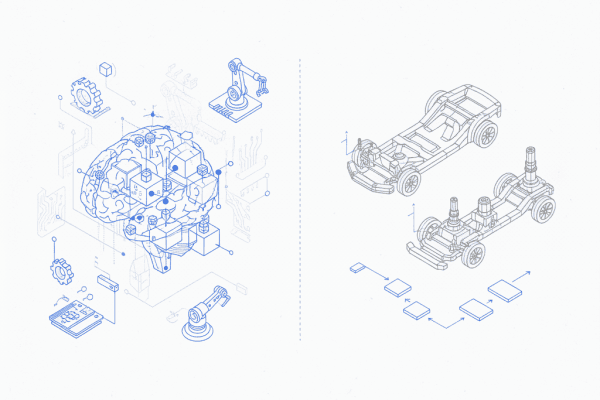
The approach that holds up has three layers:
- Mine past decisions. Every released drawing pack is a captured decision. The model learns from the corpus of historical work.
- Pair decisions with rationale. Drawings alone are not enough; you need the why. Design review notes, ECN justifications, vendor selection memos.
- Validate with the senior designer. The AI proposes an explanation for past decisions, the senior designer corrects it. The corrections become high-quality training data.
The key insight is that the senior designer is more useful as a corrector than as a narrator. They can tell you whether a proposed rationale is right or wrong. They cannot reliably free-recall the rules they use.
The corpus you need
For engineering knowledge capture to produce something useful, you need a corpus that includes:
- Released drawing packs from the last 10 to 20 years.
- ECN history with reason codes and full justifications.
- Design review meeting notes (where they exist).
- Vendor selection records.
- Failure investigation reports (RCA documents).
- Tribal knowledge memos (informal write-ups from senior designers, often emailed).
- The corresponding 3D models and PMI data.
Most equipment OEMs have most of this somewhere — in PDM, in email archives, in network drives. Consolidating it is 60 percent of the project work. The actual model training is 20 percent. Validation with the designer is the remaining 20 percent.
What a captured rule looks like
Here is an example of an extracted, validated design rule from a real project:
rule_id: KNW-2024-0147
category: pipe_support_spacing
condition:
  pipe_size: 4in_or_larger
  fluid_temperature: above_200C
  insulation_present: true
  vibration_source_within_3m: true
recommendation: use_spring_supports_at_max_3m_spacing
rationale: thermal_expansion_combined_with_vibration_causes_clamp_failure_in_rigid_supports_observed_in_2009_and_2013_failures
source:
  drawings: [PRJ-2009-1842-PIP-101-RevC, PRJ-2013-2147-PIP-203-RevB]
  ecns: [ECN-2010-118, ECN-2014-074]
  failure_reports: [FR-2009-22]
validated_by: J.K. (lead piping designer)
validation_date: 2026-02-14
confidence: high
This rule did not exist in the company’s design guide. It existed only in J.K.’s head and in the artifacts of two old failures. The AI extracted it by noticing that two of J.K.’s post-2014 designs systematically used spring supports in conditions where younger designers used rigid clamps. The pattern surfaced; J.K. confirmed and added the rationale.
Multiply this by a few thousand. That is engineering knowledge capture in practice.
What fails
Four failure modes are predictable:
- Garbage in, garbage out. If past designs include errors that were never caught, the AI will learn the errors. Validation by the senior designer is non-optional.
- Survivorship bias. Released drawings show successful designs. Failed designs are not in the corpus. The model learns what works but does not learn what to avoid. Failure reports are the antidote.
- Spurious correlations. The model may notice that designs led by Designer A always use SS304L and designs led by Designer B always use SS316L, and conclude that the choice is about the designer, not the application. Senior validation catches this.
- Stale rules. Designs from 1995 reflect 1995 vendor offerings, codes, and customer preferences. Time-weight the corpus.
Where AI is worse than the senior designer
Be honest. The senior designer beats AI on:
- Vendor relationship knowledge. AI does not know that the vendor’s account manager is responsive on Mondays only.
- Customer-specific quirks that were never documented anywhere.
- Judgment under ambiguity. “This drawing is wrong but I do not know exactly why” is not yet AI’s strong suit.
- Code interpretation in edge cases. ASME B31.3 has clauses that experienced engineers interpret differently.
The AI does not replace the senior designer. It captures a partial copy of what is documentable in their head, and it makes that knowledge available to junior designers in real time during their work.
A realistic deployment
A reasonable engineering knowledge capture deployment at a 200-engineer equipment OEM looks like:
- Year 1: corpus consolidation, initial model training, first 200 to 500 captured rules. Cost: 1 to 3 FTE.
- Year 2: expansion to 1,500 to 3,000 rules, integration with CAD design assistants. Cost: 1 FTE.
- Year 3: knowledge base maintenance, retirement-driven capture of remaining senior designers. Cost: 0.3 to 0.5 FTE.
Senior designer time involved: 60 to 120 hours total over 18 months. Spread out, not concentrated. Designers find it less painful than expected because they get to review and correct, not produce from scratch.
Where DrawingDiff fits
DrawingDiff’s role in this workflow is the corpus mining and rule extraction layer. The deeper organizational change — getting designers to use the captured knowledge during design — is a separate set of tools and processes. We do the mining; you do the deployment.
Privacy and data handling
A practical concern worth addressing: where does the captured knowledge live, and who has access. Three patterns are common.
The first is on-premise deployment, where the corpus and the model both stay inside the company network. The AI provider supplies software but never sees the data. This is the right default for equipment OEMs serving defense, semiconductor, and pharma customers who require strict IP control. The cost is operational complexity; you run the infrastructure.
The second is private-cloud deployment, where the customer rents dedicated infrastructure from the AI provider but the data is segregated from other customers. Good middle ground for customers comfortable with cloud but not with shared multi-tenant systems.
The third is shared-cloud SaaS, where data flows into a multi-tenant platform. Cheapest, fastest to deploy, and unacceptable for most equipment OEMs because of customer NDA constraints and trade-secret concerns. A surprising number of CAD AI vendors offer only this option, which limits their addressable market in the equipment industry.
How junior designers actually use the captured knowledge
A captured rule base is only valuable if junior designers consult it during work. The naive deployment is a searchable wiki. This fails because nobody searches a wiki proactively when they think they already know the answer.
The deployment that works is contextual. The AI watches what the junior designer is doing — the part being modeled, the customer, the application — and surfaces relevant captured rules in the design environment. “You are designing a high-temperature pipe support with vibration nearby. Rule KNW-2024-0147 suggests spring supports here. Reference: 2009 and 2013 failures.”
The contextual delivery converts knowledge from a reference resource into an active assistant. Junior designers report that this catches mistakes they would not have known to look for. Senior designers report that the AI sometimes surfaces rules they had forgotten themselves.
This last point matters. The capture process is not just about preserving knowledge for after retirement. It is also reinforcing knowledge for designers still active. The senior designer benefits from a system that remembers everything they have ever decided and pattern-matches across years.
Cross-company knowledge sharing
A practical question: should the captured knowledge be company-specific or industry-shared? The answer is mostly company-specific. Most equipment OEMs view their design knowledge as competitive moat. Sharing it across companies dilutes the moat.
The exceptions are codified rules from public standards (ASME, ISO, DIN), which are not proprietary. AI tools that ship with these public rules pre-loaded save customers from re-deriving them. The proprietary rules layer on top.
This hybrid is the standard architecture: public rules from standards bodies, plus customer-private rules captured from internal design history. The AI distinguishes the two and applies them in priority order (customer rule overrides public rule when they disagree, with the disagreement flagged for review).
What this means for you
- Start before the senior designer announces retirement. Capture takes 12 to 18 months on a corpus that already exists.
- The most valuable artifact is not drawings, it is ECN justifications and failure reports paired with drawings.
- Senior designer involvement is mandatory but should be structured as review, not free-form interview.
- engineering knowledge capture is a continuous practice, not a one-time project — once started, it should run for the life of the company.
Review P&ID-to-native-SOLIDWORKS assembly scope
Check whether your P&ID, BOM, part library, interface rules and spatial constraints are ready for a reviewable native assembly workflow.
Open NeuroBox D page →