- →How Will AI Change the Fab Floor by 2027?
- →What Trends Will Reshape Equipment Intelligence?
- →How Will AI Transform the Semiconductor Business Model?
- →What Will the Workforce and Ecosystem Impact Be?
Key Takeaway
By 2027, AI will be embedded in every layer of semiconductor manufacturing — from equipment design through wafer production to supply chain logistics. These 10 predictions, grounded in current technology trajectories and industry investment data, outline the transformations that fab operators, equipment makers, and investors should prepare for now.
The semiconductor industry is investing at an unprecedented rate. SEMI projects $530 billion in new fab construction through 2030. The global semiconductor market is expected to surpass $1 trillion in annual revenue by 2030, according to McKinsey. Behind these numbers is a fundamental truth: the industry’s growth depends on manufacturing capabilities that are approaching the physical limits of traditional process control methods.
AI is not a nice-to-have in this context. It is the enabling technology that makes advanced manufacturing economically viable at scale. Here are 10 specific predictions for how AI will reshape semiconductor manufacturing by 2027, each grounded in measurable trends.
How Will AI Change the Fab Floor by 2027?
Prediction 1: 80% of new fabs will deploy AI-powered Virtual Metrology from day one.
Virtual Metrology — using AI models to predict wafer quality from process sensor data without physical measurement — has moved from research curiosity to production necessity. Currently, approximately 25-30% of advanced fabs use some form of VM. By 2027, the economics will make non-VM fabs uncompetitive. A single inline metrology tool costs $2-5 million and creates a throughput bottleneck, measuring 5-10% of wafers. VM models achieving R-squared above 0.95 can predict quality for every wafer in real time, enabling 100% virtual inspection at a fraction of the cost.
Prediction 2: Autonomous Run-to-Run control will manage 60% of process recipes without human intervention.
Today’s R2R systems require process engineers to define control limits and override thresholds. By 2027, reinforcement learning-based R2R controllers will manage recipe adjustments autonomously for stable, well-characterized processes. Human engineers will focus on new process development and exception handling, while AI manages the steady-state operations that consume 70% of engineering bandwidth today. TSMC’s published research already demonstrates autonomous R2R performance matching senior engineers on mature process nodes.
Prediction 3: Equipment commissioning time will drop below 48 hours for standard tools.
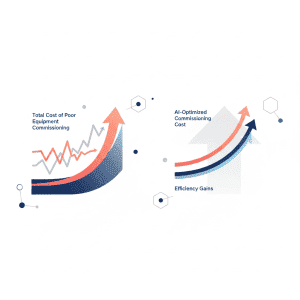
Traditional equipment commissioning takes 2-6 weeks, consuming 15-25 test wafers per recipe and requiring senior engineers on-site for the duration. AI-powered Smart DOE — the approach pioneered by MST’s NeuroBox E5200 — has already reduced this to 3-5 days with 2-3 wafers. By 2027, the combination of transfer learning (using models trained on previous installations of the same tool type) and digital twin simulation will compress commissioning to under 48 hours for tools with established AI baselines. The economic impact: $200,000-500,000 saved per tool installation.
What Trends Will Reshape Equipment Intelligence?
Prediction 4: Edge AI chips purpose-built for semiconductor equipment will emerge as a distinct product category.
Current edge AI deployments in fabs use general-purpose inference hardware — NVIDIA Jetson, Intel Movidius, or custom FPGA solutions. By 2027, at least two major semiconductor companies will release AI accelerator chips specifically designed for equipment-level inference: optimized for time-series sensor data, certified for cleanroom electromagnetic compatibility, and featuring hardware-level security for process IP protection. The market for semiconductor-equipment AI chips will reach $800 million annually by 2028.
Prediction 5: Digital twins will become mandatory for equipment qualification.
Equipment manufacturers currently qualify tools through physical testing — running hundreds of wafers through the actual hardware. By 2027, regulatory and customer requirements will mandate digital twin validation as a prerequisite for physical qualification. AI-generated digital twins, trained on sensor data from the equipment’s global installed base, will simulate process performance across thousands of operating conditions in hours rather than weeks. This shift will accelerate the equipment development cycle by 30-40% and reduce qualification costs by a similar margin.
Prediction 6: Multi-chamber AI coordination will replace golden wafer matching.
The current industry standard for ensuring consistency across multiple chambers of the same tool — running a “golden wafer” through each chamber and comparing results — is expensive, slow, and provides only a snapshot of matching quality. By 2027, AI systems will continuously monitor cross-chamber consistency using real-time sensor data, automatically adjusting recipe parameters to maintain tool-to-tool matching within specification. MST’s chamber matching AI is an early example of this approach. Industry adoption will reach 45% of multi-chamber tools by 2027.
How Will AI Transform the Semiconductor Business Model?
Prediction 7: Equipment-as-a-Service (EaaS) models will capture 20% of new tool placements.
AI-powered predictive maintenance and performance optimization enable a business model shift: instead of selling equipment outright, manufacturers can sell guaranteed performance outcomes (uptime, yield, throughput) on a subscription basis. The manufacturer maintains ownership and uses AI to optimize utilization and minimize maintenance costs. Applied Materials and Lam Research have both announced pilot EaaS programs. By 2027, 20% of new tool placements in foundry and OSAT segments will use EaaS contracts, driven by fabs’ preference for converting CapEx to OpEx.
Prediction 8: AI-driven supply chain platforms will reduce semiconductor inventory buffers by 35%.
The semiconductor industry currently holds $72 billion in excess inventory (as of Q4 2025) — a buffer against supply chain uncertainty that ties up enormous working capital. AI supply chain intelligence — predictive demand modeling, dynamic supplier matching, and real-time logistics optimization — will give companies enough confidence in supply continuity to reduce safety stock levels. MST’s Supply Chain Intelligence platform is designed specifically for this use case. By 2027, companies using AI-driven supply chain management will operate with 35% less inventory while maintaining or improving fill rates.
What Will the Workforce and Ecosystem Impact Be?
Prediction 9: The semiconductor AI engineer will become the most in-demand role in the industry.
By 2027, every major fab will have a dedicated AI engineering team alongside traditional process, integration, and yield engineering teams. The hybrid role — part process engineer, part machine learning engineer — will command premium compensation. Current market data shows semiconductor AI engineers earning 25-40% more than equivalent traditional process engineering roles. University programs are already responding: Stanford, MIT, NTU Singapore, and KAIST have all launched semiconductor AI specialization tracks since 2024.
Prediction 10: Open-source semiconductor AI tools will create an ecosystem comparable to EDA in the 1990s.
The early EDA industry was fragmented, with proprietary tools from dozens of vendors. Standardization through open interfaces (LEF/DEF, GDSII, OpenAccess) enabled an ecosystem that grew to $15 billion annually. Semiconductor AI is following the same trajectory. Open-source projects like MST’s secsgem-python driver, combined with emerging standards for equipment data exchange and model interoperability, will create a foundation layer that accelerates adoption across the industry. By 2027, open-source semiconductor AI tools will be used in over 50% of fabs, either directly or as components of commercial solutions.
The semiconductor industry’s AI transformation is not a distant future — it is a near-term operational reality that companies must plan for today. The fabs, equipment makers, and technology providers that invest in these capabilities now will define the competitive landscape through the end of the decade. Those that wait will find themselves attempting to retrofit AI into systems and processes designed for a pre-AI era — an expensive and strategically disadvantaged position.
Discover how MST deploys AI across semiconductor design, manufacturing, and beyond.