- →What Are SECS and GEM, and Why Do They Exist?
- →How Does SECS/GEM Architecture Work in Practice?
- →Why Is SECS/GEM Compliance a Market Requirement?
- →What Common Mistakes Do Equipment Makers Make with SECS/GEM?
- →How Does EDA/Interface A Extend SECS/GEM for AI Applications?
Key Takeaway
SECS/GEM is the universal communication protocol connecting semiconductor equipment to factory systems, handling everything from recipe management to real-time sensor data collection. Understanding its architecture is essential for any equipment maker pursuing factory integration and AI-powered process control.
What Are SECS and GEM, and Why Do They Exist?
Semiconductor Equipment Communication Standard (SECS) and Generic Equipment Model (GEM) are the foundational protocols that allow semiconductor manufacturing equipment to communicate with factory host systems. Developed by SEMI (Semiconductor Equipment and Materials International), these standards have been the backbone of fab automation since the 1980s.
The problem they solve is straightforward but critical: a modern semiconductor fab operates 500-2,000 tools from dozens of different vendors. Without a common communication language, integrating each tool would require custom software — an impossible maintenance burden. SECS/GEM provides that common language.
SECS-I (SEMI E4): The original physical layer standard defining RS-232 serial communication. Largely obsolete but still encountered in legacy equipment.
SECS-II (SEMI E5): The message content standard defining data structures and message types. SECS-II specifies how equipment and host exchange information — equipment status, alarm notifications, recipe transfers, process data, and control commands. There are over 200 defined message types organized into 20+ streams (categories).
HSMS (SEMI E37): High-Speed SECS Message Services replaced SECS-I with TCP/IP transport, enabling gigabit-speed communication. Virtually all modern SECS/GEM implementations use HSMS as the transport layer.
GEM (SEMI E30): The behavioral standard that defines how equipment should act — state models, communication establishment, alarm management, remote control, data collection, spooling, and recipe management. GEM turns raw SECS-II messaging into a predictable, standardized equipment behavior model.
How Does SECS/GEM Architecture Work in Practice?
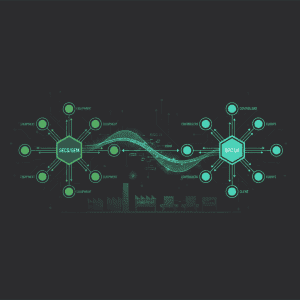
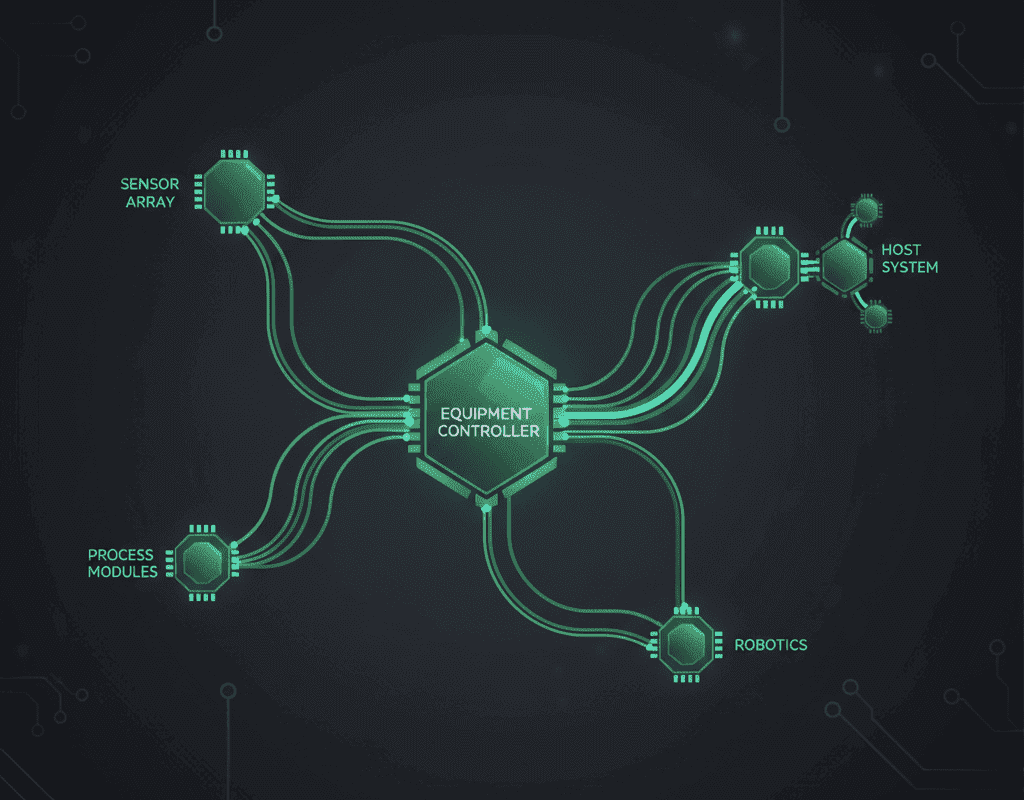
A SECS/GEM implementation consists of several interconnected subsystems:
Communication Management: The HSMS layer establishes and maintains the TCP/IP connection between equipment and host. It handles connection establishment (active or passive mode), data exchange, link test heartbeats (typically every 30-60 seconds), and error recovery. A robust HSMS implementation automatically reconnects after network interruptions without data loss.
State Machine: GEM defines a hierarchical state model. The top level tracks communication state (not communicating, communicating). Below that, the control state distinguishes between online-local (operator has priority), online-remote (host has priority), and equipment offline. The processing state tracks equipment activity — idle, executing, paused. These states determine which operations are permitted at any moment.
Data Variables and Collection Events: Equipment exposes its data through three types of variables. Status Variables (SVs) reflect current equipment state — chamber pressure, temperature setpoints, wafer count. Equipment Constants (ECs) are configurable parameters — alarm limits, default recipes, timing values. Data Variables (DVs) capture transient process data — sensor traces, step completion data. Collection Events (CEs) trigger data reports when significant events occur — process start, process complete, alarm triggered.
Alarm Management: Equipment reports anomalies through a standardized alarm system. Each alarm has an ID, text description, severity level (personal safety, equipment safety, parameter control, all others), and on/off state. The host can enable or disable specific alarms and receives real-time notifications of alarm state changes.
Recipe Management: Recipes (called Process Programs in SECS/GEM terminology) can be uploaded from host to equipment, downloaded from equipment to host, deleted, and verified. The host controls which recipes are available on each tool, ensuring process consistency across the fab.
Why Is SECS/GEM Compliance a Market Requirement?
For semiconductor equipment makers, SECS/GEM compliance is not optional — it is a prerequisite for selling into any major fab:
Customer Mandate: Every tier-1 fab (TSMC, Samsung, Intel, SK Hynix, Micron) and most tier-2 fabs require GEM compliance as a purchase condition. The specification level varies — some require basic GEM (SEMI E30), others require GEM300 (SEMI E116, the 300mm extension) or EDA/Interface A (SEMI E120/E125/E132/E134 for high-speed equipment data).
Integration Cost: A non-compliant tool forces the fab to build custom integration software, adding $50,000-200,000 in integration costs and 3-6 months of delay. Fabs increasingly refuse to absorb this cost, making non-compliance a deal-breaker.
Data Foundation: SECS/GEM is the data pipeline that feeds every advanced manufacturing application — Virtual Metrology, R2R control, Fault Detection and Classification, predictive maintenance. Without proper SECS/GEM implementation, these AI applications cannot access the equipment data they need. Conversely, a well-implemented SECS/GEM interface makes AI integration dramatically easier.
What Common Mistakes Do Equipment Makers Make with SECS/GEM?
Having supported hundreds of SECS/GEM integrations, MST has identified recurring implementation pitfalls:
Incomplete Variable Exposure: Equipment makers expose the minimum variables required for basic operation but hide the rich sensor data that enables AI applications. A deposition chamber might expose 20 summary variables when it actually has 200+ real-time sensor channels. Exposing comprehensive data from the start avoids costly firmware updates later when customers request it for FDC or VM.
Poor Timestamp Synchronization: SECS/GEM messages carry timestamps, but equipment internal clocks often drift from the factory time server. A 500ms clock offset can corrupt process-metrology data alignment, destroying VM model accuracy. Best practice: implement NTP synchronization with sub-100ms accuracy and include high-resolution timestamps in all data reports.
Recipe Management Gaps: Many implementations handle recipe upload and download but fail on edge cases — recipe verification after upload, handling of recipe body modifications, version tracking, and recipe parameter validation against equipment capabilities. These gaps surface during fab acceptance testing and cause delays.
State Machine Violations: The GEM state model is precisely defined, but many implementations take shortcuts — allowing operations in incorrect states, failing to report state transitions, or implementing incomplete state hierarchies. Automated GEM compliance testing tools catch these issues early.
Spooling Failures: When the host connection drops, GEM requires equipment to spool (buffer) messages for later delivery. Implementations that lack adequate spool storage, lose message ordering, or fail to resume correctly after reconnection cause data gaps that affect production visibility.
How Does EDA/Interface A Extend SECS/GEM for AI Applications?
While SECS/GEM handles equipment control and basic data collection, Equipment Data Acquisition (EDA), also known as Interface A, provides the high-bandwidth data channel required for modern AI applications:
Sampling Rate: SECS/GEM typically collects data at 1-10 Hz (triggered by collection events). EDA supports continuous streaming at 10-1,000 Hz, capturing the fine-grained sensor dynamics that machine learning models need for accurate prediction.
Data Volume: A single chamber running EDA at 100 Hz across 200 parameters generates approximately 1.7 GB per day. This requires dedicated data infrastructure — high-throughput message brokers, time-series databases, and efficient compression — that goes beyond traditional SECS/GEM host systems.
Decoupled Architecture: EDA uses a separate communication channel (typically SOAP/XML over HTTP, or increasingly, modern REST/gRPC interfaces) that does not interfere with the primary SECS/GEM control channel. This separation ensures that high-volume data collection cannot impact equipment control responsiveness.
MST provides open-source SECS/GEM driver libraries that equipment makers can integrate directly into their control software, reducing implementation time from 6-12 months to 4-8 weeks. These drivers handle HSMS communication, GEM state management, variable collection, and EDA streaming — letting equipment makers focus on their core process expertise rather than communication protocol engineering.
What Should Equipment Makers Prioritize in Their SECS/GEM Strategy?
For equipment makers building or upgrading their factory communication capabilities, the priority order is clear:
1. Solid GEM Foundation (Months 1-3): Implement compliant GEM with comprehensive variable exposure, robust state machine, full recipe management, and reliable spooling. Use automated compliance testing. This is the minimum viable product for fab integration.
2. EDA Data Streaming (Months 3-6): Add high-frequency sensor data streaming with configurable sampling rates, efficient data encoding, and reliable delivery. This enables customer AI applications and positions the equipment as AI-ready.
3. AI Integration Layer (Months 6-9): Build on the data foundation to offer embedded AI capabilities — Virtual Metrology, predictive maintenance alerts, process optimization recommendations — that use the SECS/GEM and EDA data internally. This differentiates the equipment from competitors and creates recurring software revenue opportunities.
4. Fleet Intelligence (Months 9-12): Connect multiple deployed tools into a fleet analytics platform where cross-tool insights improve individual tool performance. This requires standardized data schemas and secure communication — both built on the SECS/GEM foundation.
SECS/GEM may lack the excitement of machine learning algorithms, but it is the essential infrastructure layer that makes everything else possible. Equipment makers who invest in excellent SECS/GEM implementation build the foundation for AI differentiation, faster customer integration, and long-term competitive advantage in an increasingly data-driven industry.
We open-sourced our SECS/GEM Python driver. 3 lines of code to connect. 15,000+ downloads, 40+ contributors.
View Open-Source Driver →Discover how MST deploys AI across semiconductor design, manufacturing, and beyond.