
- →Why Is ESG Suddenly a Board-Level Issue for Semiconductor Companies?
- →What Makes Carbon Accounting So Difficult for Semiconductor Fabs?
- →How Does AI Transform Semiconductor Carbon Accounting?
- →What Does Implementation Look Like for a Typical Fab?
- →What Is the Financial Case for Proactive ESG Investment?
Key Takeaway
New ESG regulations (EU CSRD, SEC Climate Disclosure, ISSB Standards) will require semiconductor companies to report Scope 1, 2, and 3 emissions with audit-grade accuracy by 2025-2026. Manual carbon accounting in a semiconductor fab — which consumes 50-100MW of power and uses 30+ process gases — is a $2-5M annual compliance burden with high error risk. AI-powered energy and emissions management platforms can automate 85% of the reporting workload while simultaneously reducing energy costs by 12-18%.
Why Is ESG Suddenly a Board-Level Issue for Semiconductor Companies?
Three years ago, ESG reporting in the semiconductor industry was largely voluntary, limited to annual sustainability reports with self-reported metrics and minimal verification. That era is over.
The regulatory landscape has shifted dramatically. The EU Corporate Sustainability Reporting Directive (CSRD), effective for large companies starting fiscal year 2024, requires detailed environmental disclosures aligned with European Sustainability Reporting Standards (ESRS). The SEC’s Climate Disclosure Rule mandates Scope 1 and 2 greenhouse gas emissions reporting for publicly traded companies. The International Sustainability Standards Board (ISSB) has released IFRS S1 and S2, creating a global baseline for climate-related financial disclosures.
For semiconductor companies, these regulations create an immediate compliance challenge. A modern 300mm fab is one of the most energy-intensive industrial facilities on Earth, consuming 50-100 megawatts continuously — equivalent to a small city. The industry’s total electricity consumption exceeds 70 TWh annually (roughly equal to Belgium’s entire electricity use), generating substantial Scope 2 emissions. Process gases used in etching, deposition, and cleaning (SF6, NF3, CF4, C2F6) have global warming potentials 10,000-23,000 times that of CO2, creating significant Scope 1 emissions.
The financial stakes are real. Non-compliance with CSRD can trigger fines up to 5% of annual EU revenue. SEC climate disclosure violations carry securities law penalties. And increasingly, major customers (Apple, NVIDIA, Intel) are requiring suppliers to report and reduce emissions as a condition of procurement. TSMC’s supply chain decarbonization program, for example, asks key suppliers to achieve RE100 (100% renewable energy) by 2040.
What Makes Carbon Accounting So Difficult for Semiconductor Fabs?
Semiconductor carbon accounting is uniquely complex for five reasons:
Process gas diversity and variability. A typical fab uses 30-50 different process gases, each with different global warming potentials, utilization rates, and abatement efficiencies. Calculating actual emissions requires real-time monitoring of gas consumption per tool, per recipe, combined with tool-specific abatement system efficiency — not just aggregate facility-level gas purchases. The IPCC’s Tier 2a methodology for semiconductor emissions requires process-specific utilization and byproduct formation rates that vary by tool type and recipe.
Energy consumption complexity. Fab energy is consumed across cleanroom HVAC (35-40% of total), process equipment (30-35%), ultrapure water and chemical systems (15-20%), and support facilities (10-15%). Attributing energy to specific products or process steps requires sub-metering at a granularity that most fabs lack. When a customer asks “what is the carbon footprint of the chips you make for us?”, answering accurately requires product-level energy allocation.
Scope 3 emissions dwarf Scope 1+2. For fabless semiconductor companies and equipment OEMs, Scope 3 emissions (supply chain and product use) represent 80-95% of total carbon footprint. A semiconductor equipment maker’s Scope 3 includes the energy consumed by every tool in every customer fab for 15-20 years of operational life. Estimating this requires accurate models of equipment energy consumption across varying operating conditions — exactly the kind of modeling that AI excels at.
Multi-jurisdictional reporting requirements. A global semiconductor company might need to report under CSRD for European operations, SEC rules for U.S. listed entity requirements, and local regulations in Taiwan, South Korea, Japan, and China — each with different methodologies, boundaries, and reporting timelines. Maintaining consistent, reconcilable data across these frameworks is a significant data management challenge.
Audit-grade accuracy requirements. Unlike voluntary sustainability reports, regulated disclosures require third-party verification with assurance standards comparable to financial audits. This means auditable data trails, documented methodologies, and quantified uncertainty bounds — a level of rigor that spreadsheet-based carbon accounting cannot achieve.
How Does AI Transform Semiconductor Carbon Accounting?
AI-powered energy and emissions management platforms address each of these challenges through four capabilities:
Capability 1: Automated data collection and integration. Instead of manual monthly readings from utility meters and gas cabinet logs, AI platforms continuously ingest data from building management systems (BMS), equipment sensors (via SECS/GEM), gas distribution panels, abatement systems, and utility meters. This real-time data collection eliminates 80-90% of the manual data gathering effort and reduces transcription errors to near zero.
For a large fab with 500+ tools, automated data collection replaces 2-3 full-time equivalents (FTEs) dedicated to ESG data gathering — a direct savings of $300,000-$500,000 per year.
Capability 2: Physics-informed emissions modeling. AI models trained on process chemistry and equipment physics calculate actual emissions from each tool and recipe, accounting for gas utilization rates, byproduct formation, abatement efficiency, and gas-specific global warming potentials. These models go far beyond simple emissions factors, capturing the real-world variability that makes semiconductor emissions so difficult to estimate.
For example, an NF3 remote plasma clean on a CVD chamber has dramatically different emissions depending on plasma power, chamber temperature, and clean duration. A physics-informed model captures these dependencies, while a simple emissions factor approach (NF3 consumed x GWP) can overestimate actual emissions by 30-50% — causing companies to invest in abatement for emissions that do not actually exist.
Capability 3: Product-level carbon footprint allocation. By combining tool-level energy monitoring with production scheduling data from MES, AI platforms can allocate energy and emissions to specific products, process steps, and even individual wafer lots. This capability is increasingly demanded by customers implementing Scope 3 supply chain accounting — and it is essentially impossible without AI-driven data integration.
Capability 4: Predictive energy optimization. The same AI models that calculate emissions can optimize energy consumption. By analyzing patterns in equipment energy use, HVAC loads, and production scheduling, the platform identifies opportunities to reduce energy waste without impacting production. Typical results include 12-18% reduction in total facility energy consumption, achieved through optimized equipment idle modes, HVAC scheduling, and production sequencing.
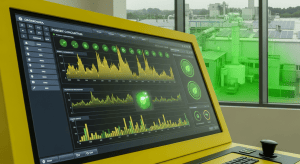
MST’s NeuroEnergy platform is specifically designed for this application: it combines real-time energy monitoring, AI-driven emissions calculation, and automated reporting generation in a single platform that serves both compliance and optimization objectives.
What Does Implementation Look Like for a Typical Fab?
A phased implementation of AI-powered ESG management typically follows this timeline:
Phase 1 (Month 1-3): Energy data infrastructure. Deploy sub-metering at critical energy nodes (main switchgear, chiller plants, major equipment groups). Connect to BMS and equipment monitoring systems. Establish baseline energy consumption profiles by facility zone and equipment type. Deliverable: real-time energy dashboard with facility-level granularity.
Phase 2 (Month 3-6): Emissions calculation engine. Integrate gas distribution monitoring data. Deploy process gas emissions models for each major tool type. Implement abatement efficiency monitoring. Validate calculations against historical emissions inventories. Deliverable: automated monthly emissions reporting aligned with regulatory frameworks.
Phase 3 (Month 6-9): Optimization and allocation. Deploy predictive models for energy optimization. Implement product-level carbon footprint allocation. Integrate with production planning for carbon-aware scheduling. Deliverable: 12-18% energy cost reduction and customer-ready product carbon footprint reports.
Phase 4 (Month 9-12): Audit-ready reporting. Implement audit trail and documentation for all data sources, calculations, and methodologies. Configure multi-framework reporting (CSRD, SEC, ISSB, CDP). Conduct internal audit dry run. Deliverable: third-party-verifiable ESG report generation.
Total implementation cost: $500K-$1.5M depending on fab size and existing data infrastructure. Expected first-year ROI: 3-5x from energy savings alone, before counting compliance cost avoidance.
What Is the Financial Case for Proactive ESG Investment?
The ROI for AI-powered ESG management comes from three sources:
Direct energy savings: 12-18% reduction in facility energy costs. For a fab spending $40-80M annually on electricity, this represents $5-15M in savings — often enough to fund the entire ESG platform within the first year.
Compliance cost avoidance: Manual ESG reporting requires 5-10 FTEs for a large fab, plus $500K-$1M in external consulting and assurance fees. AI automation reduces this to 1-2 FTEs plus $200-$400K in external fees — a net savings of $1.5-3M annually.
Revenue protection: As major customers implement supply chain carbon requirements, suppliers who cannot provide accurate product-level carbon data risk losing business. For a semiconductor company with $500M in revenue from customers with active Scope 3 programs, the revenue at risk from non-compliance is $50-100M over the next 3-5 years.
Capital cost reduction: Companies with strong ESG performance access cheaper capital. Green bond issuances in the semiconductor sector have achieved 15-30 basis point reductions in borrowing costs. For a company with $2B in debt, that translates to $3-6M in annual interest savings.
How Should Decision-Makers Prepare for 2026 and Beyond?
The regulatory trajectory is clear: ESG reporting requirements will only increase in scope, detail, and enforcement rigor. Here is what semiconductor leaders should do now:
Immediate (Q1-Q2 2026): Audit your current ESG data infrastructure. Identify gaps between what you can report today and what CSRD/SEC/ISSB will require. This gap analysis is the foundation for your implementation roadmap.
Near-term (Q3-Q4 2026): Deploy automated energy and emissions monitoring for your largest facilities. Focus on the 20% of data sources that drive 80% of your emissions profile. Establish baseline metrics that will demonstrate year-over-year improvement.
Medium-term (2027): Expand to product-level carbon accounting and Scope 3 estimation. Integrate ESG data into financial reporting systems. Begin using AI-driven optimization to reduce emissions while maintaining production targets.
The semiconductor companies that treat ESG as a strategic advantage rather than a compliance burden will find themselves with lower energy costs, happier customers, cheaper capital, and stronger regulatory positioning. Those that treat it as a box-checking exercise will spend more, know less, and face growing risk with each new regulatory deadline.
AI does not just make ESG compliance possible — it makes it profitable.
Cut semiconductor fab energy costs by 8-15% with AI-powered energy management.