
- →The Hidden Cost of CVD Flow Interruption
- →Why Vision Is the Right Detection Approach
- →The NeuroBox E5200V Checkpoint Architecture
- →Deployment Case: From Offline Validation to Production Integration
- →Technical Implementation Notes
Key Takeaway
Flow interruption in CVD equipment is a high-risk defect source that traditional post-process metrology cannot catch in time. MST’s NeuroBox E5200V deploys real-time video stream AI at ProcessStart and ProcessEnd checkpoints, converting reactive post-process inspection into proactive in-line detection. Validated against real customer flow interruption footage before production deployment, the system achieves zero missed detections and prevents defective wafers from advancing to the next process step.
The Hidden Cost of CVD Flow Interruption
In semiconductor manufacturing, CVD (Chemical Vapor Deposition) processes depend critically on consistent liquid delivery — whether precursor solutions, cleaning agents, or coating materials sprayed within the process chamber. When flow interruption occurs — caused by nozzle clogging, pressure fluctuation, or line air bubbles — thin film uniformity degrades, and yield loss follows.
The real problem isn’t flow interruption itself. It’s when you find out about it.
In conventional fabs, engineers detect flow anomalies through post-process metrology: film thickness uniformity, sheet resistance, or electrical parametric data. By then, the wafer has completed the full process step. The timeline looks like this:
- Flow interruption occurs mid-process — undetected
- Process completes → wafer moves to metrology
- Metrology flags abnormal results → engineers trace back to equipment
- Hours or a full shift may pass between interruption and discovery
- Subsequent lots may continue running on a faulty tool
For high-value wafers at advanced nodes, each undetected flow interruption event can translate to tens of thousands of dollars in scrapped material and rework. The post-process inspection model was tolerable when wafer values were lower and process windows were wider. In today’s environment, it’s no longer acceptable.
Why Vision Is the Right Detection Approach
Flow interruption is inherently a visual anomaly. When liquid spray breaks, the nozzle-exit region shows visible changes: altered spray pattern, droplet formation, or complete absence of flow. These changes are immediately detectable by a camera but can only be inferred indirectly by metrology instruments — and only after the process has completed.
This gives video-based AI detection a fundamental advantage:
- Detects the anomaly source directly, not a downstream symptom
- Real-time response: millisecond detection latency, alarm triggered during the process
- Non-invasive: camera mounted at chamber viewport, zero impact on process conditions
- Traceable: video records retained for engineering review and root cause analysis
The NeuroBox E5200V Checkpoint Architecture
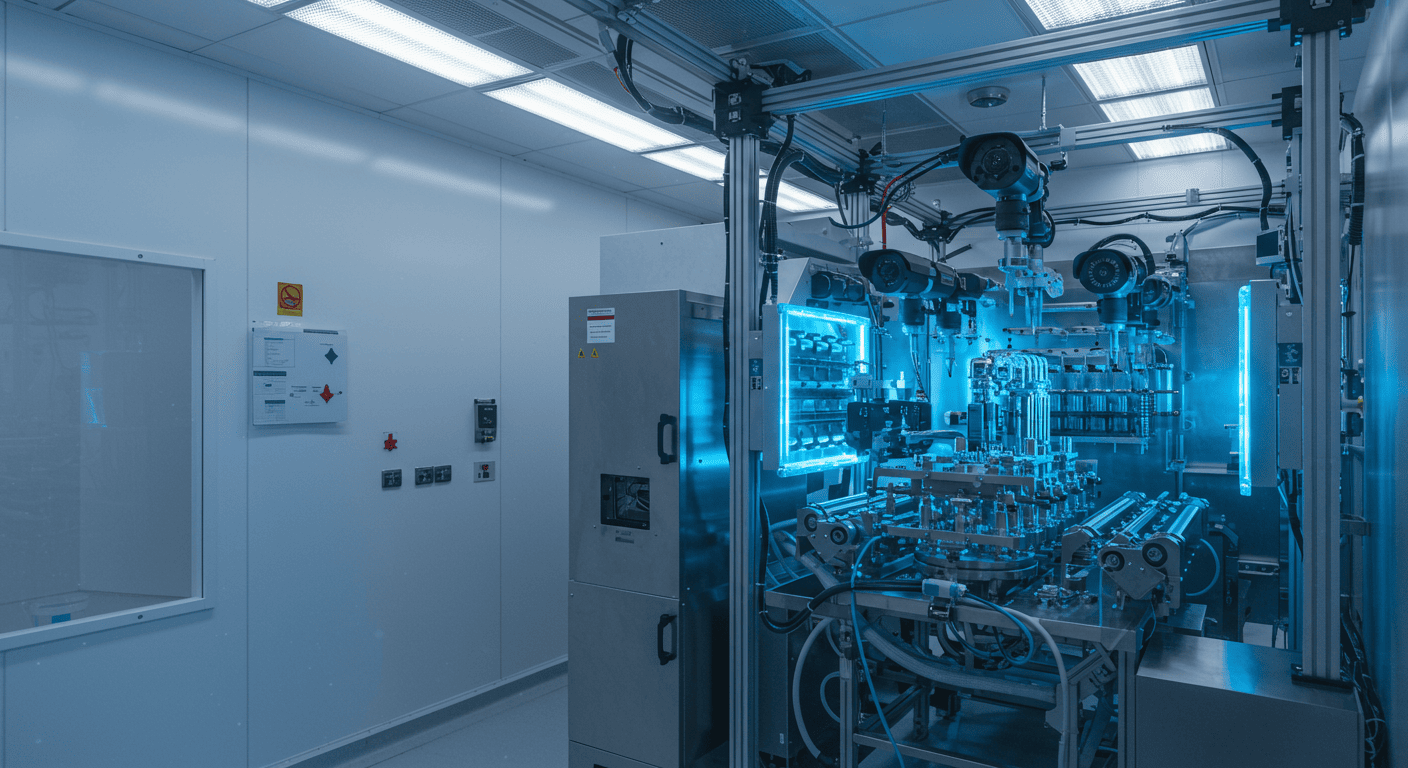
MST’s NeuroBox E5200V implements a dual-checkpoint detection strategy for CVD equipment, inserting inspection at two critical moments in the process sequence:
ProcessStart Checkpoint
When the equipment receives the process start command, E5200V performs an initial spray state verification: is the fluid path clear, is nozzle activation normal, does the initial spray pattern match the baseline profile? This checkpoint intercepts problems caused by residue from previous lots or equipment state drift before the wafer is exposed.
ProcessEnd Checkpoint
At process completion, E5200V re-examines the spray termination state and retrospectively reviews process-window frames for any anomalies. If a brief flow interruption occurred during the run, this checkpoint catches it before the wafer advances to the next operation — even if the interruption was too short to trigger real-time alarming.
This dual-checkpoint design provides both predictive detection at process entry and retrospective confirmation at process exit, covering the entire process window with a compact integration footprint.
Deployment Case: From Offline Validation to Production Integration
For a domestic semiconductor equipment manufacturer’s CVD tool program, MST adopted a phased validation approach that minimizes production integration risk:
Phase 1: Offline Validation
The customer’s engineering team extracted real flow interruption footage from historical maintenance records — videos documenting actual anomaly events captured during previous equipment troubleshooting. These covered a range of scenarios: complete flow cutoff, partial flow reduction, and intermittent interruption.
NeuroBox E5200V processed this footage in offline mode. All flow interruption events were correctly identified across the full anomaly spectrum, with false positive rates on normal spray footage held within acceptable limits.
This validation step is critical: the customer’s engineers confirmed the AI’s detection capability on real historical anomalies before committing to production deployment. There was no need to wait for new anomalies to occur on the production line to validate the system.
Phase 2: Production Line Integration
Following validation, E5200V was integrated with the equipment’s EAP via SECS/GEM interface. The system subscribes to ProcessStart and ProcessEnd events, processes real-time video from the chamber viewport camera, and sends alarm signals to the MES when flow interruption is detected.
The phased approach — validate on historical data, then integrate into production — is MST’s recommended deployment methodology for equipment vision applications. It separates the AI validation question from the system integration question, allowing both to be addressed in the right order.
Technical Implementation Notes
Video Stream Processing in Harsh Chamber Environments
CVD chamber optical conditions differ substantially from standard industrial vision environments: elevated temperatures, plasma luminescence, highly reflective chamber walls, and variable ambient lighting from process gases. E5500V’s vision models are trained and optimized specifically for semiconductor equipment chamber optics, maintaining stable detection performance under complex backgrounds that would challenge general-purpose vision systems.
Small Sample Learning
Flow interruption is a low-frequency anomaly under normal production conditions. Historical footage is limited. E5200V uses small-sample learning methodology: a customer-provided set of anomaly videos — typically ten to twenty clips — is sufficient for model training and validation. The system does not require months of production data accumulation before becoming operational.
Edge Inference
Video stream data volumes are high, and process checkpoint timing requirements are strict. E5200V performs all inference at the equipment edge, without cloud dependency. Inference latency is maintained at the millisecond level, meeting the real-time response requirements of process checkpoints in production environments.
Beyond Flow Interruption: Expanding Vision Coverage
CVD flow interruption detection represents one starting point for equipment vision intelligence. The same deployment architecture extends naturally to additional inspection scenarios:
- Post-PM chamber cleanliness confirmation: verify chamber wall condition before resuming production after preventive maintenance
- Wafer load state verification: confirm wafer position and seating are normal before process start
- Plasma color anomaly detection: infer process gas state from emission spectra during plasma processes
- Robot motion anomaly detection: position and velocity deviation during wafer transfer sequences
These scenarios share a common profile: visually detectable, not directly covered by inline metrology, high cost of post-process discovery. They represent the practical scope of equipment vision intelligence as a category — not a narrow solution to a single problem, but a systematic approach to closing the detection gap that metrology alone cannot cover.
Conclusion
The shift from post-process inspection to real-time process checkpoints is not an incremental efficiency improvement. It is a fundamental change in quality control architecture. When an anomaly is captured at the moment it occurs rather than discovered after the damage has propagated, the economics of semiconductor manufacturing change materially.
If your team is evaluating vision inspection solutions for CVD or other equipment types, MST’s engineering team is available to discuss your specific process environment and deployment requirements.
Deploy real-time AI process control with sub-50ms latency on your production line.