- →Why Is the SECS/GEM Driver Decision More Important Than It Appears?
- →What Open-Source SECS/GEM Options Are Available?
- →What Do Commercial SECS/GEM Drivers Offer?
- →How Do You Calculate the True Total Cost of Ownership?
- →When Does Open-Source Make Sense Despite Higher TCO?
Key Takeaway
Open-source SECS/GEM libraries (secsgem for Python, EquipmentModel.js) cost nothing to license but typically require 3-6 months and $100K-$300K in engineering effort to reach production quality. Commercial SECS/GEM drivers (Brooks/Cimetrix, Peer Group, SECS4NET) cost $15K-$80K per license but deploy in weeks with compliance testing included. For equipment OEMs shipping 10+ tools, commercial drivers have 40-60% lower 5-year TCO. For internal fab integration or R&D prototyping, open-source can be cost-effective if you have skilled C#/Python developers. NeuroBox includes production-grade SECS/GEM connectivity built in, eliminating the driver selection decision entirely.
Why Is the SECS/GEM Driver Decision More Important Than It Appears?
SECS/GEM drivers are the foundation of semiconductor equipment communication. Every data point that flows from equipment to MES, every recipe download, every remote command, and every alarm notification passes through the SECS/GEM driver layer. A failure in this layer does not degrade performance — it halts communication entirely, potentially stopping production.
Despite this criticality, SECS/GEM driver selection often receives less attention than it deserves. The decision is typically made by a software engineer or integration team lead, sometimes without full visibility into the long-term cost implications. This article provides a structured comparison to ensure the driver decision aligns with your organization’s total cost of ownership objectives.
What Open-Source SECS/GEM Options Are Available?
The open-source SECS/GEM ecosystem has grown significantly in recent years:
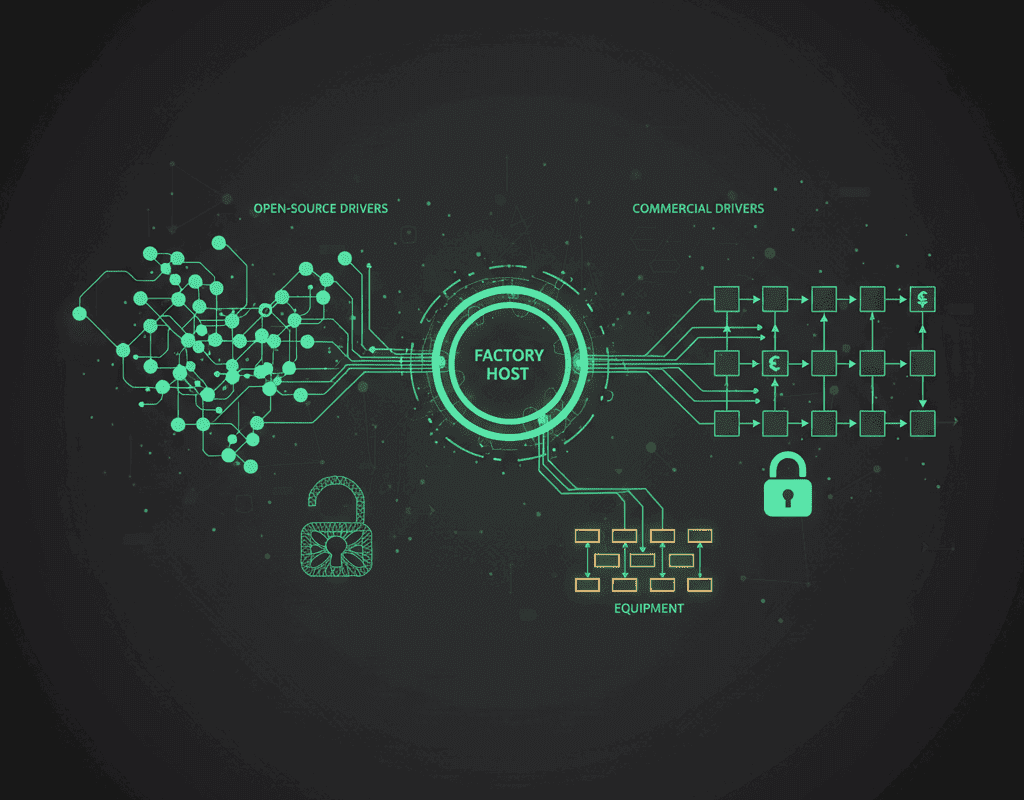
secsgem (Python): The most mature open-source SECS/GEM library, providing SECS-I and HSMS communication, SECS-II message encoding/decoding, and a basic GEM implementation. Available under LGPL license. Strengths: Python ecosystem integration, active community, good documentation for basic use cases. Limitations: performance constraints for high-throughput applications (Python GIL), incomplete GEM300 implementation, limited compliance testing against SEMI standards.
EquipmentModel.js (Node.js): A JavaScript-based SECS/GEM implementation targeting web-based equipment interfaces. Strengths: modern async architecture, easy web UI integration. Limitations: smaller community, less mature SECS-II implementation, not widely used in production semiconductor environments.
Various C/C++ Libraries: Several partial SECS/GEM implementations exist on GitHub in C and C++, often created as university projects or personal experiments. Most implement HSMS and basic SECS-II messaging but lack complete GEM state machine implementation. Use with extreme caution in production environments.
Common Open-Source Limitations: No compliance testing against SEMI E4/E5/E30/E37 standards, incomplete GEM state machine implementations (particularly around spooling, multi-block transfers, and error recovery), limited support for GEM300 extensions (E40 carrier management, E87 carrier tracking, E90 substrate tracking), and no vendor support or SLA guarantees.
What Do Commercial SECS/GEM Drivers Offer?
The commercial SECS/GEM driver market is served by several established vendors:
Cimetrix (now part of Brooks Automation): The market leader with CIMConnect SDK. Supports SECS-I, HSMS, complete GEM and GEM300 state machines. Available for Windows (.NET) and Linux. Pricing: $15K-$40K per development license plus per-unit royalties of $500-$2000 for equipment OEMs. Strengths: largest installed base, comprehensive compliance testing, extensive documentation, responsive support. Used by major equipment OEMs globally.
Peer Group (now part of Brooks Automation): PeerGEM SDK with similar capabilities to Cimetrix. Strong in the Asian market with Japanese and Korean language support. Pricing comparable to Cimetrix.
SECS4NET / Other .NET Libraries: Mid-market options providing SECS/GEM communication in .NET environments. Lower cost ($5K-$15K) with more limited GEM implementation scope. Suitable for simpler equipment interfaces that do not require full GEM300 compliance.
Ergo Tech / Midas: Regional vendors serving specific markets (Taiwan, Korea) with localized support and pricing. Often bundled with equipment integration services.
Common Commercial Advantages: SEMI compliance testing and certification documentation, complete GEM and GEM300 state machine implementation with all edge cases handled, professional support with SLAs (typically 24-48 hour response), regular updates for new SEMI standard revisions, and battle-tested reliability across thousands of production deployments.
How Do You Calculate the True Total Cost of Ownership?
The TCO comparison must account for all cost categories over a meaningful time horizon (we recommend 5 years):
Open-Source TCO Components:
Development effort to reach production quality: 2-4 engineer-months for basic HSMS/SECS-II ($40K-$100K in engineering cost). GEM state machine implementation and testing: 3-6 engineer-months ($60K-$150K). GEM300 implementation (if needed): additional 2-4 engineer-months ($40K-$100K). Compliance testing and documentation: 1-2 engineer-months ($20K-$50K). Ongoing maintenance and bug fixes: 0.25-0.5 FTE annually ($25K-$60K/year). Integration with new equipment types: 2-4 weeks per tool type ($10K-$25K each).
5-Year Open-Source TCO for Equipment OEM (shipping 20 tools/year): Initial development: $140K-$400K. Maintenance over 5 years: $125K-$300K. New tool type integration (5 types): $50K-$125K. Total: $315K-$825K
Commercial TCO Components:
Development license: $15K-$40K one-time. Per-unit royalty (20 tools/year x 5 years = 100 units): $50K-$200K total at $500-$2000/unit. Annual maintenance/support: $3K-$8K/year ($15K-$40K over 5 years). Integration effort (significantly reduced): 1-2 days per tool type ($2K-$5K each). Internal training: $5K-$10K one-time.
5-Year Commercial TCO for Equipment OEM (shipping 20 tools/year): License and royalties: $65K-$240K. Maintenance: $15K-$40K. Integration and training: $15K-$35K. Total: $95K-$315K
For equipment OEMs shipping 10+ tools annually, commercial drivers typically deliver 40-60% lower 5-year TCO. The crossover point where open-source becomes cheaper is approximately 5 or fewer tools total — essentially R&D or prototype environments.
When Does Open-Source Make Sense Despite Higher TCO?
There are legitimate scenarios where open-source SECS/GEM is the right choice:
R&D and Prototyping: University research labs, equipment startups building their first prototype, and innovation teams exploring SECS/GEM integration for the first time benefit from the zero-cost entry and learning flexibility of open-source libraries.
Custom Host Applications: Fabs building custom MES or data collection systems may prefer open-source drivers for maximum control over the communication layer. If you have experienced SECS/GEM developers in-house, the development effort is significantly reduced.
Specific Language Requirements: If your equipment software stack is built on Python or Node.js and you need native integration (not a separate service), open-source libraries in those languages offer the best path. Commercial drivers are predominantly Windows/.NET-based, though Linux support is improving.
Avoiding Vendor Lock-In: Some organizations prefer open-source to avoid dependency on a single commercial vendor, particularly for strategic communication infrastructure. The trade-off is accepting responsibility for maintenance, compliance, and support internally.
Is There a Third Option That Eliminates the Decision?
For organizations that need SECS/GEM connectivity as part of a broader AI and process control platform, integrated solutions eliminate the driver selection decision entirely.
NeuroBox E3200 and E5200 include production-grade SECS/GEM and OPC UA connectivity as built-in platform capabilities. The driver layer is not a separate purchase or integration project — it is part of the platform. Pre-built connectors for 50+ equipment types mean that most tools connect within hours of deployment, not weeks or months.
This integrated approach is particularly relevant for fabs and equipment OEMs whose primary objective is AI-driven process control, not SECS/GEM driver development. The driver is a means to an end — getting equipment data into AI models. Spending months developing or integrating a standalone driver delays the higher-value work of model development and process optimization.
For organizations that already have SECS/GEM infrastructure in place (existing MES with equipment connectivity), NeuroBox can also connect to the MES data layer rather than directly to equipment, leveraging existing driver investments.
The SECS/GEM driver decision should be evaluated in the context of your broader smart manufacturing strategy. If your end goal is AI-powered process control, an integrated platform that includes equipment connectivity may offer the fastest path to value — with the driver question answered as a built-in capability rather than a standalone procurement decision.
Discover how MST deploys AI across semiconductor design, manufacturing, and beyond.