- →Why Do Single-Product AI Companies Hit a Growth Ceiling?
- →What Makes a Platform Company Different from a Multi-Product Company?
- →How Is MST Building an AI Platform Across Three Dimensions?
- →What Are the Economic Advantages of the Platform Model?
- →How Does MST’s Three-Country Model Enable Platform Scale?
Key Takeaway
The most valuable AI companies in the world — Palantir ($250B+ market cap), ServiceNow, Snowflake — share one defining characteristic: they evolved from single products into interconnected platforms that become more valuable as customers adopt additional modules. MST is applying this same ecosystem strategy to industrial AI, operating five platforms across industrial, commercial, and consumer dimensions from three countries with 50+ enterprise customers. The platform approach creates compounding advantages in data, distribution, and customer retention that single-product AI companies cannot match — and it is increasingly what separates companies that scale from those that stall.
Why Do Single-Product AI Companies Hit a Growth Ceiling?
The AI industry is littered with companies that built excellent point solutions but struggled to grow beyond their initial market. The pattern is predictable: a startup develops a strong AI model for one specific use case — defect detection, demand forecasting, document classification — acquires early customers, achieves promising pilot results, and then discovers that scaling requires solving problems that have nothing to do with the AI model itself.
The challenges are structural. Single-product companies face high customer acquisition costs because every new sale requires educating a new buyer about a new category. They have limited pricing power because they solve one problem and must compete with other single-point tools on that specific function. They generate narrow data assets that improve only their one model rather than creating cross-functional intelligence. And they are vulnerable to platform players who can bundle equivalent functionality into a broader offering at marginal cost.
McKinsey’s 2025 analysis of 400 AI companies found that single-product AI companies achieved a median net revenue retention rate of 108%, while platform AI companies achieved 135%. The difference — 27 percentage points of annual revenue expansion from existing customers — compounds dramatically over time. After five years, the platform company’s revenue from a single cohort of customers is 2.3x larger than the single-product company’s, even with identical initial contract values.
What Makes a Platform Company Different from a Multi-Product Company?
The distinction between a platform and a collection of products is critical and often misunderstood. A multi-product company sells several separate tools that share a brand and a sales team but operate independently. A platform company builds interconnected products that share data, workflows, and infrastructure — creating value through their interactions that no individual product could generate alone.
Palantir is the canonical example. Foundry does not just sit alongside Gotham and Apollo — they share a common ontology layer that maps relationships between data objects across the entire enterprise. A customer using Foundry for supply chain optimization and Gotham for security operations gets a unified view of how supply chain disruptions create security vulnerabilities — an insight that neither product could produce independently. This interconnection is what makes Palantir’s platform exponentially more valuable than the sum of its parts.
ServiceNow followed the same trajectory. What began as an IT helpdesk tool evolved into a platform spanning IT operations, HR service delivery, customer service, and security operations. The common workflow engine and data model mean that an incident detected in IT security can automatically trigger an HR notification, a customer communication, and a compliance filing — across four products, in one automated sequence.
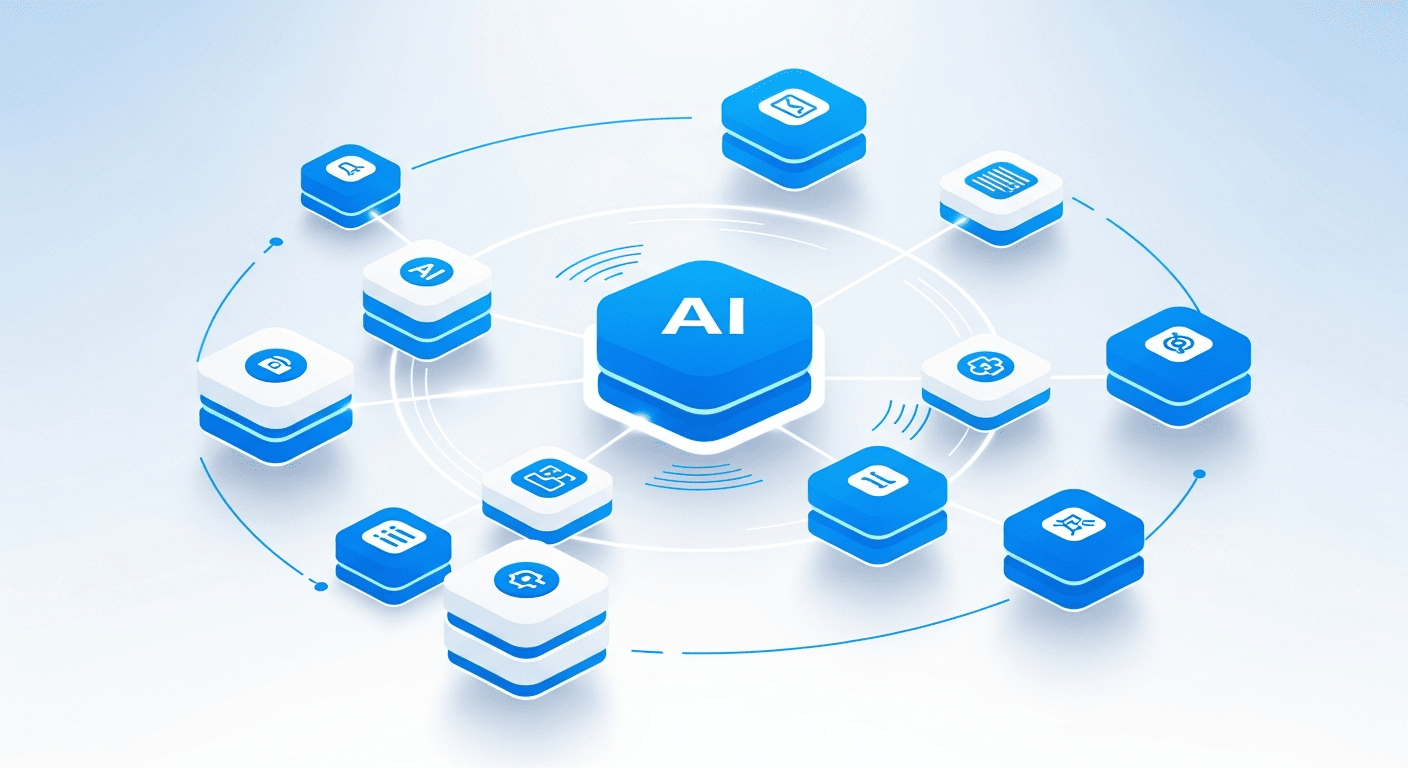
The pattern is consistent: platform companies build a shared technical foundation (data model, workflow engine, integration layer) and then deploy multiple application layers on top of it. Each new application enriches the shared foundation, which in turn makes every existing application more valuable.
How Is MST Building an AI Platform Across Three Dimensions?
MST’s platform strategy is distinctive because it spans not just multiple products but multiple market dimensions — industrial, commercial, and consumer — connected by shared AI infrastructure and a unified data philosophy.
Industrial dimension. Two platforms address the full lifecycle of industrial operations. NeuroBox (AI for Semiconductor) covers manufacturing execution — virtual metrology, run-to-run control, equipment intelligence, smart DOE, and energy management — deployed as edge AI systems directly on production lines. DrawingDiff (AI for Engineering) covers the upstream design phase — P&ID analysis, 3D drawing comparison, and engineering change management. Together, they span from facility design through commissioning to production optimization, creating a data continuum that no competitor currently matches.
Commercial dimension. Two platforms address business operations. BlogBurst.ai (AI for Marketing) provides AI-powered content generation and multi-platform distribution — essentially an AI virtual CMO that can produce and publish content across 9 platforms simultaneously. The Supply Chain Intelligence platform applies AI to supplier matching, procurement optimization, and cross-border trade operations. These commercial platforms generate revenue independently while also serving as distribution channels and data sources for MST’s industrial offerings.
Consumer dimension. MysticStage (AI for Entertainment) explores the intersection of AI and consumer engagement through Web3 gaming IP and interactive experiences. While earlier-stage than the industrial and commercial platforms, MysticStage provides MST with a consumer touchpoint and a testing ground for AI interaction models that can eventually inform industrial human-machine interfaces.
The five platforms share common AI infrastructure — model training pipelines, deployment frameworks, monitoring systems — which means improvements to core AI capabilities benefit all five simultaneously. A better computer vision model developed for DrawingDiff’s engineering drawing analysis can be adapted for NeuroBox’s visual inspection module. Natural language processing advances from BlogBurst.ai can improve the conversational interfaces of industrial products.
What Are the Economic Advantages of the Platform Model?
The platform approach creates four compounding economic advantages that fundamentally alter a company’s growth trajectory.
Cross-sell efficiency. Acquiring a new customer for a platform’s first product costs the same as acquiring them for a single-product company. But selling the second, third, and fourth product to that same customer costs 60–80% less because the relationship, trust, and technical integration already exist. MST’s experience confirms this: customers who adopt NeuroBox for production monitoring adopt DrawingDiff for design review at a 40% conversion rate within 18 months — at near-zero incremental acquisition cost.
Data network effects. Each platform generates data that improves the others. Manufacturing data from NeuroBox informs DrawingDiff’s understanding of which design parameters most impact production outcomes. Marketing performance data from BlogBurst.ai reveals which technical messages resonate with industrial buyers, improving MST’s own go-to-market for NeuroBox and DrawingDiff. These feedback loops create a data moat that deepens with every customer and every transaction.
Switching cost accumulation. A customer using one AI product can switch to an alternative with moderate effort. A customer using three interconnected AI products from the same platform — with shared data, integrated workflows, and trained teams — faces a switching cost that grows geometrically with each additional product adopted. Palantir’s 98% customer retention rate is not primarily a function of product quality; it is a function of integration depth.
Valuation premium. Public markets consistently value platform AI companies at 15–25x revenue, compared to 6–10x for single-product AI companies. The rationale is straightforward: platforms have higher revenue visibility (driven by cross-sell and retention), lower marginal costs (driven by shared infrastructure), and stronger competitive moats (driven by data and integration effects). For MST and its investors, the platform strategy is not just an operational choice — it is a value creation multiplier.
How Does MST’s Three-Country Model Enable Platform Scale?
A global AI platform cannot be built from a single location. Different markets have different strengths, and the optimal strategy is to locate each function where it has the greatest advantage. MST’s three-country operating model reflects this principle.
Singapore serves as corporate headquarters and strategic center. It provides geopolitical neutrality for serving customers in both Eastern and Western markets, access to Southeast Asian growth markets, and a regulatory environment designed for global technology companies. Singapore is where MST’s platform strategy is coordinated, investor relationships are managed, and global partnerships are structured.
Shanghai is the R&D engine, particularly for semiconductor AI. China has the world’s largest concentration of semiconductor fabs and the deepest pool of engineers experienced in semiconductor process control. MST’s Shanghai team develops the core AI models for NeuroBox, conducts on-site deployments at Chinese fabs, and generates the training data that powers the entire industrial AI platform. With over 50 enterprise customers primarily in the Chinese semiconductor ecosystem, Shanghai is where MST’s platform proves its value at scale.
The United States provides market access to the world’s most valuable engineering services and technology markets. DrawingDiff operates from the U.S. to serve American EPC firms, semiconductor fab construction projects triggered by the CHIPS Act, and the broader $372 billion U.S. engineering services sector. The U.S. presence also validates MST as a global company — a requirement for institutional investors and multinational customers who expect their AI partners to have feet on the ground in major markets.
This distributed model means MST can develop AI where the talent and data are strongest (Shanghai), commercialize where the markets are largest (U.S. and China), and govern from where the strategic flexibility is greatest (Singapore). It is the same model that enabled companies like Grab, Sea Group, and Flex to build multi-billion-dollar platforms from Singapore — applied to the AI infrastructure sector.
What Can Other AI Companies Learn from the Platform Playbook?
The transition from single product to platform is the most consequential strategic decision an AI company will make, and the timing matters as much as the direction. Companies that attempt platform expansion too early — before achieving product-market fit in their initial vertical — dilute focus and burn capital. Companies that wait too long find that competitors have already occupied adjacent positions and customer relationships have calcified around point solutions.
The optimal path, demonstrated by Palantir, ServiceNow, and now MST, follows a consistent sequence: dominate a specific use case, build a technical foundation that is generalizable beyond that use case, expand into adjacent problems that share the same customer or data environment, and invest in the shared infrastructure that connects everything.
MST’s journey illustrates this progression. The company began with NeuroBox — a focused edge AI solution for semiconductor virtual metrology. Success with 50+ customers generated both the revenue to fund expansion and the domain expertise to identify adjacent opportunities. DrawingDiff extended upstream into engineering design. BlogBurst.ai addressed a universal business need (marketing) while serving as a distribution platform for MST’s own content. Each expansion was deliberate, funded by existing operations, and connected to the platform’s shared AI infrastructure.
For investors evaluating AI companies, the platform question is a useful filter. Ask not just whether the company has a strong product, but whether it has the architecture, the market position, and the strategic vision to become a platform. The single-product companies of today are the acquisition targets of tomorrow. The platform companies are the acquirers — and the ones that define how AI reshapes entire industries.
Discover how MST deploys AI across semiconductor design, manufacturing, and beyond.