- →Why Are Traditional Component Libraries Failing Equipment Design Teams?
- →What Does an Intelligent Parts Database Look Like?
- →How Does AI Transform a Parts Database Into a Design Decision Engine?
- →What Does It Take to Build an Intelligent Parts Database?
- →What ROI Can Companies Expect From an Intelligent Parts Database?
Key Takeaway
Traditional component libraries store geometry. Intelligent parts databases store engineering knowledge: application constraints, compatibility rules, procurement data, and usage patterns. Companies that transform their parts libraries into AI-powered knowledge systems reduce component selection errors by 60-75% and cut BOM generation time by 80%. This infrastructure is also the foundation that enables AI design automation platforms to generate accurate assemblies.
Why Are Traditional Component Libraries Failing Equipment Design Teams?
Every semiconductor equipment company maintains a component library. It is the collection of 3D models, 2D drawings, and specification sheets for the valves, fittings, instruments, and other parts that go into their equipment. In most companies, this library lives in a PDM system (SolidWorks PDM, Teamcenter, Windchill) and contains anywhere from 2,000 to 15,000 part records.
The problem is not that the library exists. The problem is what it does not contain. A traditional component library answers one question: what does this part look like in 3D? It does not answer the questions that designers actually need during the design process: Can this valve be used with chlorine gas? What is the lead time from Swagelok versus Parker for this fitting? What is the maximum operating temperature? Has this part ever caused a field failure? What did we use last time we designed a similar gas stick?
A 2024 study of engineering workflows at 31 equipment OEMs found that designers spend an average of 38 minutes per component selection decision when working with traditional libraries. This time is consumed by searching the library for candidate parts, opening vendor catalogs to verify specifications, checking procurement databases for availability and cost, consulting colleagues about past experience with specific parts, and cross-referencing process requirements to ensure material compatibility.
For a 200-component gas panel, that is approximately 126 hours spent on component selection alone (not all components require a full 38-minute decision, but many complex components require more). This is time that produces no 3D geometry, no drawings, and no tangible design output. It is pure information gathering that could be dramatically compressed with better data infrastructure.
What Does an Intelligent Parts Database Look Like?
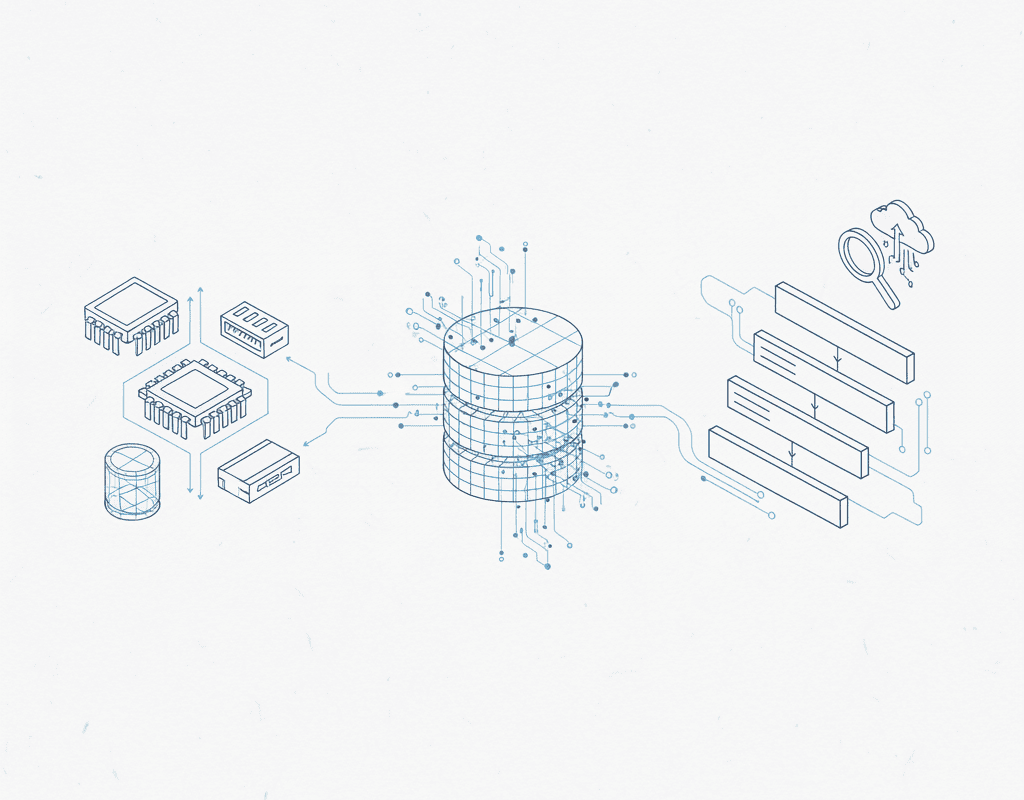
An intelligent parts database extends the traditional 3D model library with structured engineering knowledge organized into several layers:
Physical specifications layer. Beyond basic dimensions, this includes pressure-temperature ratings at specific conditions, material certifications (with actual mill cert data, not just material designations), surface finish specifications (critical for semiconductor-grade components), connection types and sizes, weight, and envelope dimensions including actuator and handle clearances.
Application compatibility layer. This is the most valuable and least commonly maintained layer. For each component, it records which process gases and chemicals it is approved for, temperature and pressure limits for each gas service (which may differ from the generic rating), compatibility with adjacent components (e.g., mixing brass and stainless steel in certain gas services), and any customer-specific restrictions (some fabs prohibit certain vendors or material grades).
Procurement intelligence layer. Current pricing from qualified vendors (updated quarterly or on-demand), lead times by vendor and region, minimum order quantities, alternative parts that are functionally equivalent, and historical purchase volumes and pricing trends. This data enables automated BOM costing and procurement optimization.
Usage history layer. How many times this part has been used in past designs, which product lines it appears in, any field performance issues (failure rates, warranty claims, customer complaints), and engineering change orders that have affected the part specification. This historical data is invaluable for risk assessment during component selection.
Design context layer. Standard sub-assemblies (gas sticks, manifold blocks) that this component typically appears in, preferred mounting orientations, required clearance envelopes for maintenance, and connection sequence requirements for assembly. This data enables automated assembly generation systems to place components correctly without human intervention.
How Does AI Transform a Parts Database Into a Design Decision Engine?
With structured data across all five layers, AI can automate the component selection process that currently consumes 38 minutes per decision:
Constraint-based filtering. Given a position in the process flow (from the P and ID), the AI automatically identifies the process conditions at that point (gas type, pressure, temperature, flow rate) and filters the component database to show only parts that are rated for those conditions. This eliminates the most common source of component selection errors: choosing a part that meets most but not all process requirements.
Preference-weighted ranking. Among the technically valid options, the AI ranks alternatives based on the companys historical preferences, procurement considerations (cost, lead time, vendor reliability), and standardization goals (preferring parts already used elsewhere in the same project to reduce BOM complexity). This ranking mimics the decision process of an experienced designer who knows which parts the company likes and why.
Automatic alternative identification. When a preferred part is unavailable or has extended lead time, the AI identifies functionally equivalent alternatives from the database, highlighting any specification differences that the engineer should evaluate. This reduces the procurement disruptions that frequently delay equipment delivery.
BOM generation with procurement data. Once components are selected, the AI generates a complete BOM with vendor part numbers, quantities, unit costs, lead times, and total costs. This BOM is immediately actionable by procurement, not a design-side document that requires manual translation.
NeuroBox D integrates this intelligent parts database as a core subsystem. When the platform generates a 3D assembly from a P and ID, every component selection is made against the full database, ensuring that the generated design uses approved parts, meets process specifications, and reflects the companys procurement preferences. This is a fundamental difference from manual design, where the quality of component selection depends entirely on the individual designers knowledge and diligence.
What Does It Take to Build an Intelligent Parts Database?
Transforming a traditional component library into an intelligent parts database is a structured but significant undertaking. Based on implementation experience across multiple equipment companies, here is what the process involves:
Phase 1: Data audit and gap analysis (2-4 weeks). Inventory the existing library: how many parts, what data is available for each, what is missing. Typical findings: 3D models exist for 70-85% of commonly used parts, physical specifications are complete for 60-75%, application compatibility data exists for only 20-35%, and procurement data is in a separate system with no linkage to the engineering library.
Phase 2: Core data enrichment (8-16 weeks). Fill the critical gaps for the most commonly used components (typically the top 500-800 parts that account for 90% of usage). Sources include vendor technical datasheets, internal material compatibility databases, procurement system exports, and field service records. This phase is labor-intensive but can be partially automated: AI can extract specifications from vendor PDFs and populate structured database fields, reducing manual data entry by 50-60%.
Phase 3: Application rules encoding (4-8 weeks). Work with senior process engineers to codify the application rules that govern component selection. Which valves for which gas services? What material grades for what temperature ranges? Which vendors are preferred for which component types? This knowledge currently resides in peoples heads and needs to be externalized into the database as structured rules.
Phase 4: Integration and validation (4-6 weeks). Connect the intelligent parts database to the design workflow, whether that means integration with SolidWorks, with an AI assembly generation platform, or with the procurement system. Validate the database against recent design projects: would the AI-selected components match what the designers actually chose? Discrepancies reveal either database gaps or opportunities to improve standardization.
Total timeline: 18-34 weeks for a company with a 5,000-part library. Total investment: typically $150K-350K in engineering time and tools, depending on the starting condition of the existing library and the level of application data that needs to be captured.
What ROI Can Companies Expect From an Intelligent Parts Database?
The return on investment comes from multiple sources:
Component selection time reduction: 70-85%. With AI-powered selection, the average decision time drops from 38 minutes to 6-10 minutes (primarily review and confirmation of the AI recommendation). For a company executing 40 projects per year with 200 components each, this saves approximately 3,700 engineering hours annually.
Component selection error reduction: 60-75%. Automated specification matching eliminates the most common error type: selecting a component that does not meet all process conditions. This reduces downstream rework costs by $180K-420K annually for a typical mid-sized OEM.
BOM accuracy improvement. Automated BOM generation with current procurement data reduces BOM errors from an industry average of 4.2% to below 0.5%. Fewer BOM errors mean fewer procurement disruptions, fewer assembly delays, and fewer expedited shipping charges.
Standardization improvement. The AI naturally drives standardization by preferring parts already in the database over novel selections. Companies report 15-25% reduction in unique part numbers used across projects within the first year, which simplifies procurement, reduces inventory carrying costs, and improves spare parts availability.
AI design automation enablement. This is the strategic payoff. An intelligent parts database is the prerequisite for AI-driven assembly generation. Without it, AI systems cannot make reliable component selections. With it, they can generate complete, accurate assemblies that reflect the companys engineering knowledge and procurement reality.
Where Should Equipment Companies Start?
Audit your current library coverage and quality. You cannot improve what you have not measured. Count your parts, assess data completeness by layer, and identify the top 500 parts by usage frequency.
Start with application compatibility data. This is the highest-value, most-neglected data layer. Even partial coverage of your top components will immediately reduce selection errors.
Connect engineering and procurement data. The separation between design libraries and procurement systems is one of the most common and costly data silos in equipment manufacturing. Even a simple linkage between part numbers and current pricing/lead times provides immediate value.
Plan for AI integration from the start. Structure your data with machine readability in mind. Use consistent units, standardized material designations, and structured fields rather than free-text notes. This investment in data quality pays dividends when you implement AI-assisted design tools.
The component library is the most underleveraged asset in most equipment companies. It already contains thousands of hours of engineering knowledge but in a form that is largely inaccessible to automated systems. Converting this asset from a geometry warehouse into an intelligent design knowledge base is the single highest-impact infrastructure investment an equipment company can make for both near-term productivity improvement and long-term AI readiness.
Still designing assemblies manually?
NeuroBox D converts your P&ID into a complete SolidWorks assembly — in hours, not days. See how it works with your own designs.
See how NeuroBox D converts P&ID to native SolidWorks assemblies in hours, not weeks.