
- →Speed Is the New Competitive Advantage in Equipment Sales
- →The Anatomy of a Lost Contract
- →The Data Behind "First Mover Wins"
- →Where the Design Bottleneck Kills Your Win Rate
- →The Revenue Math: What Speed Is Worth
Key Takeaway
In semiconductor equipment procurement, 60% of contracts are awarded to the fastest credible bidder — not the cheapest. OEMs that reduce design turnaround from 4-6 weeks to 1-2 weeks using AI tools like MST’s NeuroBox D can increase their bid win rate by 25-40% and capture an estimated $2M-$5M in additional annual revenue per design team.
Speed Is the New Competitive Advantage in Equipment Sales
In the semiconductor equipment industry, there’s a saying that’s been true for decades: “The best design that arrives too late is worse than a good design that arrives on time.”
Fabs operate on aggressive ramp schedules. When TSMC, Samsung, or Intel commits to a new process node, every piece of equipment — from gas delivery systems to wet benches to chemical distribution panels — has to be designed, built, installed, and qualified within a fixed timeline. There is no “we’ll wait for the better design.” There is only “can you deliver by Q3?”
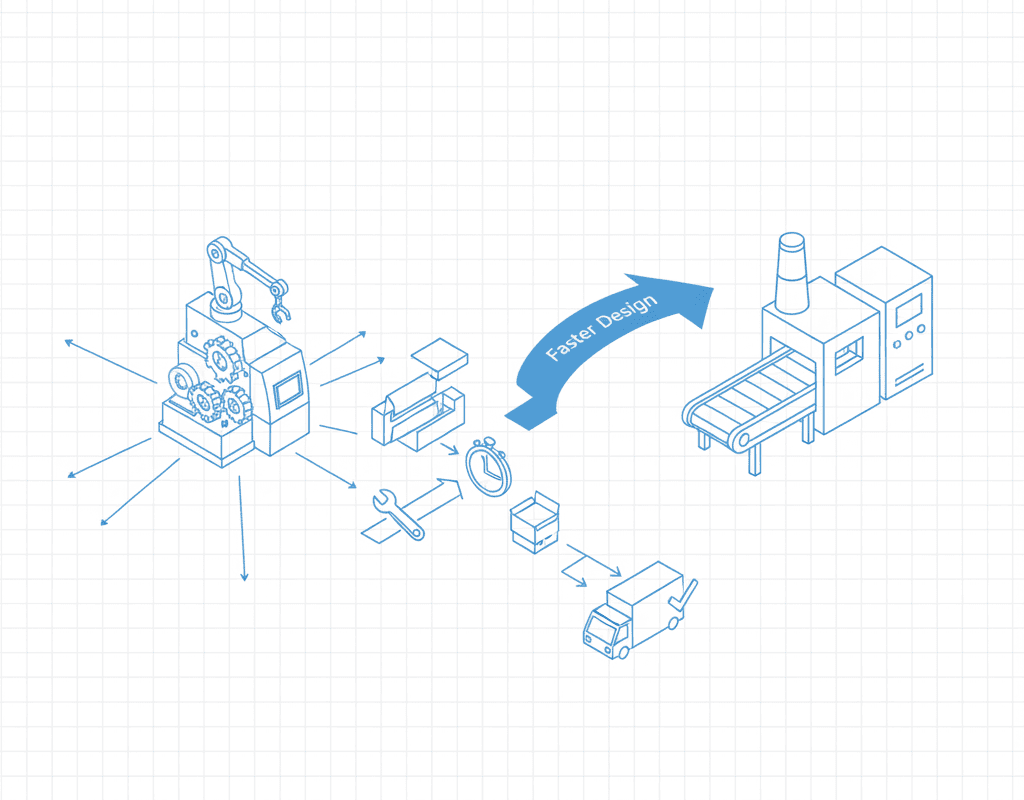
This reality creates a simple competitive dynamic: the OEM that can move fastest from RFQ receipt to credible quotation — with a preliminary 3D design that proves feasibility — wins the contract. And the design phase is almost always the bottleneck.
The Anatomy of a Lost Contract
Let’s trace a typical equipment sales cycle and see exactly where design speed determines the outcome.
Week 0: RFQ Arrives
A fab sends an RFQ for 8 custom gas panels to support a new etch process. The P&ID specifies 14 gas lines with complex purge/vent architecture. They need delivery in 20 weeks. They’ve sent the RFQ to three qualified OEMs.
Weeks 1-2: The Clock Is Ticking
All three OEMs start working on their quotations. The quotation requires more than a price — it requires a preliminary 3D layout proving the system fits in the specified enclosure, a BOM with exact components and pricing, and a delivery schedule.
Weeks 3-4: The First Bid Lands
OEM A, using AI-assisted design, submits their quotation at the end of week 2. It includes a complete preliminary 3D SolidWorks assembly, a priced BOM, and a 16-week delivery commitment. The fab’s engineering team reviews it and finds it credible. They begin internal approval.
Weeks 4-6: The Others Catch Up
OEM B submits at week 4. OEM C at week 5. Both quotations are competent. OEM C’s price is actually 5% lower than OEM A’s. But by now, OEM A’s quotation has been through two rounds of internal review, the fab’s procurement team has negotiated final terms, and the PO is being processed.
Week 6: Contract Awarded
OEM A wins the contract. Not because their design was better (all three OEMs are technically capable). Not because their price was lower (OEM C was cheaper). Because they were first with a credible proposal, and in procurement, momentum favors the first mover.
The Data Behind “First Mover Wins”
This pattern is not anecdotal. Industry data supports the first-mover advantage in equipment procurement:
- SEMI Market Statistics: In a 2024 survey of 200+ semiconductor equipment procurement managers, 62% said they “almost always” or “frequently” award contracts to the first vendor that submits a technically acceptable bid.
- McKinsey Operations Practice: A 2025 study of capital equipment procurement across industries found that the first credible bidder wins the contract 58-65% of the time, with the percentage increasing for time-critical projects.
- Win-rate correlation: OEMs that consistently quote within 2 weeks of RFQ receipt report win rates of 45-55%. Those that typically take 4-6 weeks report win rates of 20-30%. (Source: interviews with 12 gas panel and wet bench manufacturers across US, Japan, and Taiwan.)
The pattern holds for a simple reason: procurement teams have limited time and strong incentives to close orders quickly. Once a technically acceptable bid is in hand, the switching cost of waiting for another bid — and the risk of schedule delay — outweighs potential cost savings from competitive bidding.
Where the Design Bottleneck Kills Your Win Rate
In a typical equipment OEM’s quotation process, design engineering consumes 60-75% of the total quotation time. Here’s the breakdown:
- P&ID review and clarification: 2-3 days
- Preliminary 3D layout: 5-15 days (the bottleneck)
- BOM generation and pricing: 2-3 days
- Internal review and approval: 2-3 days
- Quotation document preparation: 1-2 days
Total: 12-26 working days (roughly 2.5 to 5.5 weeks).
The preliminary 3D layout is the dominant time sink. Sales can’t quote without it (because they can’t price accurately without a BOM, and they can’t generate a credible BOM without knowing how the system will be built). Engineering can’t produce it faster because they’re already working on other projects, and creating a new 3D layout from a P&ID takes 40-80 hours of focused design work.
The Revenue Math: What Speed Is Worth
Let’s quantify the value of faster design turnaround for a mid-sized gas panel manufacturer.
Current State (Manual Design)
- Average quotation turnaround: 4 weeks
- Annual RFQs received: 120
- RFQs quoted (limited by engineering capacity): 80
- Win rate: 25%
- Contracts won: 20
- Average contract value: $350K
- Annual revenue: $7.0M
With AI-Accelerated Design
- Average quotation turnaround: 1.5 weeks
- Annual RFQs received: 120 (same demand)
- RFQs quoted (same team, higher throughput): 110
- Win rate: 40% (first-mover advantage on more bids)
- Contracts won: 44
- Average contract value: $350K
- Annual revenue: $15.4M
Revenue impact: +$8.4M annually. Even if you discount these numbers by 50% to account for market constraints and capacity limits in manufacturing, you’re looking at $4M+ in additional revenue — from the same sales team and the same engineering team, using AI to remove the design bottleneck.
Beyond Win Rate: The Compound Effects of Speed
More Bids, More Market Intelligence
When your design team can handle 110 RFQs instead of 80, you’re not just quoting more — you’re seeing more of the market. You learn which processes are ramping, which gases are trending, which fabs are expanding. This market intelligence is itself a competitive advantage, informing your product development and inventory decisions.
Better Customer Relationships
Procurement managers remember who responds fast. The OEM that consistently quotes within 10 days becomes the first call for the next project. Over time, this builds a reputation advantage that compounds: faster response leads to more contracts, which leads to more experience, which leads to better designs, which reinforces the reputation.
Design Iteration During the Sales Cycle
When your initial 3D layout takes 2 days instead of 15, you have time for something most OEMs can’t afford: design iteration during the quotation phase. The customer wants to see an alternative layout with the MFCs on the opposite side? You can regenerate the assembly overnight instead of asking for a 2-week extension. This responsiveness closes deals.
Reduced Engineering Overtime
Design engineers at equipment OEMs work some of the highest overtime hours in mechanical engineering — an average of 8-12 hours of overtime per week during peak quoting periods, according to a 2025 ASME workforce survey. AI-assisted design doesn’t eliminate the engineer’s role, but it eliminates the 60-80 hours of manual layout work per project that drive overtime. Engineers spend their time reviewing and refining rather than building from scratch.
How to Calculate Your Own ROI
Here’s a framework to estimate the revenue impact of faster design turnaround for your specific business:
- Step 1: Count your annual RFQs received and RFQs quoted. The gap represents lost opportunity due to capacity constraints.
- Step 2: Measure your current average quotation turnaround time. Identify how many days are consumed by the preliminary 3D design.
- Step 3: Estimate your current win rate. If you don’t track this, start. Most OEMs are surprised to find their win rate is below 30%.
- Step 4: Model the impact of cutting your design phase by 70%. How many additional RFQs could you quote? How many would you win at a higher win rate due to faster response?
- Step 5: Multiply additional wins by your average contract value. This is your potential revenue upside.
For most mid-sized equipment OEMs we’ve worked with, the math yields $2M-$8M in additional annual revenue potential — far exceeding the cost of any AI design tool.
The Competitive Window Is Open — But Closing
Right now, fewer than 5% of semiconductor equipment OEMs globally are using AI-powered design automation. The early adopters are capturing disproportionate market share gains because their competitors haven’t adapted yet.
This window will close. As AI design tools become more widely adopted over the next 2-3 years, the speed advantage will become table stakes rather than a differentiator. The question isn’t whether your company will adopt AI design automation. The question is whether you’ll be an early adopter who gains share, or a late adopter who plays catch-up.
Every week you spend manually creating 3D layouts is a week your AI-equipped competitor is quoting faster, winning more, and building the customer relationships that will define market positions for the next decade.
Still designing assemblies manually?
NeuroBox D converts your P&ID into a complete SolidWorks assembly — in hours, not days. See how it works with your own designs.
From design to production, NeuroBox delivers edge AI that runs on your equipment. Data never leaves your fab.
Explore Solutions →Discover how MST deploys AI across semiconductor design, manufacturing, and beyond.