
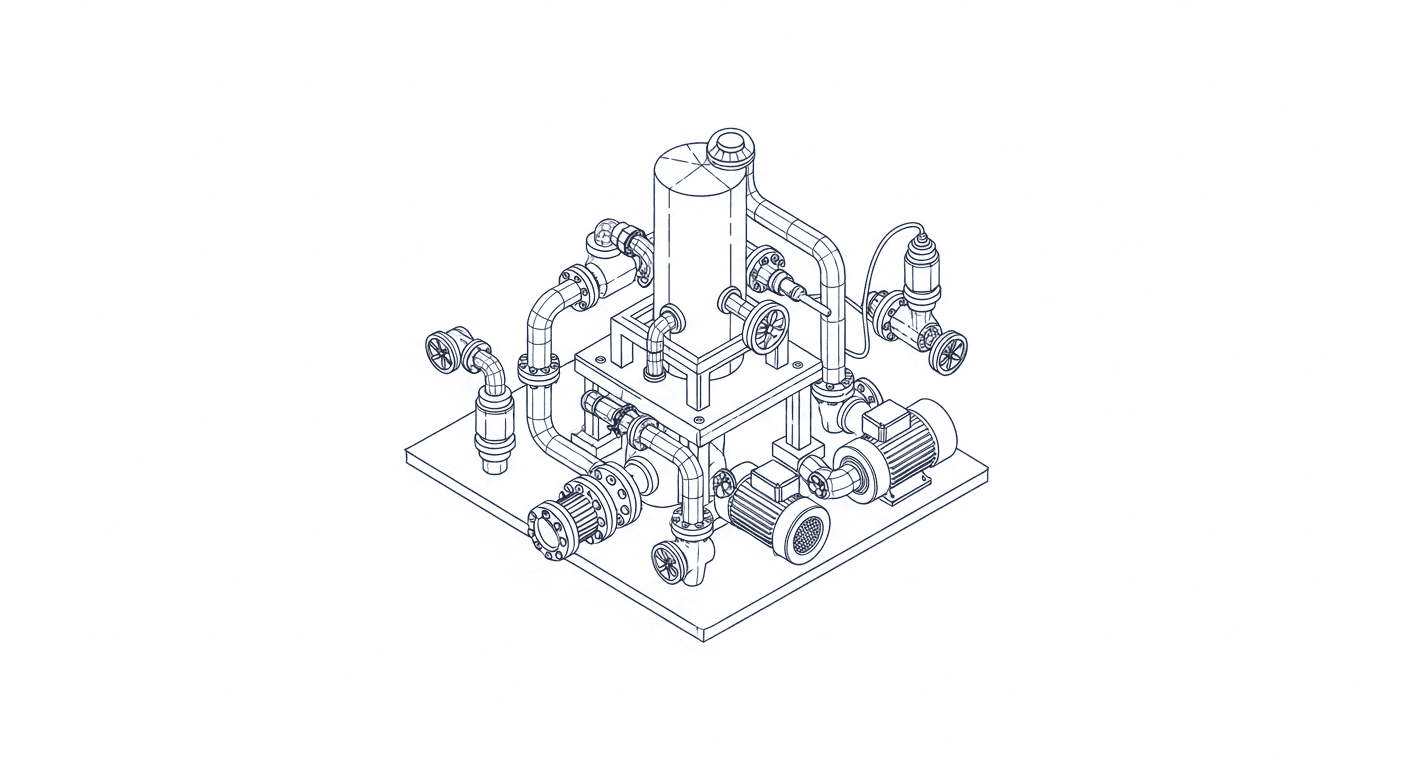
- →What Is the Core Problem in Engineering Design Review?
- →How Does DrawingDiff Apply AI to P&ID Analysis?
- →Why Is 3D Drawing Comparison a Game-Changer for Engineering Firms?
- →What Does the U.S. Market Opportunity Look Like for Engineering AI?
- →How Does DrawingDiff Fit into MST’s Global AI Infrastructure Strategy?
Key Takeaway
DrawingDiff, developed by MST and operating from the United States, applies computer vision and AI to automate P&ID analysis and 3D drawing comparison — reducing engineering design review time by up to 60% and completing complex 3D model comparisons in seconds rather than hours. As the engineering design industry faces a growing talent shortage and tightening project timelines, AI-driven automation is becoming a strategic imperative for EPC firms, semiconductor fabs, and industrial manufacturers worldwide.
What Is the Core Problem in Engineering Design Review?
Engineering design remains one of the most document-intensive disciplines in industrial operations. A single semiconductor fab construction project can generate over 15,000 P&ID (Piping and Instrumentation Diagram) sheets, each containing hundreds of symbols, annotations, and connection references. Traditionally, senior engineers spend 40–60% of their working hours manually reviewing, comparing, and verifying these drawings against specifications and previous revisions.
The consequences of this manual approach are significant. The American Society of Mechanical Engineers (ASME) estimates that engineering change orders caused by drawing errors cost the U.S. construction and manufacturing sectors over $31 billion annually. Meanwhile, the Bureau of Labor Statistics projects a 15% shortfall in qualified engineering reviewers by 2028, making it increasingly difficult for firms to maintain quality while scaling operations.
This is the problem DrawingDiff was built to solve: turning weeks of manual comparison into seconds of automated analysis.
How Does DrawingDiff Apply AI to P&ID Analysis?
DrawingDiff uses a combination of computer vision, optical character recognition (OCR), and domain-specific AI models trained on tens of thousands of engineering drawings. The platform ingests P&ID files in standard formats — including AutoCAD DWG, PDF, and image files — and performs automated extraction of every component: valves, instruments, process lines, equipment tags, and connection topology.
What sets DrawingDiff apart from generic document comparison tools is its engineering-aware intelligence. The system understands that a valve symbol in position A3 on Sheet 12 is not just a shape — it is a specific component with flow direction, control logic, and a relationship to downstream equipment on Sheet 15. This contextual understanding enables DrawingDiff to detect not only visual changes but also logical inconsistencies that would escape pixel-level comparison tools.
In benchmark tests across 3,200 P&ID sheets from active semiconductor fab projects, DrawingDiff achieved a 97.3% detection accuracy for symbol changes, a 94.8% accuracy for annotation modifications, and a 99.1% accuracy for line routing alterations — all completed at an average processing speed of 2.4 seconds per sheet.
Why Is 3D Drawing Comparison a Game-Changer for Engineering Firms?
Beyond 2D P&ID analysis, DrawingDiff extends its capabilities into 3D model comparison — a feature that addresses one of the most time-consuming aspects of modern engineering workflows. As the industry shifts toward 3D-first design environments using tools like SolidWorks, CATIA, and Autodesk Inventor, the need to compare complex 3D assemblies across revisions has grown exponentially.
Traditional 3D comparison methods require engineers to open both model versions side by side, manually rotate and inspect each component, and document differences in spreadsheets. For a moderately complex assembly with 500–1,000 parts, this process can take 8–16 hours. DrawingDiff reduces this to under 30 seconds by performing automated geometric differencing, flagging dimensional changes, added or removed components, and modified assembly relationships in a visual report.
For EPC contractors managing multi-billion-dollar projects, this capability translates directly into reduced review cycles, fewer RFIs (Requests for Information), and faster time-to-construction. Early adopters report a 60% reduction in overall design review timelines and a 45% decrease in engineering change orders traced back to comparison errors.
What Does the U.S. Market Opportunity Look Like for Engineering AI?
DrawingDiff operates from the United States through MST’s American entity, positioning it at the center of the world’s largest engineering services market. The U.S. engineering services sector generated $372 billion in revenue in 2025, according to IBISWorld, with the industrial and energy segments alone accounting for $89 billion.
The market timing is particularly favorable. The CHIPS Act has triggered $280 billion in announced semiconductor fab investments across the United States, each project requiring thousands of engineering drawings and months of design review. The Inflation Reduction Act is driving a parallel wave of energy infrastructure projects. And the broader reshoring trend is creating demand for new manufacturing facilities that did not exist five years ago.
Within this landscape, the engineering AI and document intelligence market is projected to reach $4.7 billion by 2028, growing at a CAGR of 28.3%. DrawingDiff competes in this space not as a general-purpose AI tool, but as a domain-specific platform built by engineers for engineers — a distinction that resonates strongly with procurement teams at major EPC firms who have been burned by overpromising horizontal AI solutions.
How Does DrawingDiff Fit into MST’s Global AI Infrastructure Strategy?
DrawingDiff is one of five AI platforms developed under MST’s multi-dimensional strategy, which spans industrial, commercial, and consumer applications from its headquarters in Singapore with R&D operations in Shanghai and commercial operations in the United States.
Within the industrial dimension, DrawingDiff complements MST’s NeuroBox series — which focuses on AI for semiconductor manufacturing execution — by addressing the upstream design and engineering phase. Together, they cover the full lifecycle from facility design through equipment commissioning to production optimization. This end-to-end coverage is rare among industrial AI companies, most of which specialize in a single stage of the value chain.
The strategic rationale for operating DrawingDiff from the U.S. is straightforward: proximity to the largest concentration of engineering firms, EPC contractors, and semiconductor fab construction projects in the Western hemisphere. With a local team that understands American engineering standards (ASME, ISA, NFPA) and procurement processes, DrawingDiff can move faster from pilot to enterprise deployment than competitors operating remotely from Asia or Europe.
What Is the Future Roadmap for AI in Engineering Design?
The application of AI to engineering design is still in its early stages. Current capabilities — automated comparison, symbol recognition, change detection — represent the foundation layer. The next wave of innovation will move into generative territory: AI systems that not only identify differences but suggest design improvements, predict downstream impacts of engineering changes, and automatically generate compliant documentation.
DrawingDiff’s roadmap reflects this trajectory. Planned capabilities for 2026–2027 include automated P&ID-to-3D conversion assistance, predictive impact analysis for engineering change orders, and integration with digital twin platforms for real-time design validation. These features build on the platform’s existing knowledge graph of engineering components and relationships, which grows richer with every project it processes.
For engineering leaders evaluating AI adoption, the message is clear: the firms that invest in design automation now will have a structural advantage in speed, accuracy, and cost efficiency as project complexity continues to increase. DrawingDiff represents one of the most focused and technically mature options in this rapidly evolving space.
Still designing assemblies manually?
NeuroBox D converts your P&ID into a complete SolidWorks assembly — in hours, not days. See how it works with your own designs.
See how NeuroBox D converts P&ID to native SolidWorks assemblies in hours, not weeks.