- →Why Is the Semiconductor Supply Chain So Vulnerable to Disruption?
- →How Does AI Transform Semiconductor Procurement?
- →What Does AI-Optimized Logistics Look Like in Practice?
- →How Does AI Address Export Control Compliance?
- →Why Does Singapore's Position Matter for Supply Chain AI?
Key Takeaway
The semiconductor supply chain spans 70+ border crossings per chip, creating massive inefficiency in procurement, logistics, and compliance. MST’s AI-powered Supply Chain Intelligence platform uses predictive analytics and automated supplier matching to reduce procurement cycles by 35% and logistics costs by 18-25%.
A single advanced semiconductor chip crosses more than 70 international borders during its production lifecycle — from raw silicon wafer manufacturing in Japan, to photomask fabrication in the United States, to advanced packaging in Taiwan, to final assembly in Malaysia, and onward to end customers across Europe and North America. Each crossing introduces customs documentation, export control screening, lead time variability, and cost uncertainty. The global semiconductor supply chain is, by any measure, the most complex logistics network ever built by any industry.
And yet, most of it still runs on spreadsheets, email chains, and manual supplier qualification processes that take 6 to 18 months to complete.
Why Is the Semiconductor Supply Chain So Vulnerable to Disruption?
The semiconductor industry experienced a $500 billion revenue shortfall between 2020 and 2023 directly attributable to supply chain disruptions, according to the Semiconductor Industry Association. The causes were diverse — pandemic-induced factory shutdowns, shipping container shortages, the Suez Canal blockage, and escalating geopolitical tensions — but the underlying vulnerability was structural.
Semiconductor supply chains are characterized by extreme specialization and concentration. Over 90% of advanced logic chips are fabricated in Taiwan and South Korea. More than 70% of semiconductor-grade neon gas — essential for lithography — came from Ukraine before 2022. A single Japanese chemical supplier, JSR Corporation, controls roughly 30% of the global photoresist market.
This concentration means that a disruption at any node cascades rapidly. When a fire shut down a Renesas Electronics fab in March 2021 for three months, global automotive production lost an estimated 3.9 million vehicles. The problem was not the fire itself — it was the lack of supply chain visibility to quickly identify alternative suppliers and reroute materials.
How Does AI Transform Semiconductor Procurement?
Traditional semiconductor procurement operates on a request-for-quote (RFQ) model that is inherently slow. A procurement team identifies a need, contacts 5-15 potential suppliers, waits 2-4 weeks for responses, evaluates quotes manually, negotiates terms, and then begins a qualification process that can extend 12 months for critical materials.
MST’s Supply Chain Intelligence platform compresses this cycle through three AI-driven capabilities:
Intelligent Supplier Matching. The platform maintains a continuously updated knowledge graph of semiconductor suppliers, their capabilities, certifications, geographic locations, capacity utilization, and historical performance. When a procurement need arises, the AI identifies the optimal supplier shortlist in minutes rather than weeks, matching technical specifications (purity grades, particle counts, delivery formats) against verified supplier capabilities. Early deployments show a 35% reduction in procurement cycle time from initial need identification to purchase order.
Predictive Lead Time Modeling. Using historical shipment data, customs clearance patterns, carrier performance records, and real-time logistics signals, the platform predicts delivery windows with 92% accuracy within a 3-day range — compared to the industry standard of 60% accuracy within a 2-week range. This precision enables just-in-time inventory management that reduces working capital requirements without increasing stockout risk.
Dynamic Risk Scoring. Every supplier and logistics route receives a continuously updated risk score based on geopolitical signals, financial health indicators, weather patterns, regulatory changes, and historical disruption frequency. A spike in political tension affecting a shipping lane triggers automatic alerts and pre-qualified alternative routing recommendations before the disruption materializes.
What Does AI-Optimized Logistics Look Like in Practice?
Consider a typical scenario: a 300mm fab in Singapore needs to procure specialty CMP slurry from a supplier in Germany, with an alternative source in South Korea. The traditional process involves separate negotiations, shipping arrangements, and customs compliance workflows for each route.
The AI platform evaluates both options holistically. It factors in current ocean freight rates (which fluctuated by 340% between 2020 and 2025), air freight availability for urgent quantities, customs processing times at each transit port, temperature-controlled storage requirements for chemical stability, and the total landed cost including duties, insurance, and handling.
The output is not just a cost comparison — it is a risk-adjusted recommendation that accounts for lead time reliability, supplier financial stability, and geopolitical exposure. If the German route saves 8% on unit cost but introduces a 15-day lead time variance due to Red Sea shipping route uncertainty, the platform quantifies that variance in dollar terms and lets the procurement team make an informed decision.
Field results from pilot deployments show logistics cost reductions of 18-25%, driven primarily by optimized carrier selection, consolidated shipments, and dynamic routing that avoids congestion and delays.
How Does AI Address Export Control Compliance?
Semiconductor export controls have become significantly more complex since 2022. The U.S. Bureau of Industry and Security (BIS) has issued multiple rounds of restrictions on semiconductor technology exports to specific countries. The EU, Japan, South Korea, and the Netherlands have implemented complementary controls. China has responded with its own export restrictions on gallium, germanium, and other critical materials.
For companies operating across these jurisdictions — as MST does from Singapore, China, and the United States — compliance is not optional, and the penalty for violations can include criminal prosecution, debarment from government contracts, and company-ending fines.
The Supply Chain Intelligence platform automates compliance screening at every transaction. Each purchase order, shipment, and technology transfer is checked against continuously updated control lists from 12 jurisdictions. End-use certificates are generated automatically. Red flags — such as unusual order patterns, new shipping destinations, or dual-use technology combinations — trigger compliance team review before the transaction proceeds.
This automation reduces compliance processing time by 60% while improving accuracy, because the system never misses an update to a control list or overlooks a newly sanctioned entity.
Why Does Singapore’s Position Matter for Supply Chain AI?
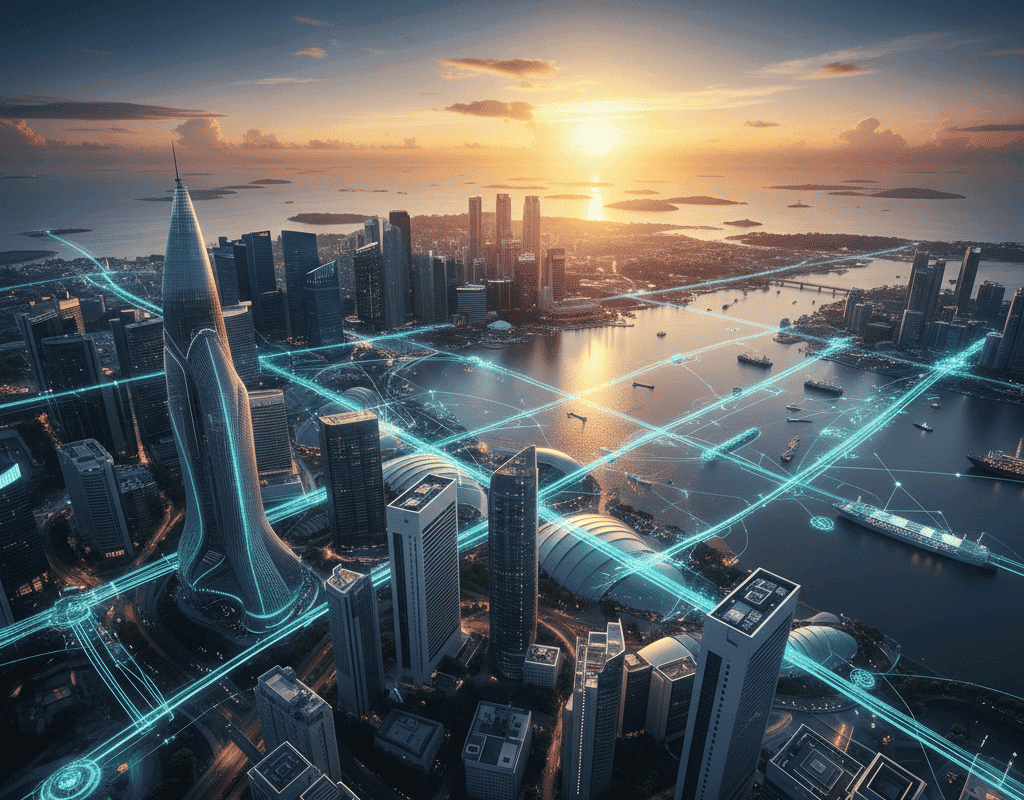
MST’s headquarters in Singapore is not incidental to its supply chain strategy. Singapore sits at the geographic and logistical center of the semiconductor supply chain. It is within a 7-hour flight of every major semiconductor manufacturing hub — Taiwan, South Korea, Japan, China, and Malaysia. Its port handles 37 million TEUs annually, making it the world’s second-busiest transshipment hub. Its free trade agreements cover more than 85% of global GDP.
For a supply chain AI platform, Singapore provides a neutral vantage point. Data flows freely. Trade relationships span every major market. The regulatory environment is business-friendly but rigorous enough to satisfy international compliance requirements. MST’s Singapore base allows the Supply Chain Intelligence platform to serve customers globally without the jurisdictional constraints that would limit a platform based in any single major semiconductor-producing country.
What Is the Future of AI-Driven Semiconductor Supply Chains?
The trajectory is clear. The semiconductor industry is investing $530 billion in new fab construction globally through 2030 (SEMI). Each new fab needs hundreds of qualified suppliers, thousands of material SKUs, and logistics networks that span continents. The manual, relationship-driven procurement model that served a $200 billion industry cannot scale to serve a $1 trillion industry.
AI-driven supply chain intelligence will become as essential to semiconductor manufacturing as EDA tools are to chip design — invisible infrastructure that makes the entire operation possible. MST’s platform is built for that future: a system that connects every node in the global semiconductor supply chain with real-time intelligence, predictive analytics, and automated compliance, turning the world’s most complex logistics network into a manageable, optimizable system.
Discover how MST deploys AI across semiconductor design, manufacturing, and beyond.