- →Inside ChamberAI: What It Actually Does
- →The Closed Ecosystem Problem
- →Lam's Semiverse and TEL's AI: Same Strategy, Same Limitation
- →The 195+ OEMs Left Behind
- →Why Building In-House Does Not Work
Key Takeaways
Source: Moore Solution Technology (mst-sg.com)
When Applied Materials unveiled ChamberAI at SEMICON West 2023, it was the clearest signal yet that semiconductor equipment was entering the AI era. The industry’s largest equipment maker had done something no one else had done at scale: embedded machine learning models directly inside the process chamber, running at the edge, optimizing in real time.
Real-time AI process control with sub-50ms latency. VM, R2R, FDC — all in one platform.
Choose how you'd like to connect:
It was impressive. It was smart. And it changed the competitive landscape overnight.
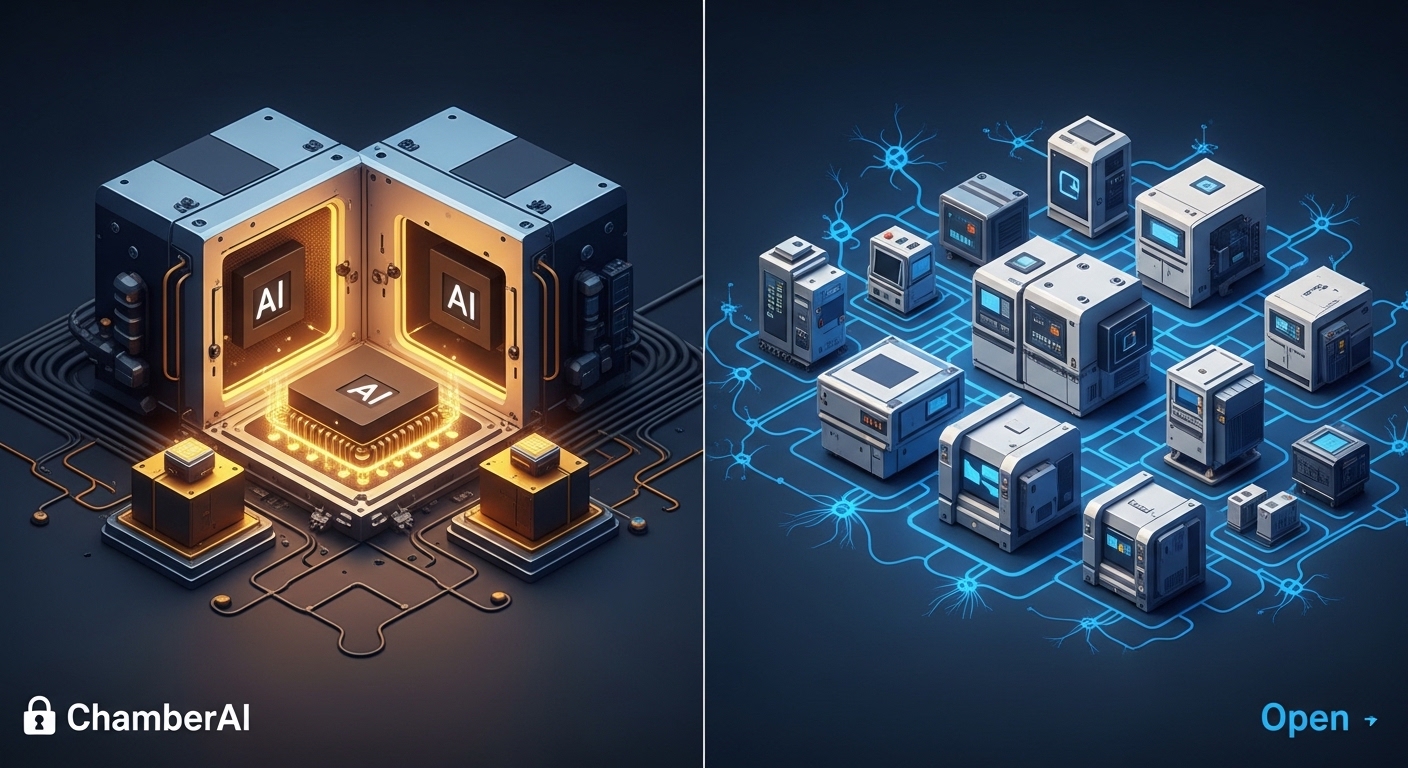
But there is a critical detail that most industry commentary has overlooked: ChamberAI only works on Applied Materials equipment. It is built with proprietary sensors, trained on proprietary data, and delivered as a subscription service that deepens Applied’s hold on its customer base. If you run a fab with equipment from 15 different vendors — which every major fab does — ChamberAI helps you optimize maybe 20-30% of your tools.
The other 70-80%? Still running blind.
Inside ChamberAI: What It Actually Does
To understand why ChamberAI matters — and why its limitations matter equally — we need to look at what it actually does technically.
The AIx Platform Architecture
ChamberAI is one component of Applied Materials’ broader AIx platform, which was designed as a three-layer stack:
| Layer | Component | Function |
|---|---|---|
| Edge (Equipment) | ChamberAI | Real-time process optimization, anomaly detection, predictive maintenance inside the chamber |
| Fab Level | Actionable Insight Accelerator (AIA) | Cross-tool analytics, fleet management, yield correlation |
| Cloud | AIx Cloud Services | Model training, global benchmarking, remote diagnostics |
How ChamberAI Works
At the equipment level, ChamberAI deploys several capabilities that together represent the most advanced equipment-level AI in the industry:
Custom Sensor Fusion: Applied installs additional proprietary sensors inside their chambers — sensors that are not part of the standard SECS/GEM data stream. These capture plasma characteristics, gas flow dynamics, temperature gradients, and other variables at resolutions that standard equipment sensors cannot match. This proprietary sensor data is a key moat — it gives ChamberAI access to information that no third-party platform can replicate on Applied equipment.
Edge ML Models: Machine learning models run directly on compute hardware attached to the equipment. These models perform inference in milliseconds, enabling real-time adjustments to process parameters during wafer processing. The models are trained on Applied’s massive dataset from 55,000+ installed tools worldwide — another significant moat.
Digital Twins: ChamberAI maintains a real-time digital twin of each chamber, continuously updating a virtual model of the chamber’s state. This enables predictive capabilities — the system can predict when a component will fail, when process drift will exceed specifications, and when maintenance is needed.
Chamber Matching: One of the highest-value capabilities. ChamberAI can automatically tune process parameters so that different chambers produce identical results — solving one of the most persistent problems in semiconductor manufacturing. Applied claims this reduces chamber-to-chamber variation by up to 50%.
The Business Model: Subscription Lock-In
Here is where ChamberAI becomes a strategic weapon rather than just a product feature. Applied delivers ChamberAI as part of their service subscription model, which contributed to $6.4 billion in AGS revenue in FY2024. Key aspects:
- Recurring revenue: ChamberAI is not a one-time purchase. It is a subscription tied to ongoing service agreements.
- Data network effects: Every tool running ChamberAI feeds data back to Applied, making models better for all customers. More customers = better models = more customers.
- Switching costs: Once a fab’s processes are optimized by ChamberAI, switching to a competitor’s equipment means losing those AI-driven optimizations and starting from scratch.
- Upsell path: ChamberAI creates a natural upsell to AIA (fab-level analytics) and cloud services, deepening the relationship.
Gary Dickerson, Applied’s CEO, has been explicit about this strategy. In the Q1 2025 earnings call, he stated that AI-driven services represent “the largest growth opportunity in Applied’s history” and that ChamberAI adoption was accelerating across their installed base.
The Closed Ecosystem Problem
ChamberAI is a remarkable product. But it has a fundamental limitation that the industry needs to confront honestly: it only works on Applied Materials equipment.
This matters because no fab runs a single vendor’s equipment. A typical 300mm fab has equipment from 10-20 different vendors:
| Process Step | Typical Vendor(s) | AI Capability |
|---|---|---|
| Deposition (CVD/PVD) | Applied Materials, Lam | ChamberAI (Applied only) |
| Etch | Lam, TEL, AMEC | Semiverse (Lam only) |
| Lithography | ASML, Canon, Nikon | ASML computational litho only |
| Thermal/Diffusion | TEL, Kokusai, ASM | TEL only (limited) |
| CMP | Applied, Ebara | ChamberAI (Applied only) |
| Wet Processing | SCREEN, TEL, Lam | None for most vendors |
| Ion Implant | Applied, Axcelis | ChamberAI (Applied only) |
| Inspection/Metrology | KLA, Onto, Hitachi | KLA 5D analytics only |
| ALD | ASM, Veeco, Picosun | None |
| Epitaxy | Applied, Veeco, Aixtron | ChamberAI (Applied only) |
The pattern is clear. Equipment-level AI exists only for the Top 5 vendors’ own equipment. Everyone else — including some very large, very important equipment companies — has nothing.
Lam’s Semiverse and TEL’s AI: Same Strategy, Same Limitation
Applied is not alone in building proprietary equipment AI. Lam Research and TEL have followed the same playbook:
Lam Research: Semiverse Solutions
Lam launched Semiverse Solutions as their AI and digital twin platform. It includes:
- Virtual process simulation — digital twins of etch and deposition processes
- Equipment Intelligent Solutions (EIS) — predictive maintenance and process optimization
- Collaborative modeling — combining physics-based models with machine learning
Semiverse is technically impressive — Lam’s physics-based process models are among the best in the industry. But like ChamberAI, it only works on Lam equipment. If you are running an AMEC etch tool or a TEL coater, Semiverse cannot help you.
Lam reported that Semiverse-driven services contributed to 30%+ of their service revenue growth in recent quarters, validating the subscription model Applied pioneered.
TEL: AI Subsidiary and Equipment Optimization
Tokyo Electron has been more measured in their AI approach but has established a dedicated AI subsidiary and is building equipment optimization capabilities focused on:
- Coater/developer process optimization
- Thermal process chamber optimization
- Fleet management across TEL tool populations
Again — TEL only, for TEL equipment.
The Common Thread
Every Top 5 vendor has made the same strategic calculation: equipment AI is too valuable to share. By keeping it proprietary, they:
- Create switching costs that protect their installed base
- Generate high-margin recurring revenue from subscriptions
- Build data moats that compound over time
- Differentiate their equipment in procurement evaluations
This is rational strategy from their perspective. But it creates an enormous problem for the rest of the industry.
The 195+ OEMs Left Behind
The semiconductor equipment market is worth over $100 billion annually. The Top 5 control roughly 65%, leaving 35% — approximately $35 billion — served by mid-size and specialized OEMs.
These companies are not marginal players. They make critical equipment for processes that the Top 5 do not cover, or they serve as second-source options that fabs require for supply chain resilience. Consider:
- NAURA (North Asia) — Asia’s largest equipment company. Revenue ~$4B. Makes etch, PVD, CVD, furnace, and cleaning equipment. Has ambitious growth targets but zero equipment-level AI platform.
- AMEC (Advanced Micro) — Asia’s leading etch company. TSV and MOCVD specialist. Growing rapidly in Asian fabs. No AI platform.
- ASM International — The world leader in ALD (atomic layer deposition). Revenue ~$2.5B. Critical for advanced node gate-all-around transistors. No equipment-level AI.
- Veeco — Leading MBE, ion beam, and laser annealing company. Key supplier for compound semiconductors and advanced packaging. No equipment AI.
- Axcelis — Ion implantation specialist. Growing rapidly in SiC and power semiconductors. No equipment AI.
- SCREEN Holdings — Dominates wet processing. Essential for every fab. No equipment-level AI platform.
These companies face a painful reality: their customers are starting to expect the same AI capabilities that Applied and Lam deliver, but they have no way to provide them.
Why Building In-House Does Not Work
The obvious question is: why don’t these OEMs just build their own AI capabilities? The answer involves three insurmountable barriers for most mid-size equipment companies:
1. The Talent Gap
Building an equipment-level AI platform requires a team that combines semiconductor process knowledge with machine learning engineering — a combination that barely exists in the job market. Applied Materials has 200-500 people working on AIx. A mid-size OEM would need at minimum 15-30 specialized engineers to build a credible platform. The annual cost for this team alone: $3-6 million.
2. The Data Challenge
Machine learning models need data. Applied has data from 55,000 installed tools across every major fab. A mid-size OEM might have data from 500-2,000 tools, often poorly instrumented and inconsistently collected. Building robust ML models with limited data requires advanced techniques (transfer learning, physics-informed ML, synthetic data) that require even more specialized talent.
3. The Time-to-Market Problem
Even with unlimited budget and perfect hiring, building an equipment AI platform from scratch takes 2-3 years. Applied started working on AIx in 2018 and launched ChamberAI in 2023 — five years of development. Mid-size OEMs do not have five years. They are losing competitive evaluations today.
What the Market Actually Needs
The semiconductor equipment industry needs what every other industry has already figured out: a platform approach to AI that is not locked to one vendor.
Think about it in other industry terms:
- Salesforce did not build a separate CRM for every company. They built a platform that works for any company.
- AWS did not build cloud services for Amazon only. They built infrastructure that any company can use.
- Palantir did not build separate analytics platforms for each government agency. They built Foundry as a universal analytics platform.
Semiconductor equipment AI needs the same evolution. The industry cannot sustain a model where only 5 vendors have AI and 195+ do not. The fabs will not accept it — they need consistent AI capabilities across their entire equipment fleet, not just the tools from their biggest vendor.
The Vendor-Agnostic Alternative
This is the problem we set out to solve with NeuroBox. Instead of building another proprietary platform for one vendor’s equipment, we built a vendor-agnostic AI platform that works on any equipment via SECS/GEM.
The key architectural difference from ChamberAI:
| Dimension | ChamberAI (Applied) | NeuroBox (MST) |
|---|---|---|
| Equipment compatibility | Applied Materials only | Any SECS/GEM equipment |
| Data source | Proprietary sensors + SECS/GEM | Standard SECS/GEM interface |
| Hardware modification | Required (custom sensors) | None required |
| Deployment model | Built into equipment | Edge device alongside equipment |
| Vendor lock-in | High (Applied ecosystem) | None (works with any vendor) |
| Lifecycle coverage | Production optimization | Design → Commissioning → Production → Service |
| Target customer | Fabs (Applied customers only) | Equipment OEMs + Fabs |
The critical distinction is the data source. ChamberAI relies partly on proprietary sensor data that only exists on Applied equipment. NeuroBox works entirely through the SECS/GEM protocol — the industry-standard communication interface that every semiconductor equipment already supports. This means it can be deployed on equipment from any vendor without any hardware modification.
Does this mean NeuroBox has access to less data than ChamberAI? In some cases, yes — proprietary sensors can capture signals that standard SECS/GEM variables do not. But in practice, most equipment has 100-500 SECS/GEM variables that are never analyzed. The gap between “data collected but ignored” and “data analyzed with ML” is far larger than the gap between “standard sensors” and “proprietary sensors.”
What This Means for Equipment OEMs
If you are an equipment OEM watching Applied, Lam, and TEL build proprietary AI platforms, the strategic implications are clear:
1. You cannot ignore equipment AI. It is becoming a procurement requirement. Within two years, RFQs from major fabs will include explicit AI capability requirements.
2. You probably cannot build it yourself. The talent, data, and time requirements are prohibitive for most mid-size equipment companies. And building a mediocre AI platform is worse than having none — it damages your credibility.
3. You need a platform partner. Just as most companies use Salesforce instead of building their own CRM, equipment OEMs should partner with a specialized AI platform rather than trying to build one.
4. The platform must be vendor-agnostic. A solution that locks you into another vendor’s ecosystem defeats the purpose. The value of an open platform is that it works across your entire product line and integrates with your customers’ mixed-vendor fabs.
The Window Is Open — But Not for Long
Applied Materials has a multi-year head start in equipment AI. They have the data, the installed base, the R&D budget, and the talent. Every quarter that passes, their data moat gets deeper and their models get better.
For the rest of the equipment industry, the window to establish a credible AI capability is approximately three years. After that, the competitive gap becomes too large to close, and fabs will increasingly consolidate their purchases with vendors who offer AI-enabled equipment.
ChamberAI changed the game. But it changed the game for one company. The rest of the industry needs a different answer — one that is open, vendor-agnostic, and accessible to equipment companies that are experts in hardware, not AI.
The technology exists. The platform exists. The question is whether equipment OEMs will act in time to use it.
If you are an equipment OEM evaluating your AI strategy, we invite you to see how NeuroBox works on your specific equipment type. No custom sensors. No hardware modifications. No two-year development timeline. Just plug into your SECS/GEM interface and start shipping smart equipment.
About the Author: This article is published by Moore Solution Technology (MST), the company behind NeuroBox — the semiconductor industry’s first vendor-agnostic equipment AI platform. MST works with equipment OEMs worldwide to embed AI capabilities into their equipment without requiring in-house AI teams. Visit mst-sg.com to learn more.
NeuroBox covers the full lifecycle: design automation, Smart DOE commissioning, and real-time production AI.
Explore Solutions →See how NeuroBox reduces trial wafers by 80%
From Smart DOE to real-time VM/R2R — our AI runs on your equipment, not in the cloud.
Book a Demo →