- →What Was the Starting Situation Before AI Implementation?
- →What Drove the Decision to Implement AI Design Automation?
- →How Was the Implementation Structured?
- →What Were the Measured Results?
- →What Challenges Were Encountered During Implementation?
Key Takeaway
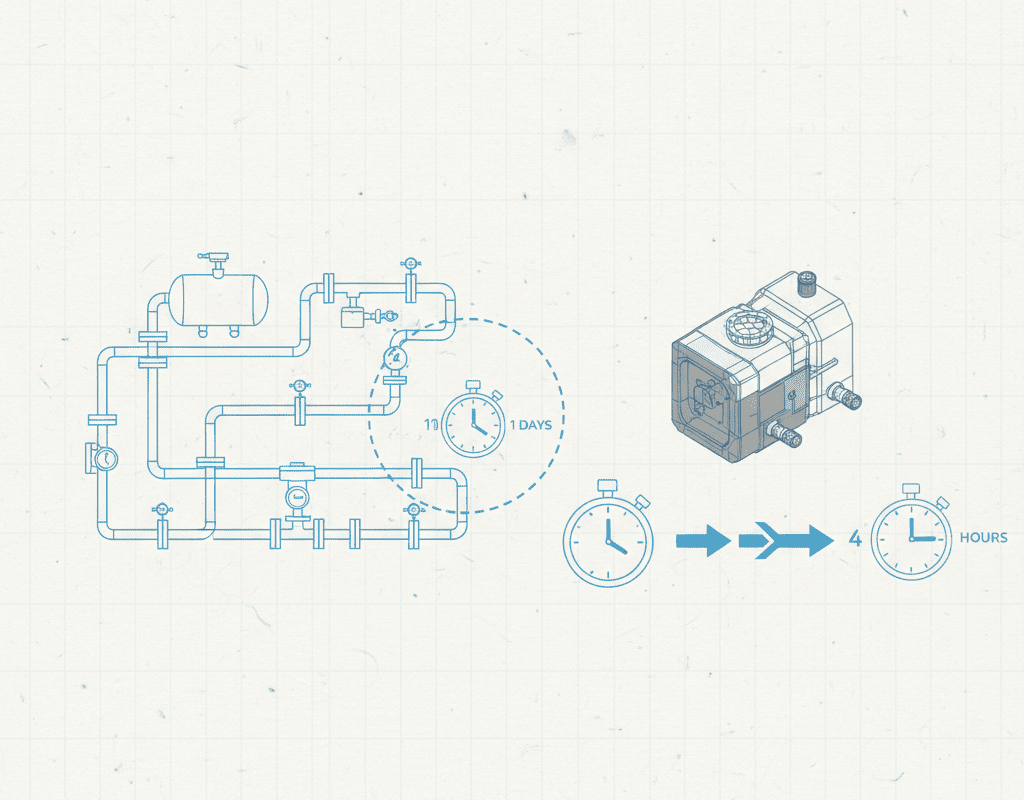
A specialty gas system manufacturer reduced their standard gas panel design cycle from 10 working days to 4 hours of AI generation plus 12 hours of engineering review by implementing AI design automation. This 83% time reduction enabled 2.4x project throughput increase without adding headcount, translating to $8.2M in additional annual revenue capacity.
What Was the Starting Situation Before AI Implementation?
The company is a specialty gas system manufacturer headquartered in Shenzhen with approximately 140 employees, $45M in annual revenue, and customers including several major semiconductor fabs in China, Taiwan, and Southeast Asia. They design and manufacture custom gas delivery panels, gas cabinets, valve manifold boxes, and bulk gas distribution systems.
Their engineering team consisted of 18 mechanical designers, 4 process engineers, and 3 electrical engineers. The mechanical design team used SolidWorks exclusively, with a component library of approximately 4,200 parts managed in SolidWorks PDM.
The mechanical design phase for a standard gas panel (150-220 components) consistently required 8-12 working days, with a median of 10 days. This broke down as follows: P and ID interpretation and component list generation took 1 day (8 hours), 3D component placement took 2 days (16 hours), tubing routing took 3.5 days (28 hours), interference checking and resolution took 1.5 days (12 hours), and manufacturing drawings and BOM took 2 days (16 hours). Total: 10 days, 80 person-hours of SolidWorks work.
The company executed approximately 85 gas panel projects per year, which fully loaded their senior design staff. They had a backlog of 12-18 projects at any given time, with customers waiting 6-8 weeks from order to design release.
What Drove the Decision to Implement AI Design Automation?
Three business pressures converged in early 2025:
Customer delivery demands were intensifying. Their largest customer, a fab equipment integrator, was pushing for 3-week total lead times on standard gas panels. With 10 days consumed by design alone, this was physically impossible. The customer explicitly stated that failure to meet the 3-week target would result in qualification of a competing supplier.
Designer attrition was creating capacity crises. Two senior designers resigned in Q4 2024 to join a competitor offering 30% higher compensation. Replacement recruiting was taking 5-7 months per position. The company estimated that the two departures cost approximately $3.8M in delayed revenue over the 6-month vacancy period.
Margin pressure required productivity improvement. Raw material costs, particularly specialty stainless steel and high-purity fittings, had increased 12-18% over the preceding two years. The company needed to reduce design labor cost per panel to maintain margins.
After evaluating three AI platforms, they selected NeuroBox D based on its P and ID parsing capability, SolidWorks-native output, and the ability to learn from their historical designs.
How Was the Implementation Structured?
The implementation followed a phased approach over 14 weeks:
Weeks 1-4: Data preparation. The company provided 120 historical gas panel designs for AI training. They enriched their component library with application metadata for the top 800 most-used components. This phase required approximately 640 hours of engineering time.
Weeks 5-8: AI training and calibration. NeuroBox D was trained on the historical design data. The calibration process involved generating test assemblies from historical P and IDs and comparing them against actual designs. Initial accuracy was 78%. After iterative refinement, accuracy reached 91%.
Weeks 9-12: Parallel production. Five live gas panel projects were run through both traditional and AI-assisted workflows simultaneously. Key findings: the AI consistently outperformed manual design on routing efficiency (14% shorter total tube length on average), the AI occasionally selected non-preferred components when the preferred part was underrepresented in historical data, and documentation generation quality was good but required formatting adjustments.
Weeks 13-14: Process transition. The company transitioned to an AI-first workflow where NeuroBox D generates the initial 3D assembly and a senior designer reviews and refines the output.
What Were the Measured Results?
Results were tracked rigorously over the first 6 months of full deployment across 32 gas panel projects:
Design time reduction. AI generation time: 2-4 hours per panel (computation time, no human labor). Human review and refinement: 8-16 hours (average 12 hours). Documentation finalization: 3-6 hours (average 4 hours). Total median: 16 hours. Compared to the 80-hour manual baseline, this represents an 80% reduction.
Design quality improvement. Interference issues found during assembly decreased from 4.2 per panel to 0.8, an 81% reduction. BOM accuracy improved from 96.1% to 99.4%. Customer-reported design issues during commissioning decreased from 1.4 per panel to 0.3, a 79% reduction.
Delivery time improvement. Design phase duration reduced from 10 working days to 2 working days. Overall project lead time reduced from 6.2 weeks to 3.4 weeks. The company now consistently meets the 3-week target for standard panels.
Throughput and revenue impact. Project throughput increased from 85 per year to an annualized rate of 204 projects per year. The backlog was eliminated within 3 months. Actual revenue run rate increased by $8.2M annualized within the first 6 months.
What Challenges Were Encountered During Implementation?
Designer resistance. Several senior designers initially viewed the AI system as a threat. The engineering VP addressed this by reframing AI as a tool that eliminates tedious routing work and elevates the designers role. Two senior designers became strong advocates. One transitioned to a customer-facing technical sales role where his deep design knowledge added value.
Component library gaps. The initial library had adequate 3D models but lacked application metadata for approximately 35% of parts. The company established an ongoing library maintenance process, adding 40-60 enriched components per month.
Non-standard projects. Approximately 15% of projects involved sufficiently novel requirements that the AI-generated starting point required significant modification. Time savings for these projects were closer to 50% rather than 80%.
IT infrastructure. The AI processing required GPU compute resources. They deployed on a cloud-hosted configuration, adding approximately $2,800 per month in compute costs.
What Are the Key Lessons for Other Equipment Companies?
Component library quality is the single biggest predictor of success. Companies with metadata-rich component libraries see faster AI training, higher generation accuracy, and shorter time to production deployment.
Start with your highest-volume, most-standardized product. The gas panel was ideal because it was high-volume, had well-defined patterns, and had extensive historical data for training.
Measure everything from day one. Rigorous tracking of design hours, error rates, and delivery times produced compelling data that justified expanding to gas cabinet and VMB product lines.
Plan for organizational change. Designer resistance consumed more management attention than any technical challenge. Companies should proactively communicate how AI changes the designer role and ensure the new role is perceived as an upgrade.
The headline is real but context matters. The AI generates assemblies in hours, but human review, refinement, and documentation add 1-2 working days. This is still transformative, but expectations should be set based on total workflow time.
Using DrawingDiff alongside NeuroBox D added further value during the review phase. Automated comparison between the AI-generated design and the original P and ID ensured that no process requirements were missed during translation. This automated cross-check replaced what had previously been a 4-6 hour manual verification step, compressing it to 15 minutes of reviewing highlighted discrepancies.
The transformation from manual to AI-assisted design is not speculative. It is happening now at equipment manufacturers who recognized that their design bottleneck was both their biggest constraint and their biggest opportunity. The technology is mature enough for production use and the business impact justifies immediate action.
Still designing assemblies manually?
NeuroBox D converts your P&ID into a complete SolidWorks assembly — in hours, not days. See how it works with your own designs.
Discover how MST deploys AI across semiconductor design, manufacturing, and beyond.