- →Why copy-paste cross-posting fails
- →What "adaptation" actually means
- →The publishing queue, not the content, is the product
- →What this unlocks for operators
- →The 9 supported channels (v2026-04)
Key Takeaway
Why copy-paste cross-posting fails
Every platform has a ranking algorithm tuned for its native content shape. Paste the same text everywhere and you trigger all of them to quietly throttle you:
- LinkedIn rewards first-line hooks and professional tone; a casual X thread opener tanks in the feed.
- X penalizes long paragraphs; a LinkedIn essay shared as one tweet dies.
- Medium suppresses articles that read like blog re-posts; it wants scroll-depth via narrative.
- Xiaohongshu (小红书) demands emoji hooks and visual-first structure; English SEO prose gets zero reach.
- WeChat official accounts favor typeset layouts with embedded images; plain text looks unprofessional.
The platforms aren’t being arbitrary — they’re optimizing for what their users open. The cost of ignoring this isn’t zero; it’s active negative.
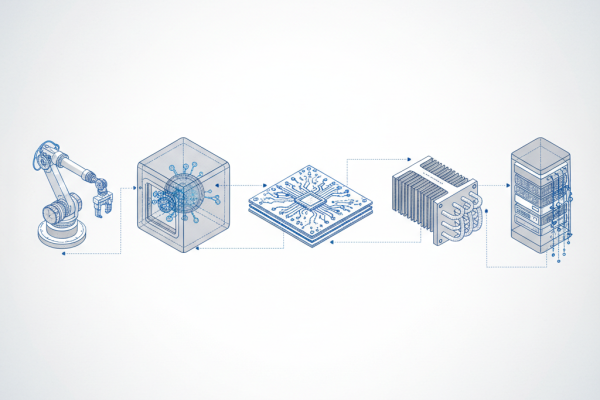
See how AI transforms semiconductor design and manufacturing — from the equipment up.
Choose how you'd like to connect:
What “adaptation” actually means
BlogBurst’s adaptation engine isn’t a template-filler. For a single topic brief like “Why Smart DOE beats traditional DOE”, the output differs across channels on five axes:
LinkedIn — authoritative, peer-to-peer. X — conversational, punchy. Medium — narrative, essayist. Substack — personal, reflective.
LinkedIn 180–280 words. X thread 4–8 tweets. Medium 1,200–1,800 words. Blog 1,500–2,500 with H2s.
First 3 seconds matter on X, first 2 lines on LinkedIn (above the “…see more”), H1 on Medium, subject line for newsletter.
LinkedIn — “what do you think?” engagement. Newsletter — “reply to this email.” Blog — “book a demo.” X — “follow for more.”
The publishing queue, not the content, is the product
Adaptation is half the problem. The other half is orchestration: when each piece goes out, what gets cross-linked, how engagement from one channel feeds back into others. BlogBurst’s queue handles:
- Per-channel timing: LinkedIn gets B2B business hours in your audience’s timezone. X gets morning-commute + evening-thumb. Weibo/Xiaohongshu gets CJK peak hours if you publish bilingual.
- Rate limiting: no single channel gets more than 2 posts/day from the same brand — reach collapses above that.
- Engagement routing: a comment on LinkedIn triggers a follow-up thread idea on X. A popular Medium story triggers a newsletter follow-up.
- Canonical tracking: the SEO-friendly original lives on your blog with canonical URL; Medium and Substack versions link back with proper
rel="canonical".
What this unlocks for operators
Once adaptation and orchestration are handled by the system, the operator’s job becomes interesting again: topic selection, brand voice calibration, and strategic timing around launches. Nobody got into marketing to rewrite the same idea 9 times for 9 different editors. That’s the part BlogBurst eats.
The 9 supported channels (v2026-04)
- LinkedIn (company + personal)
- X (formerly Twitter)
- Medium
- Substack
- WeChat Official Account (微信公众号)
- Xiaohongshu (小红书)
- WordPress (self-hosted or .com)
- Ghost
- Any custom CMS via webhook or REST API
New channels land roughly every quarter based on customer priority votes.
See the 9-platform queue live
Start free and publish your first adapted piece across all 9 channels in under 15 minutes.
NeuroBox covers the full lifecycle: design automation, Smart DOE commissioning, and real-time production AI.
Explore Solutions →See how NeuroBox reduces trial wafers by 80%
From Smart DOE to real-time VM/R2R — our AI runs on your equipment, not in the cloud.
Book a Demo →