- →Why Is CMP So Difficult to Control?
- →How Does Traditional CMP Control Work — and Where Does It Fail?
- →What Sensor Data Can AI Use for Real-Time CMP Prediction?
- →How Accurate Is AI Virtual Metrology for Post-CMP Thickness?
- →How Does Edge AI Enable Real-Time CMP Control?
Key Takeaway
Chemical Mechanical Planarization (CMP) is one of the most difficult semiconductor processes to control, with post-polish thickness variations costing fabs millions in scrap and rework. AI-powered virtual metrology can predict post-CMP thickness with less than 1% error by analyzing pad pressure, slurry flow, rotation speed, and endpoint signals in real time — eliminating the need to wait 30-45 minutes for offline metrology and enabling closed-loop Run-to-Run correction on every wafer.
Why Is CMP So Difficult to Control?
Chemical Mechanical Planarization sits at the intersection of chemistry and physics — and that makes it uniquely unpredictable. Unlike most semiconductor processes that operate in vacuum chambers with tightly controlled gas flows, CMP involves a rotating wafer pressed against a polyurethane pad with an abrasive slurry flowing between them. The material removal rate (MRR) depends on dozens of interacting variables: downforce pressure (typically 2-6 psi), platen speed (30-100 rpm), slurry flow rate (150-300 ml/min), slurry chemistry (pH, abrasive concentration, oxidizer levels), pad surface condition, and even ambient temperature.
The core problem is pad degradation. A fresh CMP pad has a surface roughness of approximately 30-50 micrometers, which gradually decreases over its lifetime of 500-1,000 wafers. As the pad glazes, the effective contact area increases, micro-asperities flatten, and slurry transport to the wafer surface changes — causing the MRR to drift by 5-15% over a pad lifetime. Traditional conditioning using a diamond disc to re-roughen the pad helps but introduces its own variability.
For a modern logic fab running 50,000 wafer starts per month, even a 2% within-wafer non-uniformity (WIWNU) in post-CMP thickness can push devices outside spec at subsequent lithography and etch steps. At advanced nodes below 7nm, the target post-CMP thickness uniformity is often plus or minus 5 angstroms across a 300mm wafer — an extraordinarily tight specification.
How Does Traditional CMP Control Work — and Where Does It Fail?
Traditional CMP control relies on two mechanisms: endpoint detection and post-process metrology. Endpoint detection uses motor current, optical reflectance, or eddy current sensors to determine when to stop polishing. While this prevents gross over-polish, it provides limited information about the final thickness profile across the wafer.
Post-process metrology — typically ellipsometry or four-point probe measurements — gives accurate thickness data, but with critical limitations. First, only 5-9 points per wafer are typically measured due to throughput constraints. Second, the measurement happens 30-45 minutes after polishing, meaning 20-50 wafers may have already been processed before an excursion is detected. Third, the correlation between a handful of metrology points and full-wafer uniformity is often poor.
The result is a reactive control loop with significant latency. A process engineer might adjust the pressure profile or platen speed based on the previous day metrology data, but by then the pad condition and slurry chemistry have already changed. Industry reports indicate that CMP-related rework accounts for 3-7% of total fab cycle time, with scrap rates of 0.5-1.2% in mature processes.
What Sensor Data Can AI Use for Real-Time CMP Prediction?
Modern CMP equipment generates enormous amounts of sensor data that goes largely unused in traditional process control. A typical Applied Materials Reflexion or Ebara CMP tool outputs 50-200 sensor channels at 1-10 Hz sampling rates, producing 2-5 GB of raw data per day per tool. The key signal categories include:
Mechanical signals: Downforce pressure per zone (typically 5 zones: center, inner ring, outer ring, retaining ring, membrane), platen motor current and torque, carrier motor current, conditioner arm position and pressure, and vibration signatures from accelerometers.
Process signals: Slurry flow rate, slurry temperature at the point of delivery, pad surface temperature measured by IR pyrometry, retaining ring temperature, and back-pressure from the wafer carrier.
Endpoint signals: In-situ optical reflectance for oxide CMP, eddy current signals for metal CMP, motor current signature analysis, and acoustic emission signals.
Consumable state tracking: Pad life (number of wafers processed), conditioner disc life, slurry batch information, and pad break-in status.
AI models — specifically Long Short-Term Memory (LSTM) networks and Temporal Convolutional Networks (TCN) — excel at finding nonlinear, time-dependent patterns in these multi-channel sensor streams. Where a traditional statistical model might use 5-10 summary features such as mean pressure and total polish time, an AI model can process full time-series waveforms, capturing transient events like slurry distribution changes or momentary pressure spikes that are invisible to summary statistics.
How Accurate Is AI Virtual Metrology for Post-CMP Thickness?
Results from leading fabs demonstrate that AI-based virtual metrology can predict post-CMP thickness with remarkable accuracy:
Oxide CMP (ILD/STI): Mean Absolute Error (MAE) of 2-4 angstroms on a target thickness of 2,000-5,000 angstroms, corresponding to prediction accuracy of 99.9%. This is comparable to the repeatability of the metrology tool itself.
Metal CMP (Cu/W): MAE of 3-8 angstroms for remaining metal thickness after polish, with dishing prediction accuracy within 5 angstroms for feature widths above 1 micrometer.
WIWNU prediction: AI models can predict within-wafer non-uniformity with a correlation coefficient above 0.85, enabling proactive pressure profile adjustments before the next wafer is loaded.
The key breakthrough is not just accuracy but speed. Virtual metrology predictions are available within 2 seconds of polish completion — compared to 30-45 minutes for offline metrology. This enables true wafer-to-wafer Run-to-Run (R2R) control, where the pressure recipe for wafer N+1 is adjusted based on the predicted result of wafer N.
In one documented case at a major foundry, implementing AI virtual metrology with R2R control for copper CMP improved Cpk from 1.2 to 1.8 over a pad lifetime, decreased the rework rate by 62%, and extended the usable pad life by 15% from approximately 800 to 920 wafers per pad.
How Does Edge AI Enable Real-Time CMP Control?
The NeuroBox E3200 platform from MST is designed for exactly this type of real-time process intelligence. For CMP applications, the deployment typically follows this architecture:
Data acquisition: The NeuroBox edge device connects to the CMP tool via SECS/GEM for recipe and event data, plus high-speed analog interfaces for continuous sensor streams. Data from all pressure zones, motor currents, and endpoint signals is collected at full resolution with no downsampling that might lose critical transient information.
Model training: Using historical production data (typically 3,000-5,000 wafers with matched metrology), the system trains an ensemble of LSTM and gradient-boosted models. The ensemble approach provides both a point prediction and a confidence interval, which is critical for process engineers who need to know when to trust the model and when to flag a wafer for physical measurement.
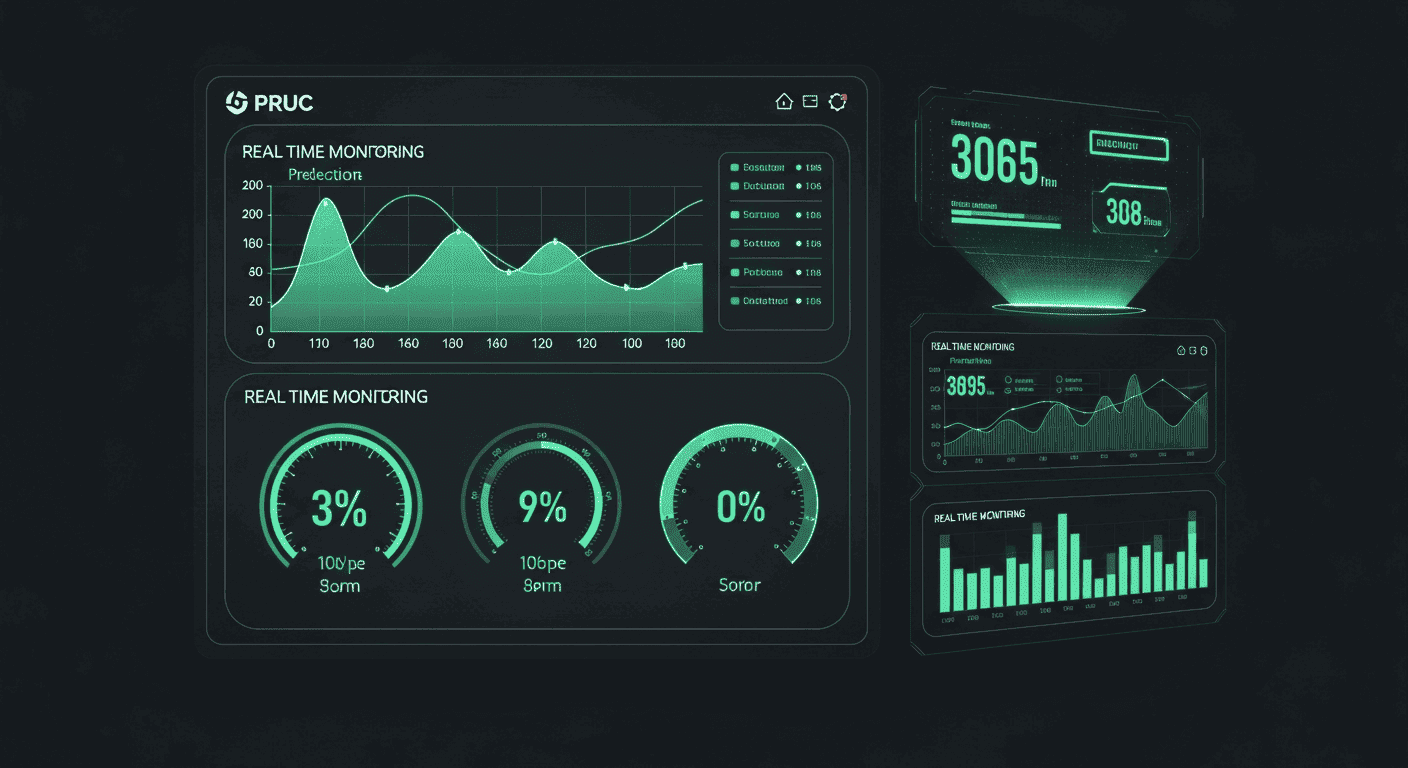
Real-time inference: During production, the model processes each wafer sensor data and delivers a thickness prediction within 2 seconds. If the predicted value exceeds the control limit, an alert is sent immediately rather than waiting for the next metrology sample. The prediction feeds directly into the R2R controller, which adjusts zone pressures, polish time, and conditioning parameters for the next wafer.
Adaptive learning: As new metrology data becomes available, the model continuously retrains on the latest data, adapting to slow-moving drifts like pad aging, slurry lot changes, and seasonal temperature variations. This eliminates the common failure mode of static models that degrade in accuracy after 2-3 months.
What ROI Can Fabs Expect from AI-Powered CMP Control?
The financial case for AI virtual metrology in CMP is compelling across multiple dimensions:
Scrap reduction: With real-time prediction catching excursions within 1 wafer instead of 20-50 wafers, typical scrap reduction is 40-60%. For a fab processing 50,000 wafers per month through CMP, reducing scrap by 0.5% at an average wafer value of $3,000-$5,000 translates to $750K-$1.25M in annual savings per CMP module.
Metrology sampling reduction: With high-confidence virtual metrology, physical sampling can be reduced from every 5th wafer to every 25th wafer for routine monitoring, freeing metrology tool capacity for other critical measurements and reducing metrology-related cycle time by 3-5 hours per lot.
Pad life extension: By precisely tracking pad condition through AI models rather than conservative time-based replacement, pad life increases by 10-20%, reducing consumable costs by $50K-$100K annually per CMP tool.
Cycle time reduction: Eliminating the metrology wait loop for CMP lots reduces total cycle time by 1-3%. For high-volume fabs, this translates directly into increased output and revenue.
The total annual value for a single CMP module ranges from $1M to $2.5M depending on fab volume and wafer value. With typical deployment costs of $150K-$250K per tool including hardware, software, and integration, the payback period is 2-4 months — making CMP one of the highest-ROI applications for AI in semiconductor manufacturing.
Deploy real-time AI process control with sub-50ms latency on your production line.