
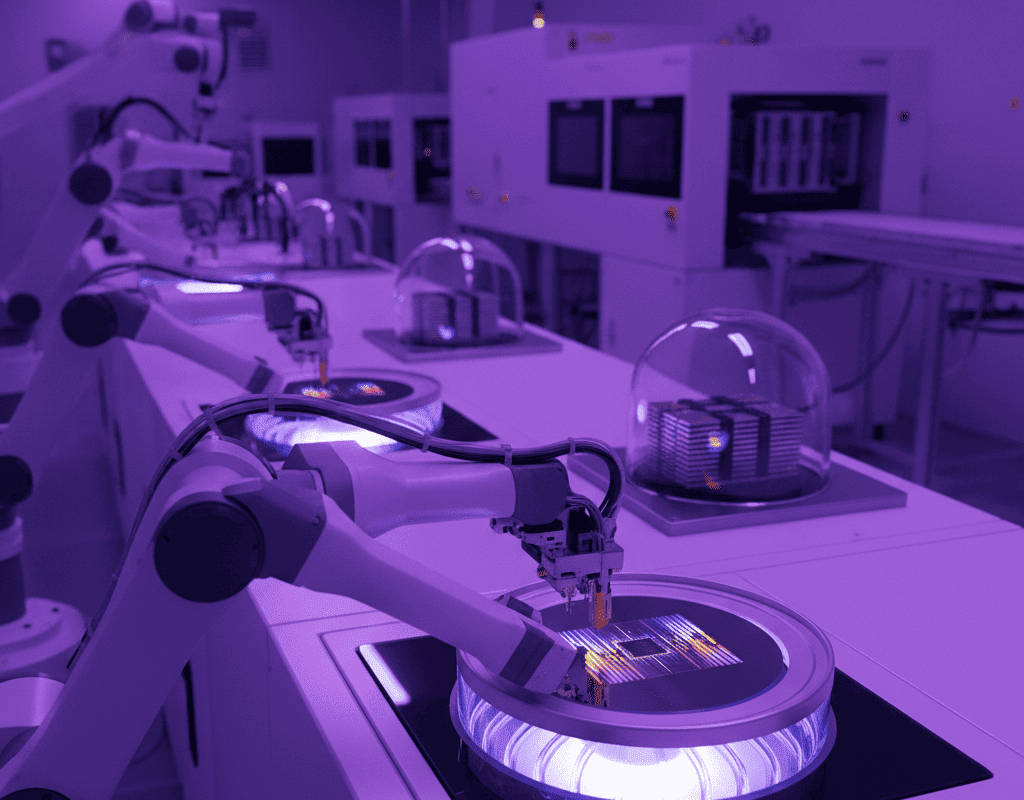
- →Why Is Advanced Packaging Suddenly the Most Critical Bottleneck in Semiconductor Manufacturing?
- →What Makes Advanced Packaging Process Control Different from Front-End Manufacturing?
- →How Does AI Address TSV Etch and Fill Challenges?
- →How Does AI Improve Bonding and Assembly Yield?
- →How Is AI Deployed for Advanced Packaging Lines?
Key Takeaway
Advanced packaging technologies like CoWoS, HBM stacking, and chiplet integration are growing at 25-30% CAGR but suffer from yield losses 3-5x higher than front-end wafer processing. AI-powered process intelligence — combining virtual metrology for TSV etch depth, warpage prediction for thin wafer handling, and thermal monitoring for hybrid bonding — can reduce advanced packaging yield loss by 30-50%, addressing the critical bottleneck that limits AI chip production capacity worldwide.
Why Is Advanced Packaging Suddenly the Most Critical Bottleneck in Semiconductor Manufacturing?
The AI revolution has fundamentally changed the economics of semiconductor packaging. Every major AI accelerator — NVIDIA H100/B200, AMD MI300X, Google TPU v5, and custom ASICs from hyperscalers — relies on advanced packaging to integrate multiple chiplets, stack HBM memory, and provide the enormous interconnect bandwidth that AI workloads demand.
TSMC’s CoWoS (Chip-on-Wafer-on-Substrate) capacity has become the most talked-about bottleneck in the semiconductor industry. As of 2025, CoWoS demand exceeds supply by an estimated 20-30%, with lead times stretching to 6-12 months. The reason is not just capacity — it is yield. Advanced packaging yield for complex multi-chip products ranges from 60-80%, compared to 90-95%+ for mature front-end wafer processing. Every percentage point of yield improvement directly translates to more AI chips reaching the market.
The packaging landscape includes several key technologies, each with unique process challenges:
CoWoS (Chip-on-Wafer-on-Substrate): Uses a silicon interposer with through-silicon vias (TSVs) to connect multiple chiplets and HBM stacks. The interposer can exceed 2,500 mm2 (the reticle limit), requiring multiple lithography stitching. Key challenges: TSV etch uniformity, Cu pillar bump coplanarity, and chip-to-interposer bonding yield.
HBM (High Bandwidth Memory): Stacks 8-16 DRAM dies using micro-bumps (pitch 25-40 micrometers) with TSVs through each die. Key challenges: thin wafer handling (50-70 micrometer die thickness), micro-bump yield (millions of connections per stack), and thermal management during operation.
Hybrid bonding: Direct Cu-to-Cu bonding at sub-micrometer pitch, enabling 10-100x higher interconnect density than micro-bumps. Key challenges: surface flatness requirement below 0.5nm RMS, Cu dishing control from CMP, and particle-free bonding surfaces.
Chiplet integration: Combining dies from different process nodes (e.g., 3nm compute + 7nm I/O + 5nm memory controller) into a single package. Key challenge: testing and known-good-die (KGD) validation before assembly.
What Makes Advanced Packaging Process Control Different from Front-End Manufacturing?
Advanced packaging presents unique control challenges that front-end AI solutions cannot directly address:
Larger feature scales but tighter relative tolerances: TSVs are 5-10 micrometers in diameter (1000x larger than front-end transistor features), but the depth uniformity requirement (within 2-3% over a 50-100 micrometer depth) is equally demanding. Cu pillar bumps at 40 micrometer pitch require height uniformity within 1-2 micrometers across a 300mm wafer — a relative tolerance of 2-5%.
Mechanical process dominance: Unlike front-end processing where chemical and plasma processes dominate, packaging involves extensive mechanical operations: wafer grinding/thinning (from 775 micrometers to 50-100 micrometers), dicing, die attach, thermocompression bonding, and molding. These mechanical processes generate vibration, temperature, and force data that require specialized AI modeling approaches.
Multi-die interactions: When bonding multiple chiplets to an interposer, the bonding quality of each chip affects the thermal and mechanical stress on neighboring chips. A slightly misaligned die can cause stress-induced warpage that propagates across the substrate, affecting subsequent die placements. This sequential, interaction-dependent process requires AI models that account for the full assembly history.
Warpage and stress management: Thin wafers and large interposers are extremely sensitive to mechanical stress. A 50 micrometer thick silicon wafer with asymmetric film stacks can warp by 200-500 micrometers, making subsequent processing (lithography, bonding) extremely difficult. Warpage changes with temperature, making real-time compensation essential during thermal process steps.
Lower process maturity: Many advanced packaging processes are still in the steep portion of the learning curve, with limited historical data for AI model training. Process recipes change frequently as engineers optimize for new products, requiring AI models that can adapt quickly with limited data.
How Does AI Address TSV Etch and Fill Challenges?
Through-Silicon Via (TSV) formation is the foundation of 3D integration, and it involves two critical steps: deep silicon etch (Bosch process) and Cu electroplating fill. Both steps benefit significantly from AI process intelligence.
TSV etch control: The Bosch process alternates between SF6 etch and C4F8 passivation cycles (typically 200-500 cycles for a 50-100 micrometer deep TSV). The etch rate depends on cycle parameters, chamber condition, and the local pattern density (loading effect). Traditional control uses fixed cycle counts with post-etch depth measurement on 5-10 sites per wafer.
AI models analyzing the real-time chamber pressure, gas flow, and RF power signatures during each etch/passivation cycle can predict the cumulative etch depth within 1-2% accuracy and the sidewall profile (scallop depth, taper angle) within 5%. This virtual metrology enables cycle-by-cycle adjustment to hit the target depth without post-process measurement delays.
Cu electroplating control: TSV fill uses bottom-up Cu electroplating with carefully controlled current density, bath chemistry (Cu2+ concentration, accelerator/suppressor/leveler additives), and temperature. The fill quality — including void-free filling, minimal overburden thickness, and uniform fill across different TSV diameters — depends on the interaction of these parameters with the evolving bath chemistry.
AI models tracking bath conductivity, dissolved Cu concentration, organic additive levels (measured by CVS — Cyclic Voltammetric Stripping), and plating current/voltage waveforms can predict the fill quality and optimal plating time for each wafer, reducing overburden by 10-20% (which directly reduces subsequent CMP time and cost) while maintaining void-free fill yield above 99.9%.
How Does AI Improve Bonding and Assembly Yield?
Die bonding — whether thermocompression bonding (TCB) for micro-bumps or hybrid bonding for direct Cu-Cu connections — is the highest-yield-loss step in advanced packaging:
Thermocompression bonding optimization: TCB involves placing a die on the substrate, heating to 250-350 degrees Celsius, and applying 10-100 N of force for 1-10 seconds. The bonding quality depends on temperature uniformity (within 3-5 degrees Celsius across the die), force distribution, time-temperature profile, and the coplanarity of the bonding surfaces.
AI models processing bonding head temperature, force sensor data, displacement measurements, and ultrasonic inspection feedback can predict the joint quality for each bond and identify parameter drift before it causes yield loss. In production deployments, AI-optimized TCB has improved first-pass bonding yield from 92-95% to 97-99% — a dramatic improvement when each bond failure means scrapping a die worth $50-$500.
Hybrid bonding surface preparation: Hybrid bonding requires extraordinary surface preparation: surface roughness below 0.5nm RMS, Cu dishing below 2nm, and zero particles above 50nm. The CMP step that achieves these specifications is extremely sensitive to pad condition, slurry chemistry, and polish time.
The NeuroBox E3200 provides real-time CMP virtual metrology specifically tuned for hybrid bonding applications, predicting Cu dishing and surface roughness from polish parameters. By catching CMP drift before the bonding step, the system prevents the cascading yield loss that occurs when improperly prepared surfaces enter the bonding tool.
Warpage compensation: For large interposers (especially those exceeding one reticle field), warpage during thermal processing is a major yield limiter. AI models that predict warpage based on the film stack, thermal history, and mechanical properties enable real-time compensation during bonding — adjusting the chuck vacuum zones, bonding temperature profile, and die placement coordinates to accommodate the actual (predicted) interposer shape rather than assuming a flat surface.
How Is AI Deployed for Advanced Packaging Lines?
The NeuroBox platform addresses the unique requirements of advanced packaging through a tailored deployment architecture:
NeuroBox E3200 for in-line process control: Connected to TSV etch, electroplating, CMP, and bonding tools, providing real-time virtual metrology and R2R control. The edge deployment is particularly valuable in packaging facilities where network bandwidth to central servers may be limited compared to leading-edge front-end fabs.
NeuroBox E5200 for process development: Advanced packaging recipes change frequently as new products are introduced (each AI accelerator generation requires modified packaging). Smart DOE accelerates recipe optimization from 4-6 weeks to 1-2 weeks, using adaptive experimentation that targets the specific failure modes of each new product design.
NeuroBox E5200V for visual inspection: Advanced packaging inspection is fundamentally different from front-end wafer inspection. Defects include bump bridging, missing bumps, die cracks, underfill voids, and warpage-induced delamination. The E5200V integrates with optical and X-ray inspection systems to provide automated defect classification with greater than 95% accuracy, replacing the manual classification that currently bottlenecks inspection throughput.
Cross-process integration: The AI system tracks each unit (wafer, die, substrate, and final package) through the complete assembly flow, creating a digital thread that enables full traceability and root-cause analysis. When a package fails at final test, the system can immediately identify which process step contributed to the failure and which other packages may be at risk.
What Is the Business Case for AI in Advanced Packaging?
The ROI calculation for advanced packaging AI is dominated by the extraordinary value of the products being manufactured:
Yield improvement value: A CoWoS package for an AI accelerator has a bill of materials (BOM) value of $2,000-$5,000 (including the compute dies, HBM stacks, and interposer). At 50,000 packages per month, improving yield by 5 percentage points (e.g., from 75% to 80%) saves 2,500 packages per month, worth $5M-$12.5M monthly or $60M-$150M annually.
Capacity multiplication: Higher yield effectively increases packaging capacity without capital investment. A 5% yield improvement is equivalent to adding 5% more packaging tools — worth $50M-$100M in avoided capital expenditure for a major OSAT or IDM.
Time-to-market acceleration: AI-powered process development reduces new product packaging qualification from 3-6 months to 1-3 months, enabling faster time-to-revenue for each new AI chip generation. Given the competitive dynamics of the AI hardware market, this acceleration can be worth hundreds of millions in captured market share.
Known-Good-Die improvement: Better process control and virtual metrology improve the accuracy of KGD testing, reducing the costly failure mode of integrating a bad die into a multi-chip package. Each false-negative KGD decision wastes $1,000-$3,000 in packaging materials and capacity.
Total annual value for a mid-sized advanced packaging line: $30M-$100M+ against a deployment investment of $1M-$3M. The payback period is measured in weeks, not months — making advanced packaging arguably the most compelling application of AI in the entire semiconductor value chain today.
Discover how MST deploys AI across semiconductor design, manufacturing, and beyond.